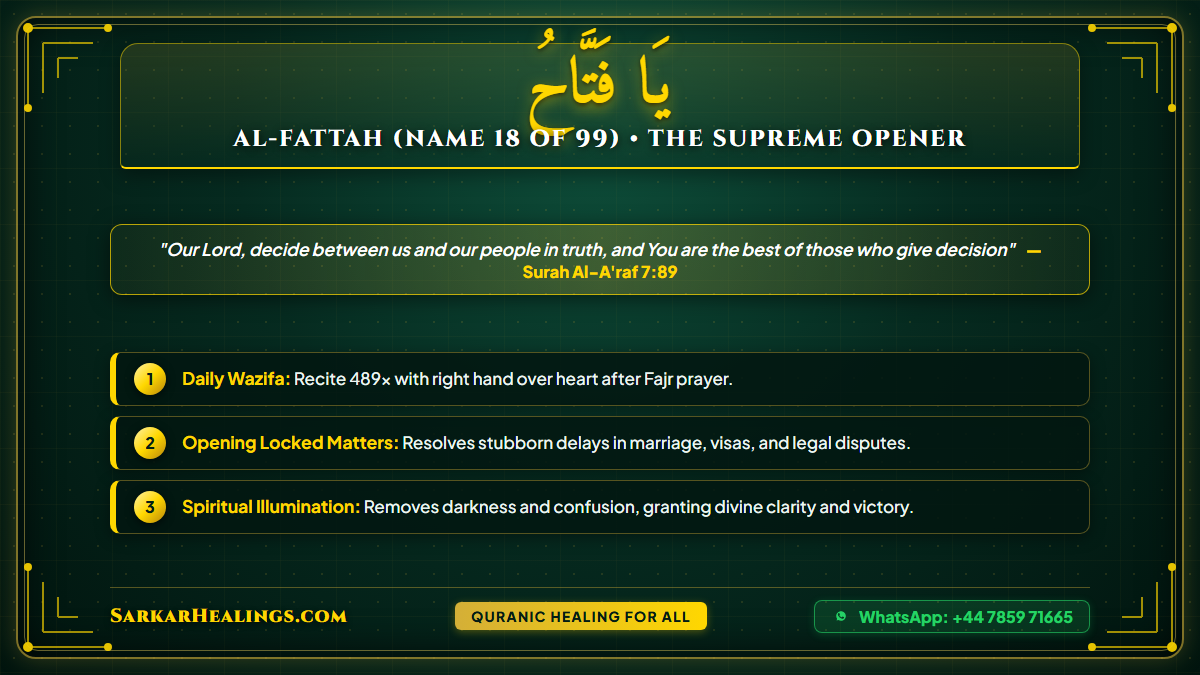
Ya Fattahu Wazifa for Victory & Openings
Featured Spiritual Remedy for Al-Fattah Meaning & Ya Fattahu Benefits (Name 18 of 99)
Hand-written using natural Saffron & Rosewater ink under strict ritual purity

Al-Fattah Taweez for Marriage, Wealth & Lawsuit Victory
Authentic hand-written Quranic Coded Dua prepared under ritual purity for protection & barakah.
€249.00

Islamic Protection Taweez — Authentic Ruqyah Shield
Authentic hand-written Quranic Coded Dua prepared under ritual purity for protection & barakah.
€249
Sarkar Healings · 99 Names of Allah · Name 18 of 99
الْفَتَّاح
Al-Fattah — The Opener, The Granter of Victory
Al-Fattah Meaning & Ya Fattahu Benefits
The One who unlocks every closed door and grants decisive victory.
Al-Fattah (The Opener, Granter of Victory) is the 18th Name of Allah. Its root ف-ت-ح conveys opening, judging, and revealing. The Name appears verbatim once in the Qur’an (34:26). It is invoked for breakthrough in difficulties, guidance, lawful provision, and spiritual insight.
Key Facts at a Glance
| Name in Arabic | الْفَتَّاح |
|---|---|
| Transliteration | Al-Fattah (invoked as Ya Fattahu) |
| English Meaning | The Opener, The Granter of Victory |
| Position | 18th of the 99 Names (Asma-ul-Husna) |
| Arabic Root | ف-ت-ح |
| Quran Occurrences | The exact Name Al-Fattah (الفتاح) occurs once in the Qur’an, in Surah Saba 34:26. The root ف-ت-ح appears extensively as verbs (e.g., fataḥa, yaftaḥu, fatḥ) denoting opening, conquest, and judgement. |
| Invoked For | breakthrough, victory, guidance, provision, clarity, justice |
| Related Names | Al-Hakam · Ar-Razzaq · Al-Basit |
Meaning & the Arabic Root
Al-Fattah derives from the trilateral root ف-ت-ح (f-t-ḥ), whose core sense is to open, unseal, or remove a barrier. Morphologically it is an intensive active participle (ṣīghat mubālagha) on the pattern فَعَّال, indicating One who opens repeatedly, decisively, and completely.
Classical lexicons (Lisān al-ʿArab, Tāj al-ʿArūs) expand the meaning to include: granting victory (fatḥ), judging between disputants (by ‘opening’ the truth), revealing knowledge, and bestowing mercy or provision by removing obstacles. The Name thus unites judicial, military, spiritual, and providential dimensions.
Distinction: Al-Fattah emphasises the act of opening itself — the breakthrough moment. Al-Hakam stresses the authoritative judgement that follows. Al-Basit highlights the subsequent expansion. Al-Wahhab (The Bestower) focuses on the gift; Al-Fattah focuses on the access granted to it.
Al-Fattah in the Quran
Quran
The exact Name Al-Fattah (الفتاح) occurs once in the Qur’an, in Surah Saba 34:26. The root ف-ت-ح appears extensively as verbs (e.g., fataḥa, yaftaḥu, fatḥ) denoting opening, conquest, and judgement.
Surah Saba 34:26
Qul yajmaʿu baynanā rabbanā thumma yaftaḥu baynanā bi-l-ḥaqqi wa huwa al-Fattāḥu al-ʿAlīm
“Say: 'Our Lord will gather us together, then He will judge between us in truth, and He is Al-Fattah (The Opener/Judge), Al-Alim (The All-Knowing).'”
Surah Saba 34:26
The sole verbatim occurrence. The context is eschatological judgement: Allah ‘opens’ the dispute between believers and deniers with decisive truth. The pairing with Al-Alim underscores that the opening is grounded in perfect knowledge.
Surah Al-Fath 48:1
Innā fataḥnā laka fatḥan mubīnā
“Indeed, We have granted you a clear victory (opening).”
Surah Al-Fath 48:1
Though the Name Al-Fattah is not used here, the verbal form fatḥan mubīn (clear opening/victory) manifests the attribute. The surah’s title Al-Fath and this verse are central to the Name’s quranic theology of divinely granted breakthrough.
The Hadith Foundation of the 99 Names
Hadith — graded
Umbrella ḥadīth (the 99 Names): “Allah has ninety-nine names, one hundred less one; whoever enumerates them enters Paradise.” — Ṣaḥīḥ al-Bukhārī 2736; Ṣaḥīḥ Muslim 2677. The itemised list in Jāmiʿ at-Tirmidhī 3507 includes Al-Fattah, but its chain is graded weaker by scholars such as al-Albānī.
“The Messenger of Allah ﷺ used to say in his distress: Lā ilāha illā Allāh al-ʿAẓīm al-Ḥalīm, lā ilāha illā Allāh Rabb al-ʿArsh al-ʿAẓīm, lā ilāha illā Allāh Rabb as-samāwāti wa rabb al-arḍ wa Rabb al-ʿArsh al-karīm.” — Ṣaḥīḥ al-Bukhārī 6346; Ṣaḥīḥ Muslim 2730. While Al-Fattah is not named in this specific narration, the duʿāʾ for relief (faraj) embodies the attribute.
Specific narrations mentioning Al-Fattah by name appear in the Sunan of Abū Dāwūd and the Musnad of Aḥmad (e.g., the duʿāʾ Allāhumma anta al-Fattāḥ…), but exact numbering varies across editions; they are therefore cited here by collection only.
Classical Commentary
Classical Scholarship — Sunni / Sufi tradition
Imam al-Ghazālī (al-Maqṣad al-Asnā)
Al-Ghazālī explains that Al-Fattah is the One who opens the doors of mercy, provision, and guidance that are closed to creation. He distinguishes three levels: (1) the physical opening of fortified cities and difficult passes (fatḥ al-bilād); (2) the intellectual opening of understanding and解困 (fatḥ al-qulūb wa al-abṣār); (3) the eschatological opening of judgement between truth and falsehood (fatḥ al-ḥukm). The servant’s share is to ask Allah to open the heart to knowledge, the chest to Islam, and the doors of lawful sustenance, while remaining content with what is withheld.
Ibn ʿArabī (Akbarian tradition)
In his writings on the Divine Names, Ibn ʿArabī associates Al-Fattah with the divine attribute of al-Ḥukm (judgement) and the cosmic function of futūḥ — the continual ‘opening’ of existence from non-existence. He links the Name to the station of the Fatḥ (spiritual conquest) wherein the knower’s heart is opened to direct witnessing (mushāhada) of the Real. The key (miftāḥ) of this opening is the invocation itself, made with presence (ḥuḍūr).
Benefits of Reciting Ya Fattahu
Within the devotional tradition, the following benefits are associated with the sincere and consistent remembrance of Al-Fattah. Each reflects the meaning of the Name itself.
- Breakthrough in seemingly impossible situations
Because Al-Fattah is the Opener of what is locked, the tradition records recitation for relief when all apparent means are exhausted. - Victory over enemies and inner obstacles
The Name’s quranic link to fatḥ (conquest/judgement) makes it a refuge for those seeking triumph over external oppression or internal vices. - Guidance and clarity in decision-making
Al-Fattah opens the heart to discernment (furqān); students and judges have historically invoked it for intellectual unlocking. - Expansion of lawful provision (rizq)
As the Opener of doors of sustenance, the Name is recited with the intention of removing barriers to halal livelihood. - Healing of spiritual constriction (ḍayq al-ṣadr)
The root meaning of ‘unbinding’ extends to the chest; the wazīfa is believed to relieve anxiety and heaviness of heart alongside medical care. - Success in studies and memorisation
Scholars of the subcontinent recommended Ya Fattāḥ for opening the faculty of retention and understanding, especially before lessons. - Restoration of broken relationships
By analogy with the Name’s role in ‘opening’ judgement and reconciliation, it is invoked for softening hearts and reconciling estranged parties.
Traditional Wazifa Practices (with Sources)
Devotional Tradition — South Asian wazifa literature
The following practices belong to the devotional heritage of the South Asian Urdu wazifa manuals (e.g., Ism-e-Aʿẓam by ʿĀlam Faqrī) and the lived practice of Sufi silsilas. They are not prescribed in the Qur’an or authentic Sunnah as fixed formulas, and no specific outcome is used as a means (sabab). Heavy or prolonged regimens (chillas, high counts) are traditionally undertaken with a qualified teacher’s guidance. Recitation is for spiritual support alongside, never as a substitute for, medical or professional seek healing forment.
- Qur'anic duʿāʾ from the verse of the Name
Recite Surah Saba 34:26 (Qul yajmaʿu baynanā…) three times after each farḍ prayer, asking Allah by His Name Al-Fattāḥ to open the matter at hand. This grounds the practice directly in the revelation where the Name appears. - Daily wird of 100–300 repetitions
Recite “Yā Fattāḥu” 100 times (or 300 for greater emphasis) after Ṣalāt al-Fajr or ʿIshāʾ with wuḍūʾ, facing the qibla, preceded and followed by ṣalawāt. Consistency over 40 days is the common recommendation in the manuals. - Focused session for a specific need (ḥāja)
Pray two rakʿat ṣalāt al-ḥāja, then recite Yā Fattāḥu 1,100 times (or 700) in one sitting with presence of heart, presenting the need to Allah. The manuals note this as a ‘heavy’ practice best done with a mentor’s permission. - Combined invocation for provision and clarity
Recite Yā Fattāḥu Yā Razāqu 300 times after Ṣalāt aḍ-Ḍuḥā (forenoon prayer), a time the tradition associates with the opening of provision. End with the duʿāʾ: Allāhumma iftaḥ lī abwāba raḥmatika wa arziqnī min ḥaythu lā aḥtasib.
Etiquette (Adab) of Reciting Ya Fattahu
- Begin with istighfar — seeking forgiveness before presenting the request.
- Praise Allah and send salawat upon the Prophet ﷺ before and after the dhikr.
- Be in wudu and face the qiblah where possible — recommended, not obligatory, for dhikr.
- Ask with certainty — the Prophet ﷺ instructed asking Allah with conviction of response (Jami’ at-Tirmidhi 3479).
- Keep lawful earnings and intentions.
- Consistency over quantity — the most beloved deeds are the most constant, even if small (Sahih al-Bukhari 6464).
- Begin each session by acknowledging that only Allah holds the keys; avoid attaching the heart to a specific form the opening must take.
Frequently Asked Questions
- What does Al-Fattah mean?
- Al-Fattah means The Opener, The Granter of Victory, The Judge who decides between truth and falsehood. It comes from the root ف-ت-ح (to open, unlock, conquer, reveal).
- Does the name Al-Fattah appear in the Qur'an?
- Yes, verbatim once — in Surah Saba 34:26: “He is Al-Fattah, Al-Alim.” The root appears dozens of times as verbs (e.g., fatḥ, yaftaḥu) including Surah Al-Fath 48:1.
- How is Al-Fattah different from Al-Hakam (The Judge)?
- Al-Fattah emphasises the act of opening — removing barriers, granting access, initiating breakthrough. Al-Hakam emphasises the authoritative judgement that settles the dispute. The opening (fatḥ) often precedes or embodies the judgement (ḥukm).
- How many times should I recite Ya Fattahu for a need?
- The devotional manuals mention 100, 300, 700, or 1,100 times depending on the practice. There is no fixed number from the Sunnah; consistency and sincerity are stressed over quantity. Consult a teacher for high counts.
- Can anyone recite Ya Fattahu, or are there restrictions?
- Any Muslim — man, woman, young, old — may recite it with wuḍūʾ and reverence. No formal initiation is required for the daily wird. Extended reseek healing fors (chilla) are traditionally done under a shaykh’s supervision.
Obtain a Spiritually Prepared Ya Fattahu Taweez
At Sarkar Healings we prepare Taweez and Naqash of Al-Fattah following the etiquette and recitations described in this guide.
Explore Coded Duas & Taweez
WhatsApp Us
Or email: help@sarkarhealings.com
Continue the series: Al-Hakam · Ar-Razzaq · Al-Basit · All 99 Names of Allah
Obtain the Spiritually Prepared Al-Fattah Taweez
At Sarkar Healings we prepare this taweez and coded dua following the Qur’an and Sunnah described in this guide, with the correct intention and adab.
Or email: help@sarkarhealings.com
Need Confidential Guidance or Personal Case Analysis?
Speak directly with our senior spiritual practitioners for a private, confidential consultation regarding Istikhara interpretation, Ruqyah assessment, or customized Coded Dua selection.
This is a traditional practice, not a substitute for medical treatment, legal advice, or professional care. Scholars differ on some of these practices; where they differ, that difference is noted. Benefit and outcome are from Allah alone. If you are facing a medical, psychological, or financial emergency, seek qualified professional help first.
Seeking Opening Through Ya Fattah? – Handwritten Coded Dua
If you are reciting Ya Fattah for opening in marriage and life matters, the Al-Fattah Marriage Guidance Coded Dua gathers the same Quranic supplication – handwritten as a sabab, paired with lawful effort and family involvement.
View the Al-Fattah Marriage Guidance Coded Dua – EUR 199, free consult
Means, not guarantee. Not a substitute for family involvement or lawful matchmaking. All opening is from Allah.
Coded Duas based on Al-Fattah
Need Personal Guidance on This?
Get a confidential, free consultation with our spiritual advisor — usually replied within hours.
Complete healing path: The Complete Quran Coded Dua — all 114 Surahs & Asma-ul-Husna in one hand-written taweez.
This content and its associated Quranic recitations are offered strictly as a spiritual means (asbab) seeking Allah's guidance, protection, and barakah. Sarkar Healings does not guarantee magical outcomes or instant cures. Spiritual remedies are to be used alongside lawful personal effort and professional medical, legal, or financial advice.