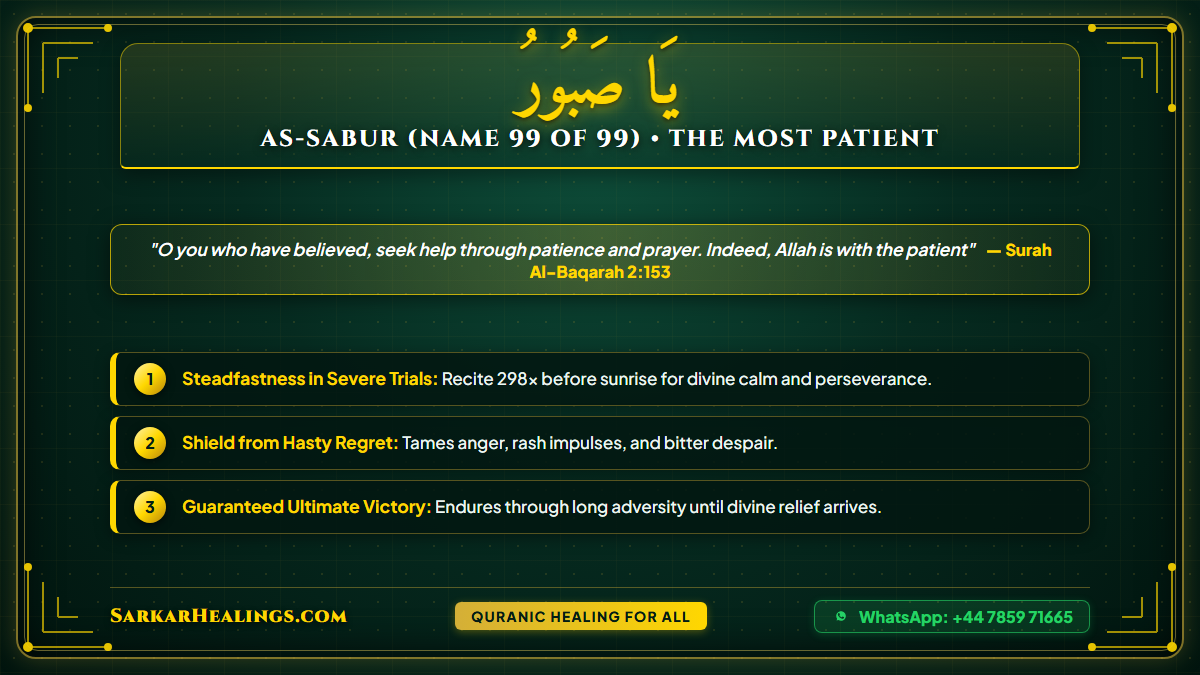
As-Sabur Meaning & Ya Saburu Benefits (Name 99 of 99)
Sarkar Healings · 99 Names of Allah · Name 99 of 99
الصَّبُور
As-Sabur — The Most Patient
As-Sabur Meaning & Ya Saburu Benefits
The One whose patience encompasses all creation, never hastening punishment nor delaying reward.
As-Sabur (The Most Patient) is the 99th Name of Allah, derived from the root ص-ب-ر (ṣ-b-r) meaning to endure, restrain, and persevere. The Name itself does not appear verbatim in the Quran, but the root occurs over 100 times (e.g., 2:153, 3:200, 16:127). It is invoked for steadfastness in trials, restraint in anger, and trust in Allah’s timing.
Key Facts at a Glance
| Name in Arabic | الصَّبُور |
|---|---|
| Transliteration | As-Sabur (invoked as Ya Saburu) |
| English Meaning | The Most Patient |
| Position | 99th of the 99 Names (Asma-ul-Husna) |
| Arabic Root | ص-ب-ر |
| Quran Occurrences | The exact form al-Ṣabūr (الصَّبُور) does not occur as a Divine Name in the Quran. The root صبر appears extensively — over 100 times — in verbal, nominal, and participial forms (e.g., al-ṣābirūn, ṣabr, ṣabbar). Key root verses include 2:153, 2:155–157, 3:200, 8:46, 11:115, 16:127, 40:55. The Name is established via the hadith of the 99 Names (Jāmiʿ al-Tirmidhī 3507) and classical exegesis. |
| Invoked For | steadfastness in hardship, restraint of anger, trust in divine timing, perseverance in worship, healing of anxiety |
| Related Names | Al-Ḥalīm · Al-Wadūd · Al-Malik |
Meaning & the Arabic Root
The root ṣ-b-r (صبر) conveys three intertwined senses: (1) to bind or restrain — holding back the self from panic, complaint, or forbidden reaction; (2) to endure — bearing hardship without collapse; (3) to persist — continuing in obedience despite difficulty. The intensive pattern faʿūl (صَبُور) denotes the One in whom this quality is maximal, perpetual, and essential.
Unlike al-Ḥalīm (The Forbearing), which highlights Allah’s slowness to anger when provoked, al-Ṣabūr underscores the vast temporal scope of His patience: He sustains the cosmos, provides for the disobedient, delays punishment, and waits for repentance across lifetimes. Unlike al-Qadīr (The Able), whose power could instantaneously enforce justice, al-Ṣabūr chooses to withhold that power in mercy.
In invocation, Yā Ṣabūr calls upon the attribute that steadies the heart when outcomes are delayed, when prayers seem unanswered, and when the soul trembles under prolonged trial.
As-Sabur in the Quran
Quran
The exact form al-Ṣabūr (الصَّبُور) does not occur as a Divine Name in the Quran. The root صبر appears extensively — over 100 times — in verbal, nominal, and participial forms (e.g., al-ṣābirūn, ṣabr, ṣabbar). Key root verses include 2:153, 2:155–157, 3:200, 8:46, 11:115, 16:127, 40:55. The Name is established via the hadith of the 99 Names (Jāmiʿ al-Tirmidhī 3507) and classical exegesis.
Surah al-Baqarah 2:153
Yā ayyuhā alladhīna āmanū istaʿīnū biṣ-ṣabri waṣ-ṣalāt; inna Allāha maʿa ṣ-ṣābirīn
“O you who have believed, seek help through patience and prayer. Indeed, Allah is with the patient.”
Surah al-Baqarah 2:153
The definitive Quranic link between divine companionship and human patience. The verse makes ṣabr the means to access Allah’s presence — the very presence named by al-Ṣabūr.
Surah Āl ʿImrān 3:200
Yā ayyuhā alladhīna āmanū ṣbirū waṣābirū wa-rābiṭū wa-ttaqū Allāha laʿallakum tufliḥūn
“O you who have believed, persevere and endure and remain stationed and fear Allah that you may be successful.”
Surah Āl ʿImrān 3:200
Commands layered patience (ṣabr), mutual encouragement in patience (ṣabār), and spiritual vigilance (ribāṭ). The promise of success (falāḥ) is tied to embodying the attribute of al-Ṣabūr.
Surah an-Naḥl 16:127
Waṣbir wa-mā ṣabruka illā billāh; wa-lā taḥzan ʿalayhim wa-lā taku fī ḍayqin mimmā yamkurūn
“And be patient, [O Muḥammad], and your patience is not but through Allah. And do not grieve over them and do not be in distress over what they plot.”
Surah an-Naḥl 16:127
The Prophet ﷺ is taught that true patience is a gift from Allah — a reflection of al-Ṣabūr — not mere human willpower. It frees the heart from grief and constriction.
The Hadith Foundation of the 99 Names
Hadith — graded
Umbrella hadith (the 99 Names): Abū Hurayrah reported: The Messenger of Allah ﷺ said, “Allah has ninety-nine names, one hundred less one; whoever enumerates them enters Paradise.” — Ṣaḥīḥ al-Bukhārī 2736; Ṣaḥīḥ Muslim 2677. The itemised list that includes al-Ṣabūr appears in Jāmiʿ al-Tirmidhī 3507; scholars (e.g., al-Albānī) grade its chain as ḍaʿīf, though the Names themselves are accepted through other routes.
“Whoever remains patient, Allah will grant him patience. No one has been given a gift better and more encompassing than patience.” — reported in Ṣaḥīḥ al-Bukhārī and Ṣaḥīḥ Muslim (exact numbers vary across editions).
The hadith affirms that patience is both a divine attribute (al-Ṣabūr) and a divinely bestowed gift; invoking Yā Ṣabūr is a means to receive that gift.
Classical Commentary
Classical Scholarship — Sunni / Sufi tradition
Imam al-Ghazālī (al-Maqṣad al-Asnā)
Al-Ghazālī explains that al-Ṣabūr is the One who does not hasten to punish the sinner, nor does He delay the reward of the obedient beyond its appointed time. His patience is not born of weakness or inability — for He is al-Qadīr — but of wisdom (ḥikma) and mercy (raḥma). He grants respite so that the servant may turn back; He withholds immediate retribution so that the door of repentance remains open. The servant’s share in this Name is to cultivate ṣabr in three stations: restraint from disobedience, endurance in affliction, and persistence in obedience.
Ibn ʿArabī and the Akbarian tradition
In his writings on the Divine Names, Ibn ʿArabī associates al-Ṣabūr with the cosmic principle of al-ḥilm (forbearance) as the breath of the All-Merciful that sustains existence moment by moment. The universe persists only because al-Ṣabūr continually renews creation without demanding instant accountability. The gnostic (ʿārif) sees every delay in answered prayer as a manifestation of al-Ṣabūr refining the seeker’s readiness.
Benefits of Reciting Ya Saburu
Within the devotional tradition, the following benefits are associated with the sincere and consistent remembrance of As-Sabur. Each reflects the meaning of the Name itself.
- Steadfastness in prolonged trials
Because al-Ṣabūr sustains creation without haste, invoking Him nurtures the capacity to endure long illnesses, financial strain, or family difficulties without despair. - Restraint of anger and impulsive speech
The root meaning of binding the self aligns with the prophetic command to restrain anger; reciting Yā Ṣabūr before reacting creates a pause for divine grace to enter. - Trust in divine timing (tawfīq)
Al-Ṣabūr’s attribute of never delaying reward beyond its appointed time seek healing fors the anxiety of ‘why hasn’t my duʿā been answered yet?’. - Perseverance in worship and dhikr
When the heart grows dry or routine feels burdensome, calling on al-Ṣabūr renews the spiritual stamina to continue — mirroring His endless sustenance of the cosmos. - Healing of anxiety and panic (with medical care)
The Quranic promise ‘Allah is with the patient’ (2:153) makes this Name a spiritual anchor for those undergoing therapy or medication for anxiety disorders. - Softening of harsh judgements toward others
Reflecting on how al-Ṣabūr bears with our faults inspires forbearance toward the faults of spouses, children, and colleagues. - Preparation for the Day of Reckoning
The Name reminds that Allah’s patience has a terminus; invoking it awakens urgency to repent before the respite ends.
Traditional Wazifa Practices (with Sources)
Devotional Tradition — South Asian wazifa literature
The following practices are drawn from the South Asian Urdu wazifa manual tradition (e.g., Ism-e-Aʿẓam by ʿĀlam Faqrī) and Sufi ṭarīqa routines. They are devotional customs, not prophetic prescriptions. No specific outcome is used as a means (sabab); they are undertaken seeking Allah’s grace through the meaning of the Name. Fixed-duration practices (chillas, high counts) are traditionally done under a qualified teacher’s guidance. Recitation accompanies — never replaces — medical or psychological seek healing forment.
- Qurʾānic-duʿā anchor (daily)
After each farḍ prayer, recite Surah al-Baqarah 2:153 (“Inna Allāha maʿa ṣ-ṣābirīn”) once, then say “Yā Ṣabūr, yā Ṣabūr, yā Ṣabūr” three times, asking for patience in the specific trial you face. - Morning/evening wird (100×)
Recite “Yā Ṣabūr” 100 times after Ṣubḥ and Maghrib with presence of heart (ḥuḍūr), visualising the attribute enveloping your worries. This count is common in the BaʿAlawī and Chishtī daily awrād. - Istighfār-ṣabr combination (300×)
Recite “Astaghfiru Allāha rabbī min kulli dhambin wa-atūbu ilayh” 100 times, then “Yā Ṣabūr” 200 times, preferably in the last third of the night. The pairing links repentance (seeking the fruit of divine patience) with the Name itself. - 40-day chilla (teacher-guided)
A traditional 40-day reseek healing for (chilla) of 1,000× “Yā Ṣabūr” daily, with minimal speech, fasting on Mondays/Thursdays, and night vigil (qiyām). Undertaken only with a shaykh’s permission and health clearance; the goal is internalising the attribute, not magical results.
Etiquette (Adab) of Reciting Ya Saburu
- Begin with istighfar — seeking forgiveness before presenting the request.
- Praise Allah and send salawat upon the Prophet ﷺ before and after the dhikr.
- Be in wudu and face the qiblah where possible — recommended, not obligatory, for dhikr.
- Ask with certainty — the Prophet ﷺ instructed asking Allah with conviction of response (Jami’ at-Tirmidhi 3479).
- Keep lawful earnings and intentions.
- Consistency over quantity — the most beloved deeds are the most constant, even if small (Sahih al-Bukhari 6464).
- When invoking Yā Ṣabūr, keep the tongue moist with istighfār — patience begins with acknowledging one’s own impatience.
Frequently Asked Questions
- What does As-Sabur mean?
- As-Sabur means The Most Patient — the One whose patience is infinite, who endures the disobedience of creation without haste to punish, and who sustains all beings while awaiting their return.
- Is As-Sabur mentioned by name in the Quran?
- The exact Name al-Ṣabūr does not appear in the Quran. The root صبر occurs over 100 times (e.g., 2:153, 3:200, 16:127), and the Name is established through the hadith of the 99 Names (Tirmidhī 3507) and scholarly consensus.
- How is As-Sabur different from Al-Halim?
- Al-Ḥalīm emphasises slowness to anger when provoked; al-Ṣabūr emphasises vast, enduring patience across time — sustaining the sinner, delaying reckoning, and granting respite for repentance.
- How many times should I recite Ya Sabur for patience?
- Traditional daily wirds use 100× after Fajr and Maghrib. Higher counts (300–1,000×) or 40-day chillas are devotional customs from South Asian manuals, best done with a teacher’s guidance. No count is mandated by hadith.
- Can anyone recite Ya Sabur, or do I need initiation?
- Any Muslim may recite this Name freely as dhikr or duʿā. Structured high-count practices or chillas traditionally require a shaykh’s permission to ensure proper adab and safeguard health.
Obtain a Spiritually Prepared Ya Saburu Taweez
At Sarkar Healings we prepare Taweez and Naqash of As-Sabur following the etiquette and recitations described in this guide.
Explore Coded Duas & Taweez
WhatsApp Us
Or email: help@sarkarhealings.com
Continue the series: Al-Ḥalīm · Al-Wadūd · Al-Malik · All 99 Names of Allah
This is a traditional practice, not a substitute for medical treatment, legal advice, or professional care. Scholars differ on some of these practices; where they differ, that difference is noted. Benefit and outcome are from Allah alone. If you are facing a medical, psychological, or financial emergency, seek qualified professional help first.
Coded Duas based on As-Sabur

Need Personal Guidance on This?
Get a confidential, free consultation with our spiritual advisor — usually replied within hours.
Complete healing path: The Complete Quran Coded Dua — all 114 Surahs & Asma-ul-Husna in one hand-written taweez.
This content and its associated Quranic recitations are offered strictly as a spiritual means (asbab) seeking Allah's guidance, protection, and barakah. Sarkar Healings does not guarantee magical outcomes or instant cures. Spiritual remedies are to be used alongside lawful personal effort and professional medical, legal, or financial advice.