Al-Wadud Meaning & Ya Wadudu Benefits (Name 47 of 99)
Sarkar Healings · 99 Names of Allah · Name 47 of 99
الْوَدُود
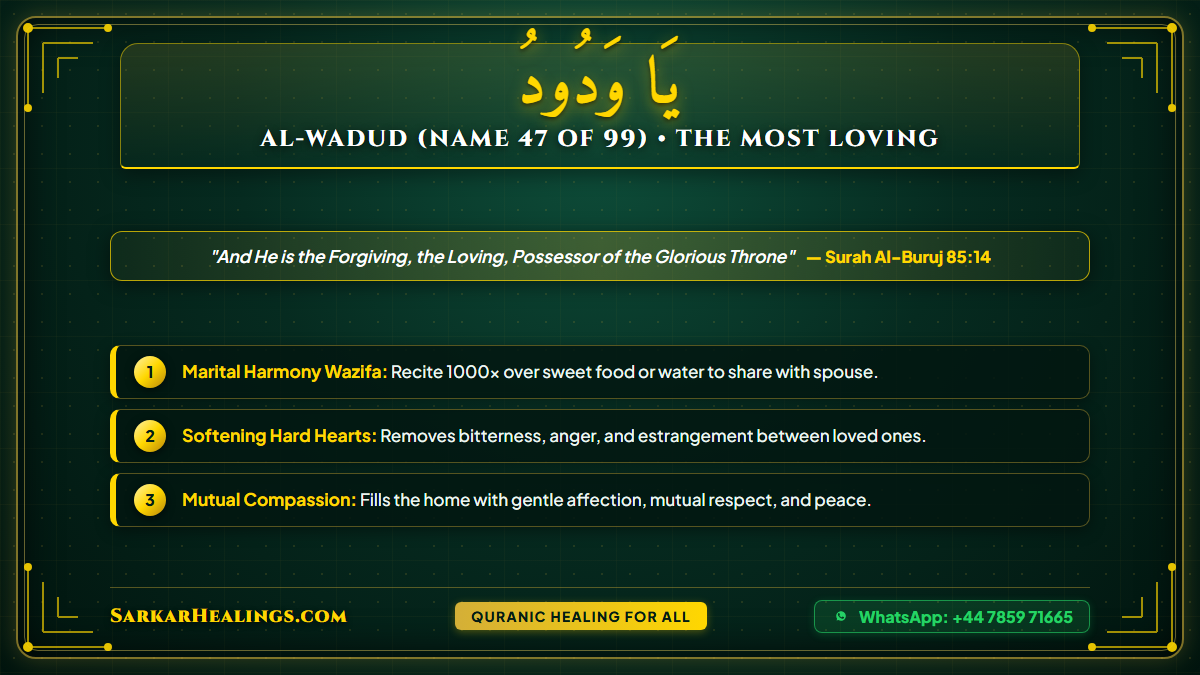
Al-Wadud — The Most Loving
Al-Wadud Meaning & Ya Wadudu Benefits
The Most Loving, The Affectionate — He who loves His creation and is beloved by them
Al-Wadud (الْوَدُود) is the 47th Name, from root w-d-d (love, affection). It appears verbatim in Quran 11:90 and 85:14. The pattern faʿūl denotes constant, enduring love. Invoked for marital harmony, softening hearts, attracting lawful love, and experiencing divine love and forgiveness.
Key Facts at a Glance
| Name in Arabic | الْوَدُود |
|---|---|
| Transliteration | Al-Wadud (invoked as Ya Wadudu) |
| English Meaning | The Most Loving |
| Position | 47th of the 99 Names (Asma-ul-Husna) |
| Arabic Root | و-د-د |
| Quran Occurrences | Al-Wadud occurs verbatim twice in the Quran: Surah Hud 11:90 (‘إِنَّ رَبِّي رَحِيمٌ وَدُودٌ’) and Surah Al-Buruj 85:14 (‘وَهُوَ الْغَفُورُ الْوَدُودُ’). Both use the intensive form al-Wadūd, signifying constant, enduring affection. |
| Invoked For | Marital harmony, softening hearts, attracting lawful love, divine love, forgiveness |
| Related Names | Ar-Rahman · Al-Ghafur · Al-Karim |
Meaning & the Arabic Root
The root و-د-د (w-d-d) conveys love, affection, warm friendship, and the desire for closeness. The morphological form فَعُول (faʿūl) indicates a permanent, intensive quality — not a fleeting emotion but a constant, essential attribute.
Al-Wadud is distinguished from Ar-Rahman (universal mercy) and Ar-Rahim (specific mercy to believers) by its emphasis on reciprocal delight: Allah loves His righteous servants, and they love Him. It differs from Al-Karim (The Generous) in that generosity is the act flowing from love, while Al-Wadud is the loving disposition itself.
In 85:14 the pairing with Al-Ghafur (The Forgiving) reveals that divine love is not conditional on perfection; it embraces the repentant sinner. In 11:90, Shuʿayb (as) invokes Al-Wadud alongside Ar-Rahim, showing that this love is accessible through sincere supplication.
Al-Wadud in the Quran
Quran
Al-Wadud occurs verbatim twice in the Quran: Surah Hud 11:90 (‘إِنَّ رَبِّي رَحِيمٌ وَدُودٌ’) and Surah Al-Buruj 85:14 (‘وَهُوَ الْغَفُورُ الْوَدُودُ’). Both use the intensive form al-Wadūd, signifying constant, enduring affection.
Surah Hud 11:90
Inna rabbī raḥīmun wadūd
“Indeed my Lord is Merciful and Affectionate (Loving).”
Surah Hud 11:90
Prophet Shuʿayb (as) reassures his people that Allah’s loving kindness (wudd) accompanies His mercy (raḥma), inviting them to repentance through hope in divine affection.
Surah Al-Buruj 85:14
Wa huwa al-Ghafūru al-Wadūd
“And He is the Forgiving, the Affectionate (Loving).”
Surah Al-Buruj 85:14
The juxtaposition of forgiveness and love indicates that Allah’s love covers faults; it is the love that welcomes the returning servant, not one that demands flawlessness.
The Hadith Foundation of the 99 Names
Hadith — graded
The umbrella enumeration hadith states: “Allah has ninety-nine names, one hundred less one; whoever enumerates them enters Paradise.” (Sahih al-Bukhari 2736; Sahih Muslim 2677). Al-Wadud is included in this count.
The itemised list in Jamiʿ at-Tirmidhi 3507 is considered by scholars to have a weaker chain (munkar) regarding the exact wording of the ninety-nine names; it is cited for reference but not as a primary proof for the list.
A sound hadith qudsi, recorded in the collections of al-Bukhari and Muslim, conveys the meaning of divine love: “When Allah loves a servant, He calls Jibril: ‘I love so-and-so, so love him.’ Then Jibril loves him and announces it to the heavens… and acceptance is placed for him on earth.” This illustrates the reciprocal love central to Al-Wadud, though the Name itself is not cited verbatim in this narration.
Classical Commentary
Classical Scholarship — Sunni / Sufi tradition
Imam al-Ghazali on Al-Wadud (al-Maqsad al-Asna)
Al-Ghazali explains that Al-Wadud signifies two complementary realities: the One who loves, and the One who is loved. Divine love (wudd) is not emotional need but the eternal will to bestow good and to draw the servant near. The servant’s love for Allah is the fruit of recognising this prior divine love. Al-Ghazali distinguishes wudd from raḥma: mercy is directed to the needy; love is directed to the beloved for the beloved’s own sake.
In the Akbarian tradition (Ibn Arabi and his school), Al-Wadud is explored as the Name through which the cosmos exists — creation is an overflow of divine love (wudd), and the spiritual path is the journey from being loved to loving in return, culminating in the station where the lover, the beloved, and the love become one reality.
Benefits of Reciting Ya Wadudu
Within the devotional tradition, the following benefits are associated with the sincere and consistent remembrance of Al-Wadud. Each reflects the meaning of the Name itself.
- Marital and familial harmony
Recited to nurture affection (mawadda) between spouses and kin, reflecting the Quranic pairing of love and mercy in 30:21. - Softening hardened hearts
The intensive form faʿūl implies love that penetrates resistance; tradition records its use for reconciliation after estrangement. - Attracting lawful love and companionship
Invoked by those seeking a righteous spouse, trusting that the Source of all love facilitates its lawful manifestation. - Experiencing divine love and nearness
The Name is a means (wasila) to feel Allah’s personal affection, as promised in the hadith qudsi of mutual love. - Hope alongside forgiveness
Paired with Al-Ghafur in 85:14, it assures the repentant that divine love welcomes them despite past faults. - Healing emotional wounds
Recited for healing alongside medical seek healing forment, addressing grief, loneliness, and the pain of rejection through connection to the Ultimate Lover. - Cultivating love for Allah and His creation
Regular invocation aligns the heart with the divine attribute, increasing love for the Beloved and compassion for creation.
Traditional Wazifa Practices (with Sources)
Devotional Tradition — South Asian wazifa literature
The following practices are drawn from the South Asian Urdu wazifa manual genre (e.g., Ism-e-Azam by Alam Faqri) and Sufi silsila传承. They are devotional traditions, not prescribed in the Quran or Sunnah with fixed counts. No outcomes are used as a means (sabab); they are believed to be means of seeking Allah’s loving assistance. Heavy fixed-duration practices (chillas, counts above 500) are traditionally undertaken with a teacher’s guidance. Recite for healing alongside medical seek healing forment, never as a replacement.
- Quranic-dua anchor (no fixed count)
After each fard salah, recite the two verses containing Al-Wadud (11:90, 85:14) once each, then supplicate: ‘Ya Wadud, Ya Ghafur, grant me Your love and forgiveness, and place love between me and [name/situation].’ This roots the practice directly in revelation. - Daily wird of 100x
Recite ‘Ya Wadudu’ 100 times after Fajr and/or Isha with wudu, facing qibla, intending softening of the heart and attraction of lawful affection. Light, sustainable, suitable for long-term continuation. - Marital harmony practice (1100x)
Recite ‘Ya Wadudu’ 1100 times daily for 40 days (chilla), with wudu, after Isha, by both spouses together or one on behalf of the family. Traditionally accompanied by blowing on water shared at meals. Undertake with a teacher’s guidance for the full chilla. - Seeking a righteous spouse (5000x over 11 days)
Recite ‘Ya Wadudu’ 5000 times in divided sittings over 11 days (approx. 455/day), with istikhara and consultation. A heavy count; traditionally done under a shaykh’s supervision. Pair with active steps (family involvement, matrimonial channels).
Etiquette (Adab) of Reciting Ya Wadudu
- Begin with istighfar — seeking forgiveness before presenting the request.
- Praise Allah and send salawat upon the Prophet ﷺ before and after the dhikr.
- Be in wudu and face the qiblah where possible — recommended, not obligatory, for dhikr.
- Ask with certainty — the Prophet ﷺ instructed asking Allah with conviction of response (Jami’ at-Tirmidhi 3479).
- Keep lawful earnings and intentions.
- Consistency over quantity — the most beloved deeds are the most constant, even if small (Sahih al-Bukhari 6464).
- Begin each sitting by sending salawat on the Prophet ﷺ, for love reaches Allah through the channel of His Beloved.
Frequently Asked Questions
- What does Al-Wadud mean?
- Al-Wadud (الْوَدُود) means The Most Loving, The Affectionate, The Constantly Loving. From root w-d-d (love, warm friendship), the pattern faʿūl denotes an enduring, intensive quality — Allah’s eternal, unchanging love for His creation and His being beloved by them.
- Does Al-Wadud appear in the Quran?
- Yes, verbatim in two verses: Surah Hud 11:90 (إِنَّ رَبِّي رَحِيمٌ وَدُودٌ) and Surah Al-Buruj 85:14 (وَهُوَ الْغَفُورُ الْوَدُودُ). Both use the definite form al-Wadūd.
- How is Al-Wadud different from Ar-Rahman and Ar-Rahim?
- Ar-Rahman/Ar-Rahim denote mercy — compassion toward need. Al-Wadud denotes love — delight in the beloved for their own sake, and reciprocal affection. Mercy flows downward to the needy; love flows between lover and beloved. Al-Wadud also implies being the Beloved whom hearts.
- How many times should I recite Ya Wadudu for marriage or harmony?
- Traditions vary: 100x daily as a wird; 1100x daily for 40 days (chilla) for marital harmony; 5000x over 11 days for seeking a spouse. These are devotional customs from the South Asian wazifa genre, not prophetic prescriptions. Heavy counts should be done with a teacher’s guidance.
- Can anyone recite Ya Wadudu, or are there restrictions?
- Any Muslim — male or female, in any state of purity (though wudu is recommended) — may recite it. There are no ritual restrictions. The only adab is sincerity, sending salawat first, and coupling supplication with lawful means (e.g., family consultation for marriage).
Obtain a Spiritually Prepared Ya Wadudu Taweez
At Sarkar Healings we prepare Taweez and Naqash of Al-Wadud following the etiquette and recitations described in this guide.
Explore Coded Duas & Taweez
WhatsApp Us
Or email: help@sarkarhealings.com
Continue the series: Ar-Rahman · Al-Ghafur · Al-Karim · All 99 Names of Allah
This is a traditional practice, not a substitute for medical treatment, legal advice, or professional care. Scholars differ on some of these practices; where they differ, that difference is noted. Benefit and outcome are from Allah alone. If you are facing a medical, psychological, or financial emergency, seek qualified professional help first.
Coded Duas based on Al-Wadud

Need Personal Guidance on This?
Get a confidential, free consultation with our spiritual advisor — usually replied within hours.
Complete healing path: The Complete Quran Coded Dua — all 114 Surahs & Asma-ul-Husna in one hand-written taweez.
This content and its associated Quranic recitations are offered strictly as a spiritual means (asbab) seeking Allah's guidance, protection, and barakah. Sarkar Healings does not guarantee magical outcomes or instant cures. Spiritual remedies are to be used alongside lawful personal effort and professional medical, legal, or financial advice.