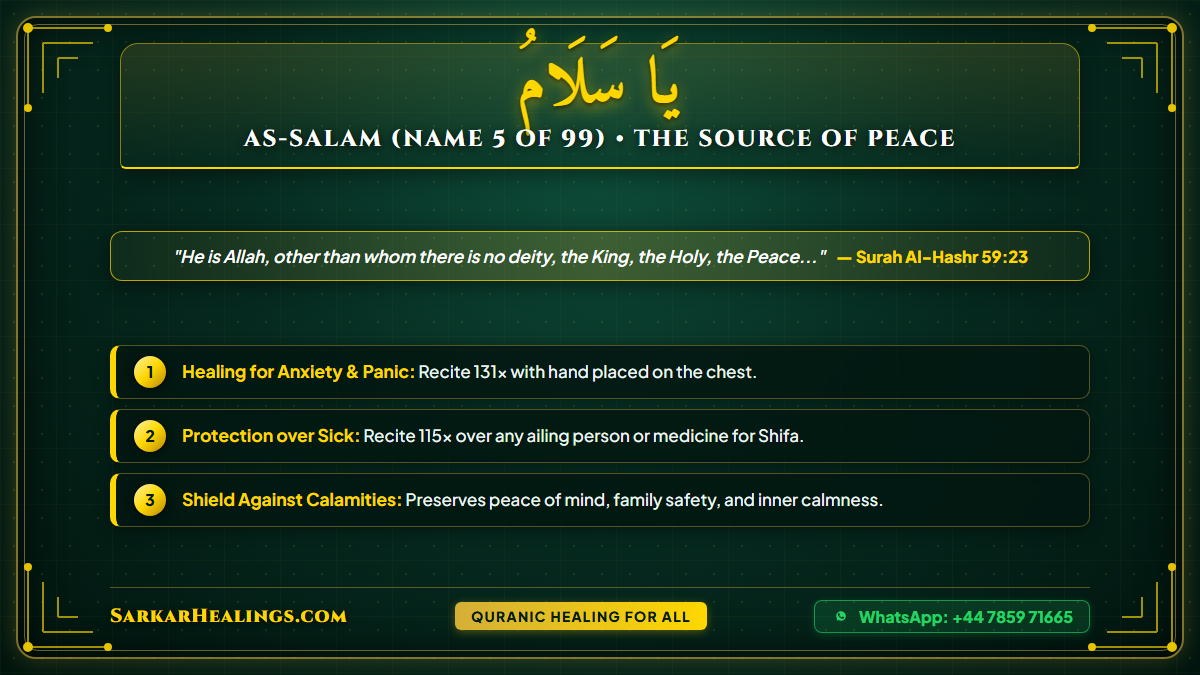
Ya Salamu Wazifa for Peace & Safety | Sarkar Healings
Featured Spiritual Remedy for As-Salam Meaning & Ya Salamu Benefits (Name 5 of 99)
Hand-written using natural Saffron & Rosewater ink under strict ritual purity
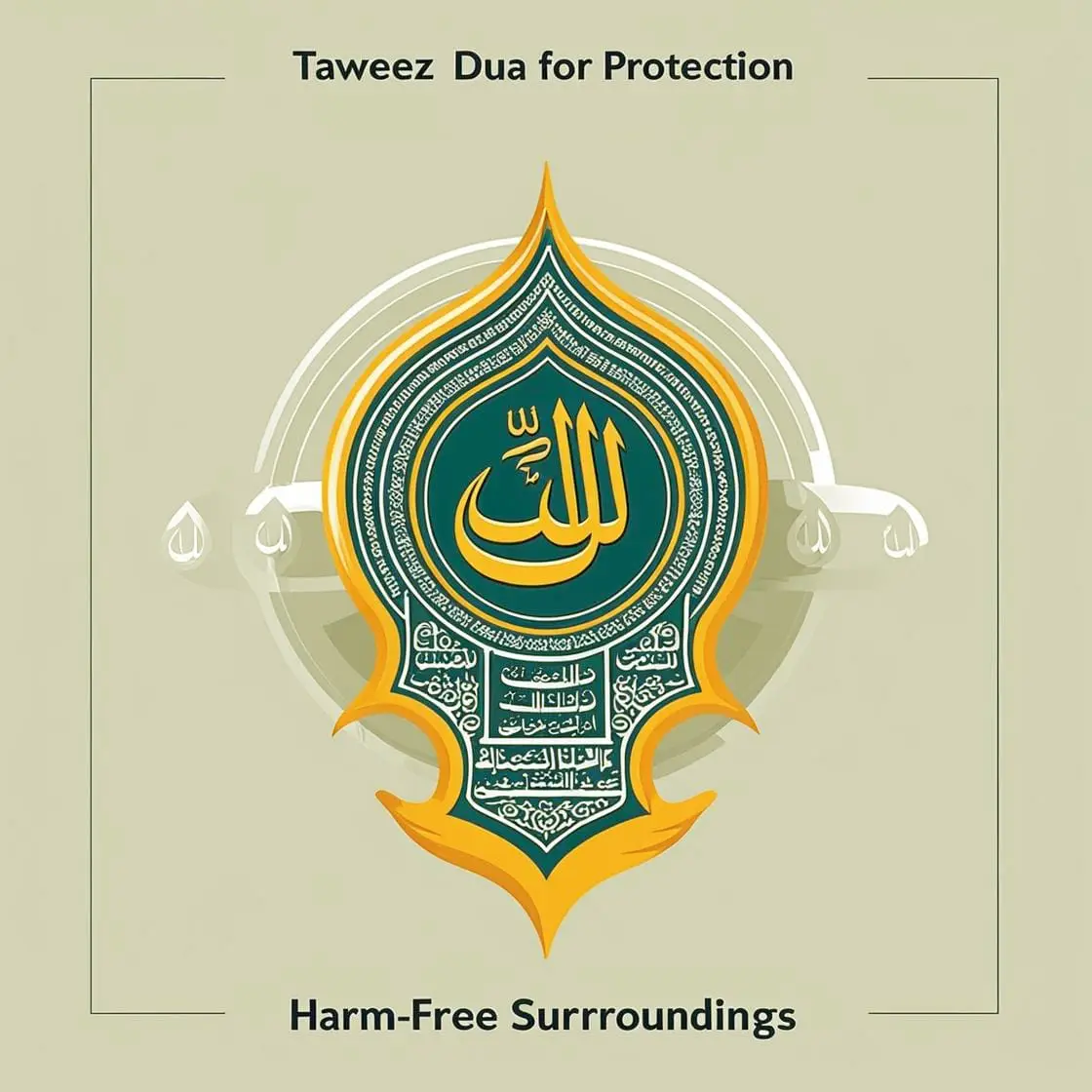
Coded Dua for Seeking a Peaceful, Protected Home
Authentic hand-written Quranic Coded Dua prepared under ritual purity for protection & barakah.
€249

Islamic Protection Taweez — Authentic Ruqyah Shield
Authentic hand-written Quranic Coded Dua prepared under ritual purity for protection & barakah.
€249
Al-Salam Coded Dua — Quranic Shifa for Unseen Affliction
A hand-written spiritual prescription (wasilah) invoking Al-Salam, powered by the Spiritual Intelligence of Asif bin Barkhiya (Quran 27:40),
£249.00
Sarkar Healings · 99 Names of Allah · Name 5 of 99
السَّلَام
As-Salam — The Source of Peace
As-Salam Meaning & Ya Salamu Benefits
The Source of Peace — the Flawless One from whom all peace flows
As-Salam (السَّلَام), the 5th of the 99 Names, means The Source of Peace. From the root س-ل-م (peace, soundness, submission). It appears verbatim in Quran 59:23 among the cluster of Names in Surah al-Hashr. Invoked for inner tranquillity, healing of heart and body, reconciliation, and protection from every defect. Al-Ghazali describes Him as the One free from all imperfection who bestows peace upon creation.
Key Facts at a Glance
| Name in Arabic | السَّلَام |
|---|---|
| Transliteration | As-Salam (invoked as Ya Salamu) |
| English Meaning | The Source of Peace |
| Position | 5th of the 99 Names (Asma-ul-Husna) |
| Arabic Root | س-ل-م |
| Quran Occurrences | As-Salam occurs verbatim once in the Quran, in Surah al-Hashr 59:23, where it appears in the cluster of Divine Names: ‘Huwa Allahu… al-Maliku al-Quddusu as-Salamu…’ The root س-ل-م appears over 140 times across the Quran in forms such as islam, salam, muslim, salima, and taslim. |
| Invoked For | Inner peace, healing, anxiety relief, reconciliation, protection from harm, soundness in faith |
| Related Names | Al-Mu'min · Al-Quddus · Ar-Razzaq |
Meaning & the Arabic Root
The root س-ل-م (s-l-m) carries the core senses of peace, safety, wholeness, soundness, and submission. From it derive salam (peace), islam (submission/entering into peace), salim (sound, flawless), and taslim (surrender). The Name As-Salam is on the pattern of fa’il (active participle), yet as a Divine Name it does not merely mean ‘the One who makes peace’ — it signifies the One who is Peace in His Essence, free from every defect, deficiency, or imperfection.
Classical lexicons note that as-salam denotes the attribute of being salim (sound/flawless) in the absolute sense. Al-Khalil ibn Ahmad al-Farahidi states that the root’s primary meaning is ‘continuity and permanence without defect’. Thus As-Salam is the One whose Being is unbroken perfection, and from whom all created peace — whether the peace of the heart, the peace of society, or the peace of the Hereafter — originates and to whom it returns.
The distinction from Al-Mu’min (The Giver of Security) is subtle but vital: Al-Mu’min bestows aman (security from fear) upon others; As-Salam is the very reality of peace itself. The distinction from Al-Quddus (The Pure) lies in focus: Al-Quddus emphasises transcendence above all impurity; As-Salam emphasises the positive perfection — the wholeness and soundness — that is the source of all well-being.
Seeking Peace Through Ya Salamu? – Handwritten Coded Dua
If you are reciting Ya Salamu for calm and composure under pressure, the Composure Dua (Surah Muzammil, Ya Salam) gathers the same supplication – handwritten as a sabab, paired with remembrance and lawful effort.
View the Ya Salam Composure Coded Dua – EUR 199, free consult
Means, not guarantee. Comfort supplication only – not medical or mental-health treatment.
As-Salam in the Quran
Quran
As-Salam occurs verbatim once in the Quran, in Surah al-Hashr 59:23, where it appears in the cluster of Divine Names: ‘Huwa Allahu… al-Maliku al-Quddusu as-Salamu…’ The root س-ل-م appears over 140 times across the Quran in forms such as islam, salam, muslim, salima, and taslim.
Surah al-Hashr 59:23
Huwa Allāhu alladhī lā ilāha illā Huwa al-Maliku al-Quddūsu as-Salāmu al-Mu'minu al-Muhayminu al-'Azīzu al-Jabbāru al-Mutakabbiru. Subḥāna Allāhi 'ammā yushrikūn.
“He is Allah, other than whom there is no deity, the Sovereign, the Pure, the Source of Peace, the Bestower of Faith, the Overseer, the Exalted in Might, the Compeller, the Superior. Exalted is Allah above whatever they associate with Him.”
Surah al-Hashr 59:23
This is the sole verbatim occurrence of As-Salam as a Divine Name in the Quran. It sits at the centre of a cluster of Names that move from sovereignty (al-Malik) through purity (al-Quddus) to peace (as-Salam), then to the bestowal of security (al-Mu’min) — a theological sequence showing that peace is the fruit of divine purity and the foundation of the security granted to creation.
Surah al-An'am 6:127 (also 10:25)
Lahum dāru s-salāmi 'inda rabbihim wa huwa waliyyuhum bimā kānū ya'malūn.
“For them is the Home of Peace with their Lord, and He is their Protector because of what they used to do.”
Surah al-An'am 6:127 (also 10:25)
The phrase Dar as-Salam (the Abode of Peace) uses the root with the definite article, identifying Paradise as the locus where the attribute of As-Salam is fully realised for the believers. It confirms that ultimate peace is not a created commodity but a nearness to the Source of Peace Himself.
The Hadith Foundation of the 99 Names
Hadith — graded
The foundational hadith for all 99 Names is the narration of Abu Hurayrah: “Allah has ninety-nine names, one hundred less one; whoever enumerates them enters Paradise.” This is recorded in Sahih al-Bukhari 2736 and Sahih Muslim 2677.
Specific to As-Salam, the Prophet ﷺ said: “Allah is As-Salam, and from Him comes peace. Blessed are You, O Possessor of Majesty and Honour.” This wording appears in the Sunan collections (including Sunan al-Tirmidhi and Sunan an-Nasa’i) as part of the supplication after the obligatory prayer. The itemised list of ninety-nine names in Jami’ at-Tirmidhi 3507 includes As-Salam, though scholars such as al-Albani grade that particular list as weak (da’if) due to its isnad; the Name itself, however, is firmly established by the Quranic verse above and by the authentic post-salah supplication.
Classical Commentary
Classical Scholarship — Sunni / Sufi tradition
Imam al-Ghazali (al-Maqsad al-Asna)
Al-Ghazali explains that As-Salam means the One who is free from every defect (‘ayb), deficiency (naqs), and affliction (afa). He is al-Salim in the absolute sense — His Essence, Attributes, and Actions are all characterised by flawless perfection. Because He is the Source of Peace, He bestows peace upon His servants in this world (soundness of body, tranquillity of heart, safety from harm) and in the next (the greeting of “Salam” from the Lord, 36:58, and the Abode of Peace). The servant’s share in this Name is to cultivate inner soundness (salama) by purging the heart of rancour, envy, and doubt, thereby becoming a channel of peace for others.
In the Akbarian tradition, Ibn Arabi and his school seek healing for As-Salam as the Name that gathers all attributes of perfection (kamal) into a single reality: the Muhammadi Reality manifests as the perfect mirror of As-Salam, and the greeting of peace (as-salamu ‘alaykum) is the activation of this Name between believers.
Benefits of Reciting Ya Salamu
Within the devotional tradition, the following benefits are associated with the sincere and consistent remembrance of As-Salam. Each reflects the meaning of the Name itself.
- Tranquillity of the heart (itminan al-qalb)
Because As-Salam is the Source of Peace, invoking this Name is traditionally believed to still the inner turbulence caused by anxiety, grief, or fear, tracing directly to the root meaning of soundness and wholeness. - Healing of bodily illness
The root س-ل-م conveys physical soundness (salima); the tradition records recitation of Ya Salamu for recovery, always alongside medical seek healing forment, as the Name addresses the Flawless One who restores wholeness. - Reconciliation between estranged parties
As-Salam is the Author of peace between hearts; wazifa practice for restoring broken relationships invokes this Name to ask the Source of Peace to replace enmity with harmony. - Protection from harm and accidents
The meaning of safety (salama) from the root underlies the practice of reciting this Name for divine guardianship during travel, surgery, or any situation of vulnerability. - Soundness of faith and death upon Islam
Since islam and salim share the root, the pious predecessors invoked As-Salam for a sound ending (husn al-khatima) — to meet Allah with a heart salim (26:89). - Relief from waswas (obsessive whispers)
The flawlessness implied by As-Salam counters the fragmentation of waswas; regular invocation is associated in the Sufi manuals with the settling of intrusive thoughts. - Blessing upon the home and family
The Quranic phrase Dar as-Salam (Abode of Peace) inspires the practice of reciting Ya Salamu in the household to invite the atmosphere of the Divine Abode into daily life.
Traditional Wazifa Practices (with Sources)
Devotional Tradition — South Asian wazifa literature
The practices below are drawn from the South Asian Urdu wazifa manual genre (e.g. Ism-e-Azam by Alam Faqri) and living Sufi silsila traditions. They are devotional customs, not prophetic prescriptions. No specific count or duration is authenticated from the Prophet ﷺ. Heavy or fixed-duration practices (chillas, counts above ~500) are traditionally undertaken with a qualified teacher’s guidance. All healing benefits are understood as sought from Allah alongside, never instead of, appropriate medical care. Outcomes are never used as a means (sabab) — the tradition records them as believed to be associated with the Name.
- The Prophetic post-salah supplication (Quranic-hadith basis)
After each obligatory prayer, recite: Allahumma anta as-Salam wa minka as-salam, tabarakta ya Dhal-Jalali wa al-Ikram (O Allah, You are As-Salam, and from You comes peace; Blessed are You, O Possessor of Majesty and Honour). This is the most authentic daily engagement with the Name, recorded in the Sunan collections. - Daily litany (wird) of 100–200 after Fajr and Maghrib
Sit facing the qibla, perform wudu, and recite Ya Salamu 100 times after Fajr and 100 times after Maghrib (or 200 once). Many manuals suggest adding Ya Salamu Ya Rahmanu for a combined invocation of peace and mercy. This light daily practice is suitable for all believers without special permission. - Focused need-based recitation (313 or 500 times)
For a specific concern — illness, family dispute, anxiety — the tradition records reciting Ya Salamu 313 times (the number of Badr companions) or 500 times in one sitting, preceded and followed by Salawat, with the matter presented sincerely to Allah. This is a devotional intensification, not a magical formula. - Forty-day chilla (1,000–1,500 daily) — with teacher only
A 40-day reseek healing for-style practice of 1,000 to 1,500 recitations daily, maintaining strict wudu, dietary discipline, and night vigil (tahajjud). Classical manuals emphasise this must be authorised and monitored by a living shaykh; it is not for self-initiation. The aim is the inward dressing of the attribute of peace, not merely numerical completion.
Etiquette (Adab) of Reciting Ya Salamu
- Begin with istighfar — seeking forgiveness before presenting the request.
- Praise Allah and send salawat upon the Prophet ﷺ before and after the dhikr.
- Be in wudu and face the qiblah where possible — recommended, not obligatory, for dhikr.
- Ask with certainty — the Prophet ﷺ instructed asking Allah with conviction of response (Jami’ at-Tirmidhi 3479).
- Keep lawful earnings and intentions.
- Consistency over quantity — the most beloved deeds are the most constant, even if small (Sahih al-Bukhari 6464).
- Begin every sitting with the intention (niyya) of drawing near to the Flawless One, and conclude by spreading the greeting of salam aloud to those around you — the Prophetic enactment of this Name.
Frequently Asked Questions
- What does As-Salam mean?
- As-Salam means The Source of Peace, the One who is flawless in His Essence and from whom all peace — spiritual, physical, and social — originates. It derives from the root س-ل-م (s-l-m), conveying peace, soundness, safety, and submission.
- Does As-Salam appear in the Quran?
- Yes, verbatim once: Surah al-Hashr 59:23 — ‘al-Maliku al-Quddusu as-Salamu…’ The root appears over 140 times, including in the phrase Dar as-Salam (Abode of Peace) in 6:127 and 10:25.
- How is As-Salam different from Al-Mu'min (The Giver of Security)?
- Al-Mu’min bestows security (aman) upon creation — the removal of fear. As-Salam is the very Essence of peace itself; He is the Flawless One whose perfection is the ontological ground of all safety and soundness. Al-Mu’min gives; As-Salam is.
- How many times should I recite Ya Salamu for anxiety or healing?
- The tradition offers no fixed prophetic number. Common devotional counts are 100–200 daily as a wird, or 313–500 for a focused need. Any practice above ~500 or extending over 40 days should be undertaken with a qualified teacher’s guidance. Always combine with medical care for health issues.
- Can anyone recite Ya Salamu, or is initiation required?
- The daily litany (100–200) and the post-salah supplication are open to all believers without initiation. Intensive chillas (40-day reseek healing fors with high counts) traditionally require a teacher’s permission and oversight in the Sufi silsila context.
Obtain a Spiritually Prepared Ya Salamu Taweez
At Sarkar Healings we prepare Taweez and Naqash of As-Salam following the etiquette and recitations described in this guide.
Explore Coded Duas & Taweez
WhatsApp Us
Or email: help@sarkarhealings.com
Continue the series: Al-Mu'min · Al-Quddus · Ar-Razzaq · All 99 Names of Allah
At Sarkar Healings we prepare this taweez and coded dua following the Qur’an and Sunnah described in this guide, with the correct intention and adab.
Or email: help@sarkarhealings.com
Need Confidential Guidance or Personal Case Analysis?
Speak directly with our senior spiritual practitioners for a private, confidential consultation regarding Istikhara interpretation, Ruqyah assessment, or customized Coded Dua selection.
This is a traditional practice, not a substitute for medical treatment, legal advice, or professional care. Scholars differ on some of these practices; where they differ, that difference is noted. Benefit and outcome are from Allah alone. If you are facing a medical, psychological, or financial emergency, seek qualified professional help first.
Coded Duas based on As-Salam
Need Personal Guidance on This?
Get a confidential, free consultation with our spiritual advisor — usually replied within hours.
Complete healing path: The Complete Quran Coded Dua — all 114 Surahs & Asma-ul-Husna in one hand-written taweez.
This content and its associated Quranic recitations are offered strictly as a spiritual means (asbab) seeking Allah's guidance, protection, and barakah. Sarkar Healings does not guarantee magical outcomes or instant cures. Spiritual remedies are to be used alongside lawful personal effort and professional medical, legal, or financial advice.