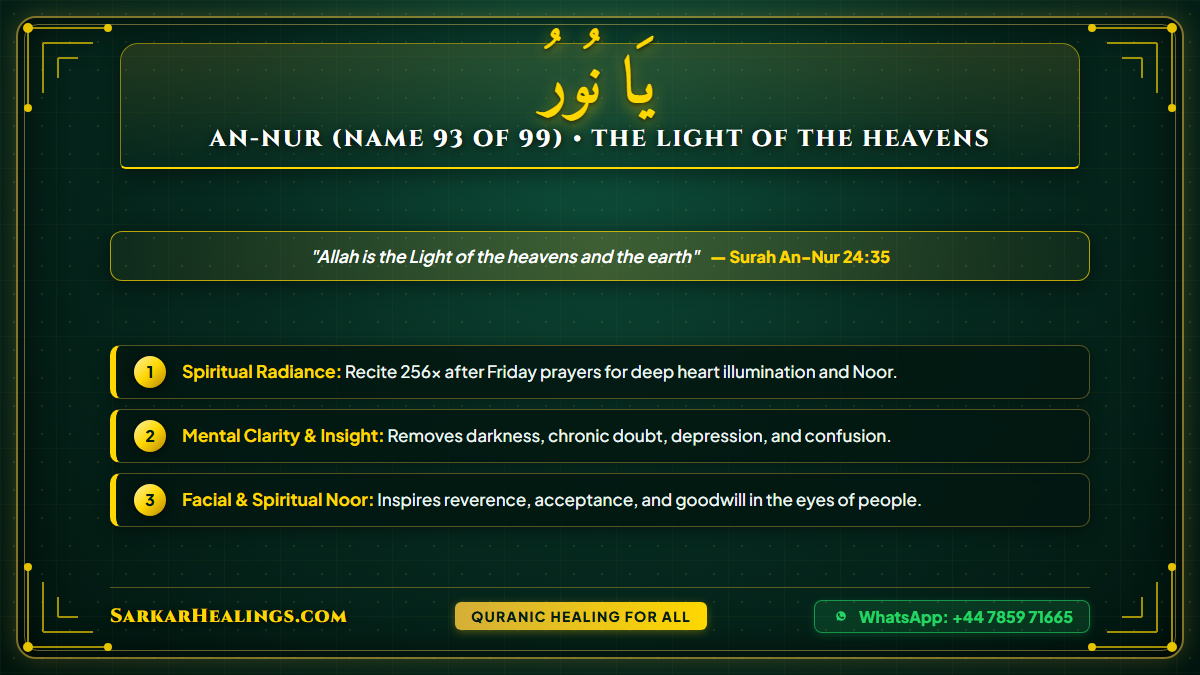
An-Nur Meaning & Ya Nuru Benefits (Name 93 of 99)
Sarkar Healings · 99 Names of Allah · Name 93 of 99
النُّور
An-Nur — The Light
An-Nur Meaning & Ya Nuru Benefits
The Light who illuminates all existence and guides the hearts of believers
An-Nur (The Light) is the 93rd of the 99 Names. From the root ن-و-ر (light, illumination), it appears verbatim in Qur’an 24:35 — ‘Allah is the Light of the heavens and the earth’. Imam al-Ghazali describes it as the source of all lights, making every existent visible. Invoked for guidance, clarity of heart, dispelling spiritual darkness, and healing alongside medical care.
Key Facts at a Glance
| Name in Arabic | النُّور |
|---|---|
| Transliteration | An-Nur (invoked as Ya Nuru) |
| English Meaning | The Light |
| Position | 93rd of the 99 Names (Asma-ul-Husna) |
| Arabic Root | ن-و-ر |
| Quran Occurrences | The Name An-Nur appears verbatim once in the Qur’an as a Divine Name in Surah An-Nur 24:35: ‘Allahu nurus-samawati wal-ard’ (Allah is the Light of the heavens and the earth). The triliteral root ن-و-ر occurs over 40 times across the Qur’an in various forms (nur, munir, anara, istanara), denoting physical light, revelation, guidance, and the light of faith. |
| Invoked For | Guidance, spiritual clarity, illumination of the heart, dispelling darkness, healing support |
| Related Names | Al-Hadi · Al-Badi' · Al-Quddus |
Meaning & the Arabic Root
The root ن-و-ر (n-w-r) conveys light, illumination, and that which makes things visible. Morphologically, An-Nur is the definite active participle (ism al-fa’il) on the pattern of fa’ul, indicating the One whose very essence is Light — not merely a possessor of light, but Light itself.
Classical lexicons distinguish nur (a subtle, self-subsisting light that reveals other things) from diya’ (a more intense, blazing light like the sun). The Qur’an uses nur for the light of the moon (10:5, 71:16), the light of revelation, and the light of faith — all reflected, dependent lights — while reserving An-Nur as a Name for the Source from which all such lights derive.
Unlike Al-Munir (The Illuminator, not among the 99), which emphasises the act of giving light to others, An-Nur affirms the Divine Essence as the uncreated Light in which all created lights participate. It is the principle of manifestation (zuhur) by which the Hidden becomes known.
An-Nur in the Quran
Quran
The Name An-Nur appears verbatim once in the Qur’an as a Divine Name in Surah An-Nur 24:35: ‘Allahu nurus-samawati wal-ard’ (Allah is the Light of the heavens and the earth). The triliteral root ن-و-ر occurs over 40 times across the Qur’an in various forms (nur, munir, anara, istanara), denoting physical light, revelation, guidance, and the light of faith.
Surah An-Nur 24:35
Allahu nurus-samawati wal-ard. Mathalu nurihi kamishkatin fiha misbah… nurun 'ala nur. Yahdi Allahu li-nurihi man yasha'.
“Allah is the Light of the heavens and the earth. The parable of His Light is as a niche wherein is a lamp… Light upon Light. Allah guides to His Light whom He wills.”
Surah An-Nur 24:35
The definitive occurrence of An-Nur as a Divine Name. The verse unfolds a layered parable: the niche (the believer’s heart), the glass (pure intellect), the blessed olive oil (revelation), and the flame (faith) — all culminating in ‘Light upon Light’, indicating degrees of illumination from the Source.
Surah Az-Zumar 39:69
Wa ashraqat al-ardu bi-nuri rabbiha…
“And the earth will shine with the Light of its Lord…”
Surah Az-Zumar 39:69
Here nur appears in the genitive construction nuri rabbiha (the Light of her Lord), affirming that the radiance flooding creation on the Day of Judgement emanates from the Attribute of An-Nur.
Surah Al-Ma'idah 5:15
Qad ja'akum min Allahi nurun wa kitabun mubin.
“There has come to you from Allah a Light and a clear Book.”
Surah Al-Ma'idah 5:15
The Prophet Muhammad ﷺ and the Qur’an are described as a nur sent from Allah — a created light that guides, distinct from the Uncreated Light (An-Nur) which is its Source.
The Hadith Foundation of the 99 Names
Hadith — graded
Umbrella hadith (the 99 Names): Narrated by Abu Hurayrah — the Messenger of Allah ﷺ said: “Allah has ninety-nine names, one hundred less one; whoever enumerates (ahsaha) them enters Paradise.” Sahih al-Bukhari 2736; Sahih Muslim 2677.
“Allah created His creation in darkness, then He cast His Light upon them. Whoever was touched by that Light on that day is guided, and whoever missed it goes astray.”
Recorded in Sahih Muslim (Kitab al-Qadr). This narration connects the Name An-Nur to the primordial act of guidance and the distinction between the people of light and darkness.
Grading note: The itemised list of the 99 Names appears in Jami’ at-Tirmidhi 3507; scholars including Ibn al-Qayyim and al-Albani grade its chain as weak (da’if), so the specific enumeration therein is not relied upon with caution.
Classical Commentary
Classical Scholarship — Sunni / Sufi tradition
Imam al-Ghazali (al-Maqsad al-Asna)
Al-Ghazali explains that An-Nur is the One who makes every existent visible. In the physical world, light is that by which colours and forms are perceived; in the spiritual world, it is the light of intellect and faith by which truths are discerned. He distinguishes three grades: the light of the senses (sun, moon), the light of the heart (knowledge, faith), and the Light of the Divine Essence — which is not perceived by eyes but by the inner eye (basirah). The Essence is Light in the sense of being manifest in Itself and the cause of manifestation for all else. “He is the Light of the heavens and the earth” means He is the illuminator of their realities, not that He is a physical light residing in them.
Ibn Arabi and the Akbarian Tradition
In the writings on the Divine Names, Ibn Arabi identifies An-Nur with the Muhammadan Reality (al-Haqeeqah al-Muhammadiyyah) — the first created light, the perfect mirror reflecting the Divine Names. He calls it the “Light of lights” (nuru al-anwar) and the “Light of the unseen” (nuru al-ghayb). The parable of the niche in 24:35 is read as the cosmological hierarchy: the niche is the Universal Intellect, the glass the Universal Soul, the lamp the Perfect Man, the olive oil the revelation, and the flame the actualised knowledge. “Light upon Light” signifies the endless self-disclosure of the One in the many.
Benefits of Reciting Ya Nuru
Within the devotional tradition, the following benefits are associated with the sincere and consistent remembrance of An-Nur. Each reflects the meaning of the Name itself.
- Guidance in confusion
Because An-Nur is the Source of all guidance, invoking this Name is traditionally believed to illuminate the heart when decisions are unclear or the path seems dark. - Clarity of intellect and memory
The Name’s association with the light of the intellect makes it a support for students and seekers of knowledge, recited for retention and understanding alongside diligent study. - Dispelling spiritual darkness
Recitation of Ya Nur is associated with removing the darkness of heedlessness (ghaflah), doubt, and sorrow, as the tradition records that light and darkness cannot coexist. - Healing of ailments of the eyes and heart
In the South Asian wazifa manuals, An-Nur is recited for physical eye complaints and for the ‘diseases of the heart’ (envy, malice, anxiety) — always alongside proper medical seek healing forment. - Strengthening faith (iman)
The Qur’an calls faith a light (57:28); invoking the Source of that light is believed to deepen conviction and steadfastness. - Protection from misguidance
The hadith of the primordial light cast upon creation underpins the practice of seeking refuge through this Name from the darkness of error and innovation. - Illumination of the grave and the Hereafter
Tradition records that the light of this Name, cultivated in the heart, becomes the believer’s light on the Bridge (Sirat) and in the grave, as per the verse ‘their light runs before them’ (57:12).
Traditional Wazifa Practices (with Sources)
Devotional Tradition — South Asian wazifa literature
The following practices are drawn from the South Asian Urdu wazifa manual genre (e.g. Ism-e-Azam compilations by scholars such as Alam Faqri) and the living transmission of Sufi silsilas. They are devotional traditions, not prescriptive hadiths. Counts above a few hundred or fixed-duration reseek healing fors (chillas) are traditionally undertaken with a qualified teacher’s guidance. Outcomes are never used as a means (sabab); the believer seeks Allah’s grace through the barakah of His Name while continuing all medical and practical means.
- Qur'anic Dua Practice — Ayat an-Nur
Recite Surah An-Nur 24:35 (Ayat an-Nur) once after each obligatory prayer, or seven times after Fajr and Maghrib, with presence of heart, asking Allah by His Name An-Nur to illumine the heart and grant guidance. This directly anchors the invocation in the verse where the Name is declared. - Daily Wird — Ya Nur 100 times
After Fajr or after Isha, sit facing the qibla, perform wudu, and recite Ya Nur 100 times (or 313 times in some manuals) with the intention of spiritual clarity and removal of inner darkness. Consistency over 40 days is commonly recommended. - Extended Count — Ya Nur 1,000 times
For specific needs (exams, major decisions, healing support), the manuals mention reciting Ya Nur 1,000 times in one sitting or split across the day, preceded and followed by Salawat. This is a heavier practice; seek a teacher’s permission if unfamiliar. - Chilla — 40 Days of 11,000 Ya Nur
A traditional 40-day reseek healing for (chilla) of 11,000 daily recitations (often divided: 3,000 after Fajr, 3,000 mid-morning, 3,000 after Asr, 2,000 after Isha) with strict dietary and behavioural adab. Undertake only under direct supervision of a Shaykh; not for beginners.
Etiquette (Adab) of Reciting Ya Nuru
- Begin with istighfar — seeking forgiveness before presenting the request.
- Praise Allah and send salawat upon the Prophet ﷺ before and after the dhikr.
- Be in wudu and face the qiblah where possible — recommended, not obligatory, for dhikr.
- Ask with certainty — the Prophet ﷺ instructed asking Allah with conviction of response (Jami’ at-Tirmidhi 3479).
- Keep lawful earnings and intentions.
- Consistency over quantity — the most beloved deeds are the most constant, even if small (Sahih al-Bukhari 6464).
- Recite facing the qibla in a dim or darkened room to symbolise the heart’s need for the Light, and keep the tongue moist with Salawat before and after.
Frequently Asked Questions
- What does An-Nur mean?
- An-Nur means The Light — the Uncreated Light of the Divine Essence that makes all things manifest. It is the 93rd of the 99 Names, from the root ن-و-ر signifying illumination, guidance, and revelation.
- Does An-Nur appear in the Qur'an?
- Yes, verbatim once as a Divine Name in Surah An-Nur 24:35: ‘Allahu nurus-samawati wal-ard’ (Allah is the Light of the heavens and the earth). The root ن-و-ر occurs over 40 times in various forms.
- How is An-Nur different from Al-Hadi (The Guide)?
- An-Nur is the essential reality of Light itself — the Source. Al-Hadi is the active bestowal of guidance upon creation. Light is what guidance consists of; Al-Hadi is the One who grants it.
- How many times should I recite Ya Nur for benefit?
- Traditional manuals suggest 100–313 times daily for general wird, 1,000 for specific needs, and up to 11,000 in a 40-day chilla under a teacher. There is no fixed number from the Sunnah; consistency with presence of heart matters more than quantity.
- Can anyone recite Ya Nur, or do I need permission?
- The basic daily wird (100–313 times) is generally permissible for any Muslim with correct intention and wudu. Heavier counts, chillas, or practices for specific healing should be undertaken with a qualified Shaykh’s guidance to ensure proper adab and safeguarding.
Obtain a Spiritually Prepared Ya Nuru Taweez
At Sarkar Healings we prepare Taweez and Naqash of An-Nur following the etiquette and recitations described in this guide.
Explore Coded Duas & Taweez
WhatsApp Us
Or email: help@sarkarhealings.com
Continue the series: Al-Hadi · Al-Badi' · Al-Quddus · All 99 Names of Allah
This is a traditional practice, not a substitute for medical treatment, legal advice, or professional care. Scholars differ on some of these practices; where they differ, that difference is noted. Benefit and outcome are from Allah alone. If you are facing a medical, psychological, or financial emergency, seek qualified professional help first.

Need Personal Guidance on This?
Get a confidential, free consultation with our spiritual advisor — usually replied within hours.
Complete healing path: The Complete Quran Coded Dua — all 114 Surahs & Asma-ul-Husna in one hand-written taweez.
This content and its associated Quranic recitations are offered strictly as a spiritual means (asbab) seeking Allah's guidance, protection, and barakah. Sarkar Healings does not guarantee magical outcomes or instant cures. Spiritual remedies are to be used alongside lawful personal effort and professional medical, legal, or financial advice.