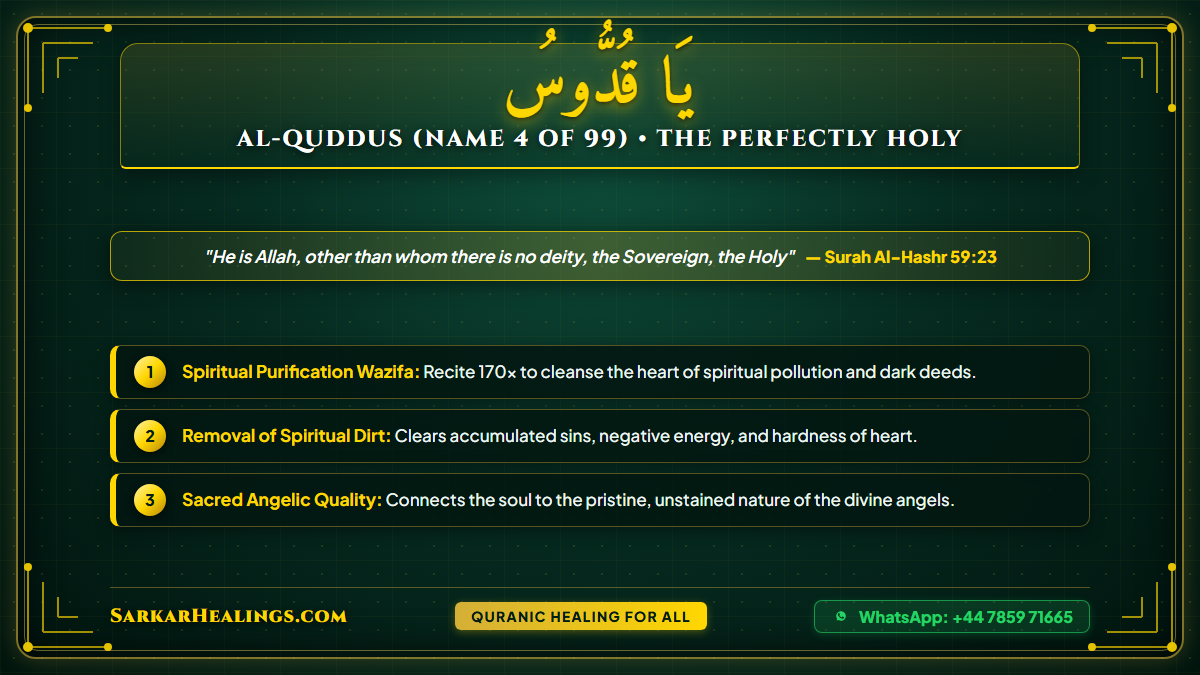
Al-Quddus Meaning & Ya Quddus Benefits (Name 4 of 99)
Sarkar Healings · 99 Names of Allah · Name 4 of 99
الْقُدُّوس
Al-Quddus — The Most Holy, The Most Pure
Al-Quddus Meaning & Ya Quddus Benefits
The Most Holy, The Most Pure — the Name of transcendent purity and sanctity
Al-Quddus (The Most Holy, The Most Pure) is the 4th of the 99 Names. From root ق-د-س (holiness, purity, blessedness), it denotes Allah’s absolute transcendence above every imperfection, deficiency, or partner. It appears verbatim in Quran 59:23 and 62:1 alongside Al-Malik. Invoked for purification of the heart, protection from spiritual impurity, and nearness to the Divine.
Key Facts at a Glance
| Name in Arabic | الْقُدُّوس |
|---|---|
| Transliteration | Al-Quddus (invoked as Ya Quddus) |
| English Meaning | The Most Holy, The Most Pure |
| Position | 4th of the 99 Names (Asma-ul-Husna) |
| Arabic Root | ق-د-س |
| Quran Occurrences | Al-Quddus occurs verbatim twice in the Quran: Surah Al-Hashr 59:23 and Surah Al-Jumu’ah 62:1, in both verses paired with Al-Malik (The King). The root ق-د-س appears additionally in verbal forms (e.g. yuqaddisu in 2:30, 2:34, 20:12, 62:1) and as the noun qudus (e.g. Ruh al-Qudus in 2:87, 2:253, 5:110, 16:102). |
| Invoked For | Heart purification, protection from spiritual impurity, nearness to Allah, healing from waswas, sanctification of deeds |
| Related Names | Al-Malik · As-Salam · Al-Mutakabbir |
Meaning & the Arabic Root
The root ق-د-س (q-d-s) carries the core meanings of holiness, purity, blessedness, and being far removed from all impurity or imperfection. In its verbal form (qaddasa) it means to sanctify, purify, or declare holy — as the angels do when they say nuqaddisu laka (2:30). The noun qudus denotes the quality of absolute purity, and Ruh al-Qudus (the Spirit of Holiness) is a title for Jibril, the purest of created spirits.
Morphologically, Al-Quddus is on the pattern of fa’qul (intensive active participle), indicating a permanent, superlative attribute: the One who is essentially and eternally Most Holy. Unlike At-Tahir (The Pure), which describes a state of being cleansed, Al-Quddus denotes an intrinsic, necessary purity that cannot be acquired or lost — Allah is holy not by purification but by nature.
Al-Quddus is distinguished from Al-Malik (The King) in that sovereignty could theoretically coexist with flaw, but the King of the cosmos is necessarily Al-Quddus — His dominion is untainted by any defect, partner, or need. It is also distinct from As-Salam: Al-Quddus is the source of purity, As-Salam is the giver of soundness to creation.
Al-Quddus in the Quran
Quran
Al-Quddus occurs verbatim twice in the Quran: Surah Al-Hashr 59:23 and Surah Al-Jumu’ah 62:1, in both verses paired with Al-Malik (The King). The root ق-د-س appears additionally in verbal forms (e.g. yuqaddisu in 2:30, 2:34, 20:12, 62:1) and as the noun qudus (e.g. Ruh al-Qudus in 2:87, 2:253, 5:110, 16:102).
Surah Al-Hashr 59:23
Huwa Allahu alladhi la ilaha illa Huwa Al-Maliku Al-Quddusu As-Salamu Al-Mu'minu Al-Muhayminu Al-Azizu Al-Jabbaru Al-Mutakabbiru. Subhana Allahi 'amma yushrikun.
“He is Allah, other than whom there is no deity, the King, the Most Holy, the Source of Peace, the Granter of Security, the Overseer, the Mighty, the Compeller, the Supreme. Exalted is Allah above whatever they associate with Him.”
Surah Al-Hashr 59:23
The climactic verse of Surah Al-Hashr gathers seven Names in sequence. Al-Quddus follows Al-Malik immediately, showing that true sovereignty belongs only to the One utterly free from defect. The tasbih at the end (Subhana Allah) echoes the angels’ declaration of holiness.
Surah Al-Jumu'ah 62:1
Yusabbihu lillahi ma fi as-samawati wa ma fi al-ardi Al-Maliki Al-Quddusi Al-Azizi Al-Hakimi.
“Whatever is in the heavens and whatever is on the earth glorifies Allah, the King, the Most Holy, the Mighty, the Wise.”
Surah Al-Jumu'ah 62:1
The opening of Surah Al-Jumu’ah mirrors 59:23, pairing Al-Malik with Al-Quddus. The universal tasbih (glorification) by all creation is the appropriate response to the One who is Al-Quddus — every creature, by its very existence, declares His purity from any flaw.
Surah Al-Baqarah 2:30
Wa idh qala rabbuka lil-mala'ikati inni ja'ilun fi al-ardi khalifatan. Qalu ataj'alu fiha man yufsidu fiha wa yasfiku ad-dima'a wa nahnu nusabbihu bihamdika wa nuqaddisu lak.
“And when your Lord said to the angels, 'Indeed, I will make upon the earth a successive authority.' They said, 'Will You place upon it one who causes corruption therein and sheds blood, while we glorify You with praise and sanctify You?'”
Surah Al-Baqarah 2:30
The angels’ statement nuqaddisu lak (we sanctify/declare holy for You) uses the verb from the same root. It shows that the highest created beings define their worship as proclaiming Allah’s absolute holiness — a model for the servant invoking Ya Quddus.
The Hadith Foundation of the 99 Names
Hadith — graded
The umbrella hadith of the 99 Names: Narrated by Abu Hurayrah, the Messenger of Allah ﷺ said: “Allah has ninety-nine names, one hundred less one; whoever enumerates them enters Paradise.” Sahih al-Bukhari 2736; Sahih Muslim 2677. The itemised list in Jami’ at-Tirmidhi 3507 is graded weaker by scholars of hadith.
“The angels nearest to Allah say: Subbuhun Quddusun Rabb al-mala’ikati wa’r-Ruh (Most Glorious, Most Holy, Lord of the angels and the Spirit).” Sahih Muslim 483.
This hadith places Quddus on the tongues of the highest angels, linking the invocation Ya Quddus directly to the worship of the muqarrabun.
“The Prophet ﷺ used to say in his bowing and prostration: Subbuhun Quddusun Rabb al-mala’ikati wa’r-Ruh.” Sahih Muslim 487.
Another narration records his supplication: “Allahumma anta al-Quddus, wa baytuka al-Quddus, tabarakta ya Dhal-Jalali wa’l-Ikram” (O Allah, You are Al-Quddus, and Your House is holy, blessed are You, O Possessor of Majesty and Honour). Sahih Muslim 771. These reports root the devotional use of Ya Quddus in the Prophet’s own practice.
Classical Commentary
Classical Scholarship — Sunni / Sufi tradition
Imam al-Ghazali on Al-Quddus (al-Maqsad al-Asna)
Al-Ghazali explains that Quds in the language of the Arabs means tanzih (transcendence) and tabarru’ (freedom from all impurity). Al-Quddus is the One who is munazzah (exalted above) every defect, deficiency, need, or partner. He is pure in His essence, His attributes, and His actions — nothing impure can proceed from Him. Al-Ghazali adds a second dimension: Al-Quddus is also the One who purifies others. He sanctifies the hearts of His servants, cleanses their inward states from the rust of sins and heedlessness, and makes their deeds acceptable. The servant’s share in this Name is to strive for tazkiyat an-nafs (purification of the soul) and to keep the heart as a sanctuary fit for the Divine gaze.
The Akbarian tradition
Ibn Arabi, in his writings on the Divine Names, seek healing fors Al-Quddus as the Name that manifests the ‘ayn al-jam’ (the essence of gathering) — it collects all perfections while negating all imperfections. He associates it with the station of quds (sanctity) where the servant is purified from the attributes of humanity and clothed in the attributes of divinity (khuluq bi-akhlaq Allah). The Ruh al-Qudus (Jibril) is the channel through which this sanctity descends to the prophets and awliya.
Benefits of Reciting Ya Quddus
Within the devotional tradition, the following benefits are associated with the sincere and consistent remembrance of Al-Quddus. Each reflects the meaning of the Name itself.
- Purification of the heart (tazkiyat al-qalb)
Because Al-Quddus is the One who purifies, invoking Ya Quddus is traditionally believed to cleanse the heart from envy, pride, rancour, and the love of dunya, making it a vessel for divine light. - Protection from waswas and spiritual impurity
The Name’s meaning of absolute holiness makes it a refuge from whisperings (waswas), evil thoughts, and the influence of Shayatin — the tradition records its recitation as a shield for the inward. - Sanctification of deeds and intentions
Since Al-Quddus accepts only what is pure, regular invocation is associated with sincerity (ikhlas) and the correction of intentions, so that actions become maqbul (accepted). - Nearness to the angelic worship
The angels declare Subbuhun Quddusun; reciting Ya Quddus aligns the servant with the muqarrabun and is believed to draw angelic company and protection. - Healing from spiritual ailments alongside medical seek healing forment
In the South Asian wazifa manuals, Ya Quddus is recited for healing of ailments rooted in spiritual causes (nazar, jinn affliction, heart hardness), always as a complement to lawful medical care. - Blessing of time, provision, and dwelling
The Prophet’s supplication wa baytuka al-Quddus links the Name to barakah in one’s home, time, and sustenance; the tradition records its recitation for barakah in rizq and family life. - Preparation for death and the grave
Because Al-Quddus is the Pure who purifies, the awliya recommended frequent recitation to die in a state of inward purity, so that the meeting with Allah is upon fitrah.
Traditional Wazifa Practices (with Sources)
Devotional Tradition — South Asian wazifa literature
The following practices are drawn from the South Asian Urdu wazifa manual tradition (e.g. Ism-e-Azam by Alam Faqri) and Sufi silsila practice. They are devotional traditions, not prescribed in the Quran or Sunnah with these specific counts or durations. No outcome is used as a means (sabab); they are undertaken seeking Allah’s grace. Heavy fixed-duration practices (chillas, counts above ~500) are traditionally undertaken with a teacher’s guidance. Recite for healing alongside medical seek healing forment, never as a replacement.
- Quranic–Prophetic tasbih (after every salah)
Recite Subbuhun Quddusun Rabb al-mala’ikati wa’r-Ruh three times after each fard salah, as taught by the Prophet ﷺ (Muslim 487). This grounds the practice in the Sunnah and aligns with the angelic declaration. - Daily wird of 100× Ya Quddus
After Fajr or Isha, with wudu, face the qibla and recite Ya Quddus 100 times, preceded and followed by Salawat. The tradition records this for heart purification and protection from waswas. - Weekly chilla (40 days) of 1,000× Ya Quddus
Recite Ya Quddus 1,000 times daily for 40 consecutive days, with wudu, in a clean place, keeping the tongue moist with Salawat. Traditionally undertaken for deep spiritual cleansing and barakah in one’s home and family. Undertake only with a teacher’s permission. - Dua for sanctification of a place or object
Recite Ya Quddus 70 times over water, oil, or a room, then blow (dm) — a traditional practice for seeking barakah and protection from impurity in dwellings, sickrooms, or before studying/teaching.
Etiquette (Adab) of Reciting Ya Quddus
- Begin with istighfar — seeking forgiveness before presenting the request.
- Praise Allah and send salawat upon the Prophet ﷺ before and after the dhikr.
- Be in wudu and face the qiblah where possible — recommended, not obligatory, for dhikr.
- Ask with certainty — the Prophet ﷺ instructed asking Allah with conviction of response (Jami’ at-Tirmidhi 3479).
- Keep lawful earnings and intentions.
- Consistency over quantity — the most beloved deeds are the most constant, even if small (Sahih al-Bukhari 6464).
- Maintain physical purity (wudu) and inward presence (hudur al-qalb) when invoking Ya Quddus, for the Name demands congruence between the tongue’s declaration and the heart’s state.
Frequently Asked Questions
- What does Al-Quddus mean?
- Al-Quddus means The Most Holy, The Most Pure — the One who is intrinsically and eternally free from every defect, deficiency, partner, or impurity, and who purifies and sanctifies His creation.
- Does Al-Quddus appear in the Quran?
- Yes, verbatim in two verses: Surah Al-Hashr 59:23 and Surah Al-Jumu’ah 62:1, both times paired with Al-Malik. The root ق-د-س also appears in verbal forms (e.g. 2:30) and as Ruh al-Qudus (e.g. 2:87).
- How is Al-Quddus different from Al-Malik or At-Tahir?
- Al-Malik denotes sovereignty; Al-Quddus denotes the purity that makes that sovereignty flawless — the King is necessarily Holy. At-Tahir (The Pure) describes a state of being cleansed; Al-Quddus denotes necessary, essential holiness that cannot be acquired or lost.
- How many times should I recite Ya Quddus?
- The Sunnah tasbih Subbuhun Quddusun is recited 3× after salah. Traditional wirds use 100× daily; chillas may use 1,000× daily for 40 days. There is no fixed number in the Quran or Sunnah — consistency with presence matters more than quantity.
- Can anyone recite Ya Quddus, or is a teacher required?
- Anyone may recite the Sunnah tasbih or a modest daily wird (e.g. 100×) with wudu and reverence. Intensive chillas (high counts, 40 days) are traditionally undertaken with a qualified teacher’s guidance to ensure proper adab and safety.
Obtain a Spiritually Prepared Ya Quddus Taweez
At Sarkar Healings we prepare Taweez and Naqash of Al-Quddus following the etiquette and recitations described in this guide.
Explore Coded Duas & Taweez
WhatsApp Us
Or email: help@sarkarhealings.com
Continue the series: Al-Malik · As-Salam · Al-Mutakabbir · All 99 Names of Allah
Featured Spiritual Remedy
Hand-written using natural Saffron & Rosewater ink under strict ritual purity

Relieve Children's Pain – Coded Dua (Taweez) of Al-Quddus
Authentic hand-written Quranic Coded Dua prepared under ritual purity.
£249
This is a traditional practice, not a substitute for medical treatment, legal advice, or professional care. Scholars differ on some of these practices; where they differ, that difference is noted. Benefit and outcome are from Allah alone. If you are facing a medical, psychological, or financial emergency, seek qualified professional help first.
Coded Duas based on Al-Quddus
Need Personal Guidance on This?
Get a confidential, free consultation with our spiritual advisor — usually replied within hours.
Complete healing path: The Complete Quran Coded Dua — all 114 Surahs & Asma-ul-Husna in one hand-written taweez.
This content and its associated Quranic recitations are offered strictly as a spiritual means (asbab) seeking Allah's guidance, protection, and barakah. Sarkar Healings does not guarantee magical outcomes or instant cures. Spiritual remedies are to be used alongside lawful personal effort and professional medical, legal, or financial advice.