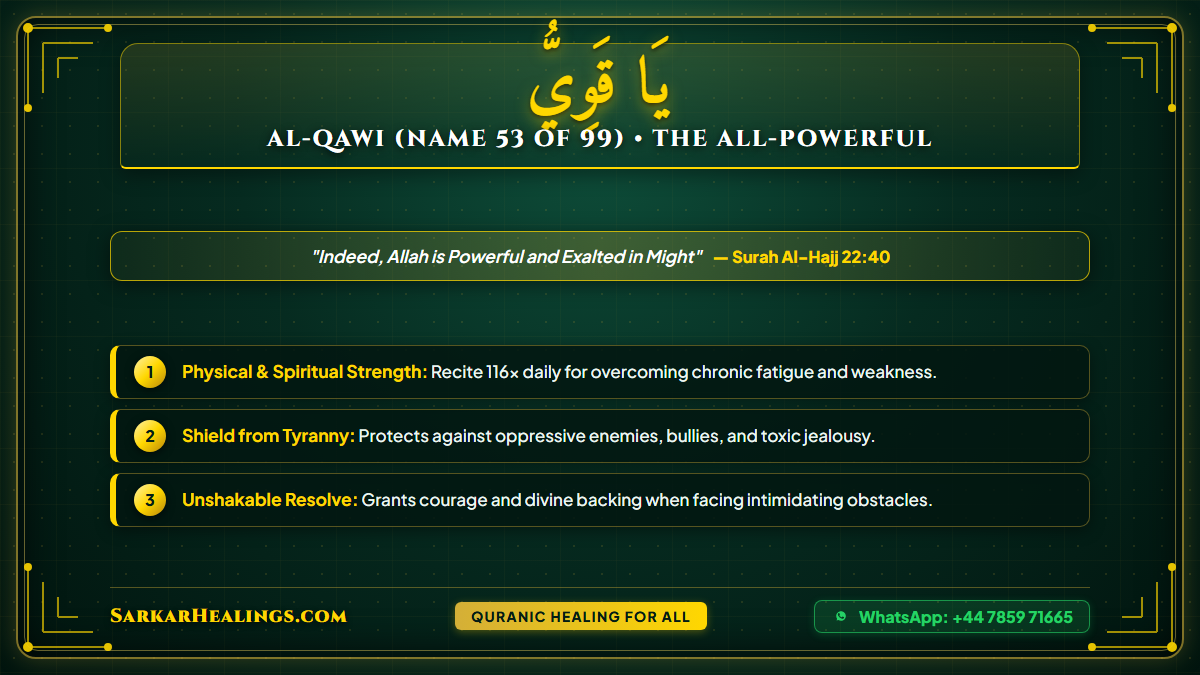
Al-Qawi Meaning & Ya Qawiyyu Benefits (Name 53 of 99)
Sarkar Healings · 99 Names of Allah · Name 53 of 99
الْقَوِيّ
Al-Qawi — The Most Strong
Al-Qawi Meaning & Ya Qawiyyu Benefits
The One whose strength is intrinsic, infinite, and in no need of means.
Al-Qawi (The Most Strong) is the 53rd Name. Its root ق-و-ي denotes strength, power, and firmness. The Quran uses Qawiyyun for Allah in 22:40 and 58:21. Invoked for inner fortitude, overcoming oppression, and trust in divine power.
Key Facts at a Glance
| Name in Arabic | الْقَوِيّ |
|---|---|
| Transliteration | Al-Qawi (invoked as Ya Qawiyyu) |
| English Meaning | The Most Strong |
| Position | 53rd of the 99 Names (Asma-ul-Husna) |
| Arabic Root | ق-و-ي |
| Quran Occurrences | The exact form الْقَوِيّ (Al-Qawi) with the definite article does not appear verbatim in the Quran. The predicate قَوِيٌّ (Qawiyyun, ‘Strong’) is affirmed of Allah in two verses: Surah Al-Hajj 22:40 and Surah Al-Mujadila 58:21. The root ق-و-ي occurs over 100 times in various forms. |
| Invoked For | inner strength, overcoming adversity, victory over oppression, firmness in faith, protection from harm |
| Related Names | Al-Matin · Al-Aziz · Al-Qadir |
Meaning & the Arabic Root
The root ق-و-ي (q-w-y) conveys strength, vigour, and the capacity to prevail. Morphologically, Qawi is the active participle (ism al-fa’il) on the pattern fa’il, indicating the One who possesses strength as an essential, permanent attribute — not acquired, not borrowed, and not diminishing.
Classical lexicons (Lisan al-Arab, Taj al-Arus) distinguish quwwah as the firmness of a thing’s constitution. When predicated of Allah, it means He is the source of all strength; every created power is a borrowed ray of His. This distinguishes Al-Qawi from Al-Qadir (Powerful): Qadir emphasises the scope of divine power (nothing escapes it), while Qawi emphasises its intensity and self-sufficiency.
Al-Qawi also differs from Al-Jabbar (The Compeller): Jabbar implies the exercise of power to set things right or overwhelm; Qawi is the attribute of strength itself, whether manifested or not. And unlike Al-Matin (The Firm), which stresses unshakeable stability, Qawi stresses active, prevailing force.
Al-Qawi in the Quran
Quran
The exact form الْقَوِيّ (Al-Qawi) with the definite article does not appear verbatim in the Quran. The predicate قَوِيٌّ (Qawiyyun, ‘Strong’) is affirmed of Allah in two verses: Surah Al-Hajj 22:40 and Surah Al-Mujadila 58:21. The root ق-و-ي occurs over 100 times in various forms.
Surah Al-Hajj 22:40
Wa layansuranna Allahu man yansuruhu; inna Allaha la-Qawiyyun Azizun
“And Allah will surely support those who support Him. Indeed, Allah is Qawiyy (Strong), Aziz (Mighty).”
Surah Al-Hajj 22:40
Revealed permitting defensive jihad; the verse ties divine support to the believers’ sincerity, grounding the promise in Allah’s intrinsic strength (Qawiyy) and invincible honour (Aziz).
Surah Al-Mujadila 58:21
Kataba Allahu la-aghlibanna ana wa rusuli; inna Allaha Qawiyyun Azizun
“Allah has written, 'I will surely prevail, I and My messengers.' Indeed, Allah is Qawiyy, Aziz.”
Surah Al-Mujadila 58:21
A decisive promise of ultimate victory for the divine cause; the Name Qawiyy here underscores that the outcome rests on Allah’s overwhelming strength, not human numbers or weapons.
The Hadith Foundation of the 99 Names
Hadith — graded
The Messenger of Allah ﷺ said: “Allah has ninety-nine names, one hundred less one; whoever enumerates them enters Paradise.” (Sahih al-Bukhari 2736; Sahih Muslim 2677)
Al-Qawi is included in the itemised list narrated by Abu Hurayrah in Jami’ at-Tirmidhi 3507. Scholars such as Ibn Hajar and Al-Albani grade this specific list as da’if (weak) due to its isnad, though the Names themselves are established by the Quran and the authentic umbrella hadith above. No additional sahih hadith singling out Al-Qawi by its invocation form is established.
Classical Commentary
Classical Scholarship — Sunni / Sufi tradition
Imam al-Ghazali on Al-Qawi (al-Maqsad al-Asna)
Ghazali explains that strength (quwwah) in created beings is accidental — it comes and goes, depends on health, food, and will. In Allah, strength is essential (dhati): He is strong in His Essence, and His strength is identical with His Essence. Nothing can weaken Him, and no resistance can exhaust Him. He creates strength in whom He wills and withdraws it from whom He wills. The servant’s realisation of Al-Qawi seek healing fors the heart of fearing created powers and instils tawakkul grounded in the Strong One.
The Akbarian Tradition
Ibn Arabi and his school seek healing for Al-Qawi as the Name that manifests in the cosmic pillar (al-imad) upholding the heavens and earth without visible supports. In his writings on the Divine Names, he associates it with the spiritual station of thabat (steadfastness) and the unveiling of divine power in the heart of the wali who relies solely on Allah.
Benefits of Reciting Ya Qawiyyu
Within the devotional tradition, the following benefits are associated with the sincere and consistent remembrance of Al-Qawi. Each reflects the meaning of the Name itself.
- Fortitude in trials
Because Al-Qawi is the source of all strength, invoking Him is believed to grant the heart steadfastness when facing calamity, illness, or oppression. - Victory over injustice
The Quranic pairing of Qawiyy with the promise of divine support (22:40, 58:21) makes this Name a traditional refuge for those seeking relief from tyranny. - Inner resilience (sabr)
Recitation nurtures the conviction that human endurance is a reflection of the Divine Attribute, helping one bear burdens without despair. - Physical vitality
In the South Asian wazifa tradition, Ya Qawiyyu is recited for bodily strength and recovery from debilitating weakness, always alongside medical care. - Breaking harmful habits
The Name’s connotation of prevailing force is invoked to overcome addictions or persistent sins, asking the Strong One to strengthen the will. - Protection for the vulnerable
Recited on behalf of children, the elderly, or travellers, calling on the One whose strength encompasses all creation. - Spiritual authority (wilayah)
Sufi manuals associate frequent invocation with the unfolding of quwwat al-qalb — strength of heart — a mark of the Friends of Allah.
Traditional Wazifa Practices (with Sources)
Devotional Tradition — South Asian wazifa literature
The following practices are drawn from the South Asian Urdu wazifa manual genre (e.g. Ism-e-Azam by Alam Faqri) and Sufi silsila traditions. They are devotional customs, not prophetic prescriptions. No specific outcome is used as a means (sabab); they are offered as means of drawing near to Al-Qawi. Heavy or fixed-duration practices (chillas, counts above 500) are traditionally undertaken with a qualified teacher’s guidance. All healing benefits are understood as sought alongside, never in place of, professional medical seek healing forment.
- Quranic-dua anchor (daily)
After Fajr and Maghrib, recite Surah Al-Hajj 22:40 and Surah Al-Mujadila 58:21 once each, then say: Ya Qawiyyu, Ya Aziz — strengthen my heart and grant me victory over what overwhelms me. 3–7 times. This roots the practice in the very verses where the Name appears. - Daily wird for resilience
Recite Ya Qawiyyu 100 times after any obligatory prayer, with hand on the chest, asking for inner strength and steadfastness in din and dunya. A common light practice in many khanqahs. - Focused need (300–500)
For a specific difficulty — illness, legal dispute, fear of an oppressor — recite Ya Qawiyyu 300 times after Isha, preceded and followed by Salawat (3x). Continue for 7, 11, or 21 days. Believed to invite divine intervention through the Name’s meaning of prevailing power. - Chilla for deep spiritual strength (11,000)
A 40-day reseek healing for-style practice: 11,000 repetitions daily (often divided across the day), with strict fasting from sin, reduced speech, and teacher supervision. Undertaken only with a shaykh’s permission for aspirants seeking the station of quwwat al-qalb.
Etiquette (Adab) of Reciting Ya Qawiyyu
- Begin with istighfar — seeking forgiveness before presenting the request.
- Praise Allah and send salawat upon the Prophet ﷺ before and after the dhikr.
- Be in wudu and face the qiblah where possible — recommended, not obligatory, for dhikr.
- Ask with certainty — the Prophet ﷺ instructed asking Allah with conviction of response (Jami’ at-Tirmidhi 3479).
- Keep lawful earnings and intentions.
- Consistency over quantity — the most beloved deeds are the most constant, even if small (Sahih al-Bukhari 6464).
- Recite with the awareness that true strength belongs to Allah alone, and never use this invocation to oppress others or justify arrogance.
Frequently Asked Questions
- What does Al-Qawi mean?
- Al-Qawi means The Most Strong — the One whose strength is essential, infinite, and independent of any means. It derives from the root ق-و-ي (q-w-y), denoting vigour, firmness, and the power to prevail.
- Does Al-Qawi appear in the Quran?
- The exact form Al-Qawi (with Al-) does not appear verbatim. However, the predicate Qawiyyun (Strong) is explicitly affirmed of Allah in Surah Al-Hajj 22:40 and Surah Al-Mujadila 58:21, both paired with Aziz.
- How is Al-Qawi different from Al-Qadir and Al-Matin?
- Al-Qadir denotes the scope of divine power (ability to do all things). Al-Matin denotes unshakeable firmness. Al-Qawi denotes the intensity and self-sufficiency of divine strength itself — the attribute of prevailing force.
- How many times should I recite Ya Qawiyyu for a specific need?
- Traditional manuals suggest 100–300 times daily for general resilience, and 300–500 times for focused needs over 7–21 days. Larger counts (e.g. 11,000 in a chilla) require a teacher’s guidance. There is no fixed prophetic number.
- Can anyone recite Ya Qawiyyu, or are there restrictions?
- Any Muslim — male or female, scholar or layperson — may recite this Name. No ritual purity (wudu) is legally required for dhikr, though it is recommended. The only restriction is the heart’s intention: it must be for Allah alone, never to harm others.
Obtain a Spiritually Prepared Ya Qawiyyu Taweez
At Sarkar Healings we prepare Taweez and Naqash of Al-Qawi following the etiquette and recitations described in this guide.
Explore Coded Duas & Taweez
WhatsApp Us
Or email: help@sarkarhealings.com
Continue the series: Al-Matin · Al-Aziz · Al-Qadir · All 99 Names of Allah
This is a traditional practice, not a substitute for medical treatment, legal advice, or professional care. Scholars differ on some of these practices; where they differ, that difference is noted. Benefit and outcome are from Allah alone. If you are facing a medical, psychological, or financial emergency, seek qualified professional help first.
Coded Duas based on Al-Qawiyy

Need Personal Guidance on This?
Get a confidential, free consultation with our spiritual advisor — usually replied within hours.
Complete healing path: The Complete Quran Coded Dua — all 114 Surahs & Asma-ul-Husna in one hand-written taweez.
This content and its associated Quranic recitations are offered strictly as a spiritual means (asbab) seeking Allah's guidance, protection, and barakah. Sarkar Healings does not guarantee magical outcomes or instant cures. Spiritual remedies are to be used alongside lawful personal effort and professional medical, legal, or financial advice.