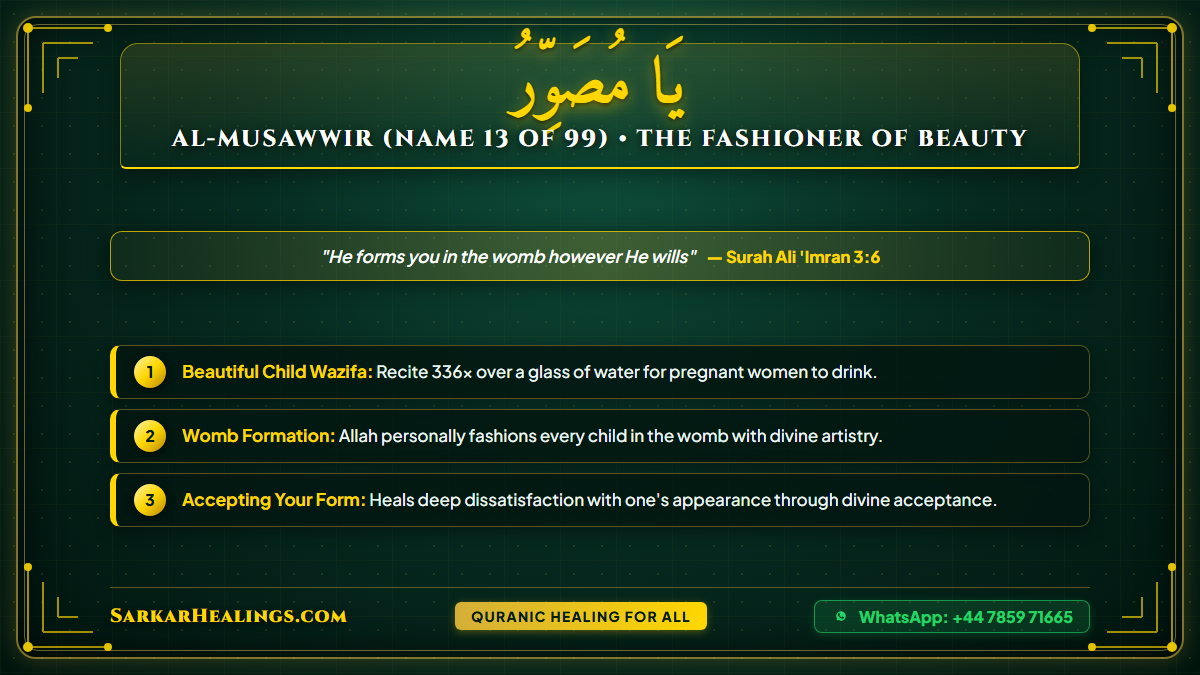
Al-Musawwir Meaning & Ya Musawwir Benefits (Name 13 of 99)
Sarkar Healings · 99 Names of Allah · Name 13 of 99
الْمُصَوِّر
Al-Musawwir — The Fashioner of Forms
Al-Musawwir Meaning & Ya Musawwir Benefits
The Fashioner of Forms — Ya Musawwir
Al-Musawwir (The Fashioner of Forms) is the 13th of the 99 Names. From root ṣ-w-r (to shape, form). Appears verbatim in Quran 59:24 alongside Al-Khaliq and Al-Bari’. Invoked for beautiful children, healing of physical deformities, creative inspiration, and spiritual beautification. Classical scholars distinguish it as the Bestower of unique, perfected forms upon creation.
Key Facts at a Glance
| Name in Arabic | الْمُصَوِّر |
|---|---|
| Transliteration | Al-Musawwir (invoked as Ya Musawwir) |
| English Meaning | The Fashioner of Forms |
| Position | 13th of the 99 Names (Asma-ul-Husna) |
| Arabic Root | ص-و-ر |
| Quran Occurrences | The Name Al-Musawwir appears verbatim once in the Quran, in Surah al-Hashr 59:24: ‘He is Allah, the Creator, the Originator, the Fashioner (Al-Musawwir).’ The root ṣ-w-r occurs as a verb (e.g., yuṣawwirukum, ṣawwarakum) in 3:6, 40:64, 64:3 describing Allah’s fashioning of humans in the womb. |
| Invoked For | beautiful children, healing physical deformities, creative inspiration, spiritual beautification, protection from evil eye |
| Related Names | Al-Khaliq · Al-Bari' · Al-Mubdi' |
Meaning & the Arabic Root
The root ṣ-w-r (ص-و-ر) carries the core meanings of forming, shaping, picturing, and giving a thing its distinctive configuration. The pattern muṣawwir (مُصَوِّر) is the intensive active participle of Form II, denoting one who fashions repeatedly, intricately, and with perfection.
Classical lexicons (e.g., Lisan al-Arab, Taj al-Arus) explain that taṣwīr is the bringing forth of a thing in a specific, measured form after its origination. Thus Al-Musawwir is the One who gives every created being its unique shape, proportion, and inward/outward design — from the galaxies to the fingerprint.
Distinction from the creative triad in 59:24: Al-Khaliq creates from non-existence; Al-Bari’ originates and separates distinct species with innate natures; Al-Musawwir perfects each individual with its particular form, features, and capacities. The three Names describe sequential aspects of a single divine act, not separate agents.
Al-Musawwir in the Quran
Quran
The Name Al-Musawwir appears verbatim once in the Quran, in Surah al-Hashr 59:24: ‘He is Allah, the Creator, the Originator, the Fashioner (Al-Musawwir).’ The root ṣ-w-r occurs as a verb (e.g., yuṣawwirukum, ṣawwarakum) in 3:6, 40:64, 64:3 describing Allah’s fashioning of humans in the womb.
Surah al-Hashr 59:24
Huwa Allāhu al-Khāliqu al-Bāri'u al-Muṣawwiru, lahu al-asmā'u al-ḥusnā yusabbiḥu lahu mā fī as-samāwāti wal-arḍi wa huwa al-ʿAzīzu al-Ḥakīm
“He is Allah, the Creator, the Originator, the Fashioner; to Him belong the Most Beautiful Names. Whatever is in the heavens and earth glorifies Him, and He is the Exalted in Might, the Wise.”
Surah al-Hashr 59:24
The sole verse where Al-Musawwir appears as a Divine Name, sealing the creative triad. The immediate mention of al-Asma’ al-Husna (the Most Beautiful Names) invites the believer to call upon Allah by this Name when seeking perfection of form — physical, moral, or spiritual.
Surah Ali 'Imran 3:6
Huwa alladhī yuṣawwirukum fī al-arḥāmi kayfa yashā'u lā ilāha illā huwa al-ʿAzīzu al-Ḥakīm
“It is He who fashions you in the wombs however He wills. There is no deity except Him, the Exalted in Might, the Wise.”
Surah Ali 'Imran 3:6
The verb yuṣawwirukum (He fashions you) shows the ongoing, intimate act of Al-Musawwir in every human gestation. Reciting this verse alongside the Name is a Qur’anic dua for healthy fetal development and gratitude for one’s own form.
Surah Ghafir 40:64
Allāhu alladhī jaʿala lakumu al-arḍa qarāran wa as-samā'a binā'an wa ṣawwarakum fa-aḥsana ṣuwarakum wa razaqakum min aṭ-ṭayyibāt
“Allah — He made for you the earth a settlement and the sky a structure, and He fashioned you and perfected your forms, and provided you with good things.”
Surah Ghafir 40:64
The verb ṣawwarakum followed by fa-aḥsana ṣuwarakum (and perfected your forms) highlights the attribute of excellence (iḥsān) inherent in Al-Musawwir’s fashioning. A powerful verse to recite when asking for physical healing or beauty of character.
The Hadith Foundation of the 99 Names
Hadith — graded
The foundational hadith for all 99 Names is narrated by Abu Hurayrah: “Allah has ninety-nine Names, one hundred less one; whoever enumerates them enters Paradise.” (Sahih al-Bukhari 2736; Sahih Muslim 2677). This hadith establishes the virtue of learning, reflecting upon, and invoking Allah by each Name, including Al-Musawwir.
“The Messenger of Allah (ﷺ) said: ‘Allah has ninety-nine Names, one hundred less one; whoever aḥṣāhā (enumerates/preserves/acts by them) enters Paradise.’”
A version recorded in Jami’ at-Tirmidhi 3507 lists the Names explicitly, including Al-Musawwir, but scholars such as Ibn al-Qayyim and al-Albani grade the itemised list itself as da’if (weak) even though the hadith’s core promise is authentic. Therefore we rely on the Bukhari/Muslim wording for the general virtue, and seek healing for the specific list as a pedagogical tradition rather than a verbatim prophetic enumeration.
No sahih hadith singles out Al-Musawwir for a specific worldly reward (e.g., “whoever recites it X times receives Y”). Any such counts belong to the later devotional tradition, not to the prophetic sunnah.
Classical Commentary
Classical Scholarship — Sunni / Sufi tradition
Imam al-Ghazali (al-Maqsad al-Asna)
Al-Ghazali explains that al-Musawwir is the One who gives each thing its ṣūra (form) — the specific arrangement of parts that makes it what it is. He distinguishes three levels: (1) the outward bodily form, (2) the inward faculties (intellect, imagination, desire), and (3) the spiritual form — the heart’s capacity to reflect divine attributes. The perfection of a thing’s form is its readiness to fulfil its created purpose. Thus calling upon Al-Musawwir is asking Allah to perfect one’s form — physical, psychological, and spiritual — for His service.
Ibn Arabi / Akbarian Tradition
In the writings on the Divine Names, Ibn Arabi associates Al-Musawwir with the ḥaqīqa Muḥammadiyya — the archetypal form in which all perfections are gathered. He teaches that the universe is a maṣnaʿ (workshop) of forms constantly renewed by Al-Musawwir, and the gnostic (ʿarif) witnesses this renewal in every moment, seeing no form as static but as a fresh bestowal of the Fashioner.
Benefits of Reciting Ya Musawwir
Within the devotional tradition, the following benefits are associated with the sincere and consistent remembrance of Al-Musawwir. Each reflects the meaning of the Name itself.
- Beautiful and healthy children
Because Al-Musawwir fashions the fetus in the womb (Quran 3:6), the tradition records reciting this Name abundantly during pregnancy and for those seeking righteous offspring, believing it draws the Fashioner’s care to the forming child. - Healing of physical deformities and skin conditions
The Name’s meaning — the Perfecter of forms — is invoked alongside medical seek healing forment for congenital issues, burns, scars, and dermatological ailments, asking the Fashioner to restore the intended harmony of the body’s form. - Creative and artistic inspiration
Artisans, calligraphers, architects, and writers recite Ya Musawwir to seek the divine spark of taṣwīr, trusting that the Source of all forms can unlock beauty and proportion in human craftsmanship. - Spiritual beautification of character
Just as Al-Musawwir perfects the outer form, the tradition holds that sincere invocation perfects the inner ṣūra — replacing ugly traits (envy, pride) with beautiful ones (generosity, humility) through the Fashioner’s subtle reshaping of the heart. - Protection from the evil eye and envy
Since the evil eye targets the beauty of form, the practice of reciting Al-Musawwir (often with Al-Khaliq and Al-Bari’) is believed to place one’s form under the Fashioner’s guardianship, neutralizing envious glances. - Ease in difficult transitions (puberty, aging, illness)
The Fashioner who shaped each life-stage is asked to make the reshaping of the body and psyche during major transitions smooth and dignified, trusting that every new form He fashions carries wisdom. - Gratitude for one's unique design
Regular remembrance of Al-Musawwir cultivates contentment with one’s God-given appearance and abilities, countering body dysmorphia and comparison by affirming that each form is a deliberate, wise artistry.
Traditional Wazifa Practices (with Sources)
Devotional Tradition — South Asian wazifa literature
The following practices are drawn from the South Asian Urdu wazifa manual genre (e.g., Ism-e-Azam by Alam Faqri) and Sufi silsila traditions. They are devotional customs, not prophetic prescriptions; no specific count or duration is authenticated from the Messenger ﷺ. Benefits are believed to flow from the Name’s meaning and the sincerity of the reciter, not from mechanical repetition. Heavy fixed-duration practices (chillas, counts above ~500) are traditionally undertaken with a qualified teacher’s guidance. Recite for healing alongside medical seek healing forment, never as a replacement.
- Qur'anic Dua Practice (after each salah)
Recite Surah al-Hashr 59:24 once, then say: Ya Khaliq, Ya Bari’, Ya Musawwir — aḥsin ṣūrati wa ṣūrat dhurrīyyatī (O Creator, O Originator, O Fashioner, perfect my form and the form of my offspring). This anchors the wazifa directly in the Quranic text where the Name appears. - Daily軸 (100× after Fajr)
Recite Ya Musawwir 100 times after Fajr prayer with hand placed gently on the area of concern (womb for pregnancy, skin for dermatological issues, heart for character). Consistency over 40 days is the common traditional recommendation. - Creative Block Relief (313× before work)
Before beginning artistic, architectural, or writing work, perform wudu, pray two rak’at nafl, then recite Ya Musawwir 313 times asking for clarity of form and proportion. The number 313 echoes the Badr tradition but holds no specific hadith basis for this Name. - Chilla for Deep Transformation (1000× daily for 40 days)
A rigorous practice: 1000× Ya Musawwir daily (split across tahajjud, post-Fajr, post-Asr) for 40 consecutive days, with fasting on Mondays/Thursdays if able. Traditionally done only under a shaykh’s supervision for profound physical or spiritual reshaping needs.
Etiquette (Adab) of Reciting Ya Musawwir
- Begin with istighfar — seeking forgiveness before presenting the request.
- Praise Allah and send salawat upon the Prophet ﷺ before and after the dhikr.
- Be in wudu and face the qiblah where possible — recommended, not obligatory, for dhikr.
- Ask with certainty — the Prophet ﷺ instructed asking Allah with conviction of response (Jami’ at-Tirmidhi 3479).
- Keep lawful earnings and intentions.
- Consistency over quantity — the most beloved deeds are the most constant, even if small (Sahih al-Bukhari 6464).
- When invoking Al-Musawwir, glance at your own hand or a flower and reflect: the same Fashioner who perfected this microcosm is reshaping your concern — this cultivates yaqīn (certainty) in the invocation.
Frequently Asked Questions
- What does Al-Musawwir mean?
- Al-Musawwir means The Fashioner of Forms — the One who gives every created thing its unique, measured, and perfect shape, from the cosmic to the microscopic. It is the intensive active participle of the root ṣ-w-r (to form, picture, fashion).
- Does Al-Musawwir appear in the Quran?
- Yes, verbatim once: Surah al-Hashr 59:24 — ‘He is Allah, the Creator, the Originator, the Fashioner (Al-Musawwir).’ The root appears as a verb describing Allah’s fashioning of humans in the womb in 3:6, 40:64, and 64:3.
- How is Al-Musawwir different from Al-Khaliq and Al-Bari'?
- Al-Khaliq creates from nothing; Al-Bari’ originates distinct species with innate natures; Al-Musawwir perfects each individual with its specific form, features, and capacities. The three Names in 59:24 describe sequential aspects of a single divine creative act.
- How many times should I recite Ya Musawwir for a specific need?
- No prophetic hadith specifies a count. Traditional manuals mention 100× daily for general barakah, 313× for creative needs, and 1000× daily for 40 days (chilla) for deep transformation — the latter only with a teacher’s guidance. Consistency and sincerity matter more than numbers.
- Can anyone recite Ya Musawwir, or are there restrictions?
- Any Muslim — male, female, young, old, in any state of purity — may recite this Name. There are no ritual restrictions. For wazifa involving high counts or chilla, traditional etiquette recommends seeking a knowledgeable mentor to ensure correct adab and avoid spiritual imbalance.
Obtain a Spiritually Prepared Ya Musawwir Taweez
At Sarkar Healings we prepare Taweez and Naqash of Al-Musawwir following the etiquette and recitations described in this guide.
Explore Coded Duas & Taweez
WhatsApp Us
Or email: help@sarkarhealings.com
Continue the series: Al-Khaliq · Al-Bari' · Al-Mubdi' · All 99 Names of Allah
Obtain the Spiritually Prepared Al
At Sarkar Healings we prepare this taweez and coded dua following the Qur’an and Sunnah described in this guide, with the correct intention and adab.
Or email: help@sarkarhealings.com
This is a traditional practice, not a substitute for medical treatment, legal advice, or professional care. Scholars differ on some of these practices; where they differ, that difference is noted. Benefit and outcome are from Allah alone. If you are facing a medical, psychological, or financial emergency, seek qualified professional help first.
Coded Duas based on Al-Musawwir

Need Personal Guidance on This?
Get a confidential, free consultation with our spiritual advisor — usually replied within hours.
Complete healing path: The Complete Quran Coded Dua — all 114 Surahs & Asma-ul-Husna in one hand-written taweez.
This content and its associated Quranic recitations are offered strictly as a spiritual means (asbab) seeking Allah's guidance, protection, and barakah. Sarkar Healings does not guarantee magical outcomes or instant cures. Spiritual remedies are to be used alongside lawful personal effort and professional medical, legal, or financial advice.