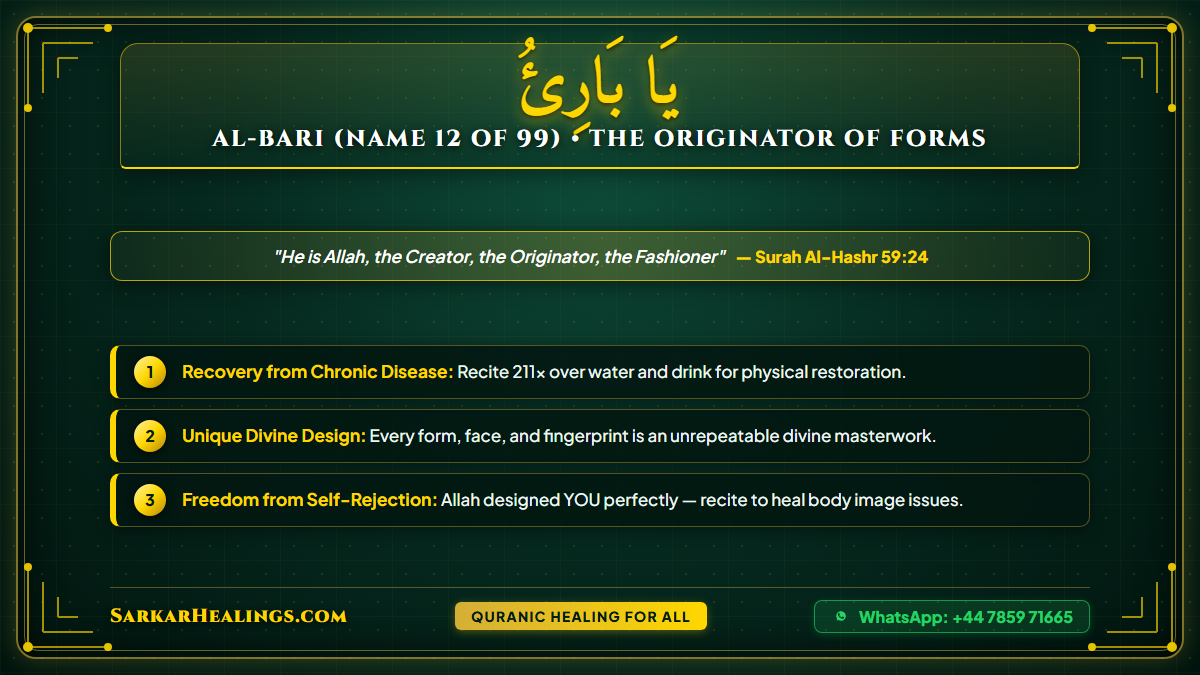
Al-Bari Meaning & Ya Bari Benefits (Name 12 of 99)
Sarkar Healings · 99 Names of Allah · Name 12 of 99
الْبَارِئ
Al-Bari — The Evolver, The Maker
Al-Bari Meaning & Ya Bari Benefits
The One who brings creation into balanced, measured existence
Al-Bari (الْبَارِئ) is the 12th of the 99 Names, from root ب-ر-أ (to create, evolve, free from fault). It appears verbatim in Quran 59:24 alongside al-Khaliq and al-Musawwir. Invoked for healing, creative solutions, and restoring order to chaos.
Key Facts at a Glance
| Name in Arabic | الْبَارِئ |
|---|---|
| Transliteration | Al-Bari (invoked as Ya Bari) |
| English Meaning | The Evolver, The Maker |
| Position | 12th of the 99 Names (Asma-ul-Husna) |
| Arabic Root | ب-ر-أ |
| Quran Occurrences | The Name Al-Bari’ appears verbatim once in the Quran: Surah al-Hashr 59:24 (Huwa Allahu al-Khaliqu al-Bari’u al-Musawwir). The root ب-ر-أ occurs in verbal forms (e.g., bara’akum, yabri’u) in several verses including 6:94, 50:11, and 67:2, denoting creation, origination, and being free from defect. |
| Invoked For | healing, creative breakthroughs, removing obstacles, pregnancy & childbirth, restoring balance |
| Related Names | Al-Khaliq · Al-Musawwir · Al-Mubdi |
Meaning & the Arabic Root
The root ب-ر-أ (b-r-ʾ) carries the senses of creating, bringing into being, evolving, and being free from fault or blemish. The form Bāri’ (active participle on the pattern fāʿil) means “the One who evolves, proportionates, and brings forth creation in a measured, faultless manner.”
Al-Khaliq is the Creator who calls existence from non-existence; Al-Bari’ is the Evolver who takes that raw existence and orders it — assigning proportions, functions, and innate soundness. The Name implies not just making, but making well: every creature is ‘barī’ (free from defect) in its original constitution.
Classical lexicons (Tāj al-ʿArūs, Lisān al-ʿArab) note that al-bar’ also means healing/curing (as in bari’a min al-marad — “he recovered from illness”), linking the Name to restoration of health and wholeness.
Al-Bari in the Quran
Quran
The Name Al-Bari’ appears verbatim once in the Quran: Surah al-Hashr 59:24 (Huwa Allahu al-Khaliqu al-Bari’u al-Musawwir). The root ب-ر-أ occurs in verbal forms (e.g., bara’akum, yabri’u) in several verses including 6:94, 50:11, and 67:2, denoting creation, origination, and being free from defect.
Surah al-Hashr 59:23-24
Huwa Allāhu alladhī lā ilāha illā Huwa al-Maliku al-Quddūsu as-Salāmu al-Mu'minu al-Muhayminu al-ʿAzīzu al-Jabbāru al-Mutakabbiru. Subḥāna Allāhi ʿammā yushrikūn. Huwa Allāhu al-Khāliqu al-Bāri'u al-Muṣawwiru. Lahū al-asmā'u al-ḥusnā. Yusabbiḥu lahu mā fi as-samāwāti wa al-arḍi wa Huwa al-ʿAzīzu al-Ḥakīm.
“He is Allah, besides Whom there is no deity, the Sovereign, the Pure, the Peace, the Bestower of Faith, the Overseer, the Exalted in Might, the Compeller, the Superior. Exalted is Allah above what they associate with Him. He is Allah, the Creator, the Evolver, the Fashioner. To Him belong the Best Names. Whatever is in the heavens and earth exalts Him. And He is the Exalted in Might, the Wise.”
Surah al-Hashr 59:23-24
This is the sole verse where Al-Bari’ appears as a Divine Name. It sits in a triad: al-Khāliq (originating), al-Bāri’ (proportioning/evolving), al-Muṣawwir (giving distinct form). The immediate context declares that all creation does tasbīḥ — each entity fulfills its evolved, proportioned purpose.
Surah at-Tin 95:4
Laqad khalaqnā al-insāna fī aḥsani Taqwīm.
“We have certainly created man in the best of stature/proportion.”
Surah at-Tin 95:4
Though the Name Al-Bari’ is not used here, the root concept of taqwīm (proportioning, shaping soundly) reflects the Bari’ attribute — every human enters existence in a state of innate balance and faultlessness.
The Hadith Foundation of the 99 Names
Hadith — graded
Sahih al-Bukhari 2736 / Sahih Muslim 2677 — Abu Hurayrah reported: The Messenger of Allah ﷺ said: “Allah has ninety-nine names, one hundred less one; whoever enumerates them (aḥṣāhā) enters Paradise.”
The version in Jami’ at-Tirmidhi 3507 appends an itemised list of the ninety-nine names including Al-Bari’. Scholars (al-Nawawi, Ibn Hajar, al-Albani) grade this appended list as ḍaʿīf (weak) in its chain, though the principle of the ninety-nine names is mutawātir via the two Sahihs.
No sahih hadith singles out Al-Bari’ for a specific virtue or duʿā’ formula. The general encouragement to call upon Allah by His Beautiful Names (Quran 7:180) applies.
Classical Commentary
Classical Scholarship — Sunni / Sufi tradition
Imam al-Ghazali (al-Maqṣad al-Asnā)
Al-Ghazali distinguishes Al-Bari’ from Al-Khaliq: the latter brings the entity into existence; the former ‘arranges its constitution, proportions its limbs, and ordains its faculties so that it is free from defect.’ He writes that Al-Bari’ is the One who ‘creates things with measure (qadar) and wisdom (ḥikma), each in its due proportion.’ The servant’s portion is to recognise the divine measure in every circumstance — illness, provision, trial — and to refrain from objecting to the Wise Evolver.
Ibn Arabi (Akbarian tradition)
In his writings on the Divine Names, Ibn Arabi associates Al-Bari’ with the ‘Breath of the All-Merciful’ (Nafas al-Raḥmān) through which entities are particularised and proportioned. He links the Name to the realm of al-aʿyān al-thābita (the immutable archetypes), where each thing’s perfect form resides before temporal manifestation. The spiritual realisation is to see every created form as a disclosure of Al-Bari”s faultless proportioning.
Benefits of Reciting Ya Bari
Within the devotional tradition, the following benefits are associated with the sincere and consistent remembrance of Al-Bari. Each reflects the meaning of the Name itself.
- Restoring physical health
Because the root implies ‘healing’ (bari’a min al-maraḍ), the Name is traditionally recited for recovery alongside medical seek healing forment, asking the Faultless Evolver to restore the body’s innate proportion. - Creative breakthroughs and problem-solving
Al-Bari’ brings ordered solutions from chaos; seekers recite it when facing tangled affairs, trusting the One who proportions all matters to unfold a balanced way forward. - Pregnancy, childbirth, and infant health
The Name’s connection to measured embryonic development (taqwīm) makes it a traditional companion for expectant mothers, recited for a sound constitution and safe delivery. - Removing inner defects and bad habits
Since Al-Bari’ creates ‘free from fault’, the Name is invoked in tazkiyah to ask Allah to excise spiritual blemishes and re-proportion the heart toward soundness. - Harmonising relationships and environments
Just as Al-Bari’ proportions the cosmos, recitation is believed to bring balance to disordered homes, workplaces, or communities. - Strengthening trust in divine decree (tawakkul)
Meditating on Al-Bari’ cultivates acceptance that every situation — even apparent disorder — falls within a wise, measured unfolding. - Artistic and vocational excellence
Craftsmen and artists traditionally invoke Al-Bari’ to imbue their work with sound proportion and freedom from flaw, mirroring the divine attribute.
Traditional Wazifa Practices (with Sources)
Devotional Tradition — South Asian wazifa literature
The following practices belong to the South Asian wazifa manual tradition (e.g., Ism-e-Azam by ʿAlam Faqri) and Sufi silsila custom. They are devotional acts, not prescriptive hadith. Heavy or fixed-duration practices (chillas, counts above ~500) are traditionally undertaken with a qualified teacher’s guidance. Recite for healing alongside medical seek healing forment, never as a replacement. Outcomes are from Allah alone; the tradition records benefits, but no traditional meanss are made.
- Qur'anic dua practice — reciting the Name in its verse context
After any fard prayer, recite Surah al-Hashr 59:23-24 once, pausing at ‘al-Bāri’u’ and repeating ‘Yā Bāri’u’ 3 times with presence of heart. Then make duʿā’ for the specific need (health, clarity, resolution). This anchors the wazifa in the revealed text where the Name appears. - Daily wird — 124 times (morning and evening)
Recite ‘Yā Bāri’u’ 124 times after Fajr and Maghrib with wudu, facing qibla if possible. The number 124 appears in classical manuals (e.g., Dalail al-Khayrat variants) for this Name. Continue for 40 days for a specific intention, then maintain as a regular wird. - Healing-focused practice — 200 times with Ayat al-Kursi
Recite Ayat al-Kursi once, then ‘Yā Bāri’u’ 200 times, then Ayat al-Kursi once. Blow on water or oil and use as complementary support during illness. Attributed to the Chishti and Qadiri silsilas for restoring bodily proportion. - Creative unblocking — 70 times before work/study
Before beginning creative, intellectual, or decision-making work, recite ‘Yā Bāri’u’ 70 times with the intention: ‘O Evolver, proportion my faculties and unfold the sound solution.’ A lighter practice for daily barakah in one’s craft.
Etiquette (Adab) of Reciting Ya Bari
- Begin with istighfar — seeking forgiveness before presenting the request.
- Praise Allah and send salawat upon the Prophet ﷺ before and after the dhikr.
- Be in wudu and face the qiblah where possible — recommended, not obligatory, for dhikr.
- Ask with certainty — the Prophet ﷺ instructed asking Allah with conviction of response (Jami’ at-Tirmidhi 3479).
- Keep lawful earnings and intentions.
- Consistency over quantity — the most beloved deeds are the most constant, even if small (Sahih al-Bukhari 6464).
- When invoking Al-Bari’, cultivate gratitude for the faultless proportion already present in your body and circumstances — the Name calls us to witness divine measure, not only to request change.
Frequently Asked Questions
- What does Al-Bari mean and how is it different from Al-Khaliq?
- Al-Bari’ (The Evolver/Proportioner) takes the raw existence originated by Al-Khaliq and arranges it with precise measure, function, and innate soundness. Al-Khaliq = bringing into being; Al-Bari’ = evolving that being into a faultless, proportioned reality. They appear together in Quran 59:24.
- Does the Name Al-Bari appear in the Quran?
- Yes, verbatim once: Surah al-Hashr 59:24 — ‘Huwa Allāhu al-Khāliqu al-Bāri’u al-Muṣawwir’. The root ب-ر-أ appears in verbal forms (e.g., ‘bara’akum’, ‘yabri’u’) in several other verses.
- Can I recite Ya Bari for a specific illness?
- The tradition records reciting Ya Bari’ for healing alongside medical seek healing forment, because the root carries the sense of recovery (bari’a min al-maraḍ). It is a devotional support, not a substitute for professional care.
- How many times should I recite Ya Bari for a need?
- Common traditional counts include 124 (daily wird), 200 (healing focus), 70 (creative clarity), or 3 after the verse 59:24. Fixed high counts or 40-day chillas are traditionally done with a teacher’s guidance. Consistency matters more than a magic number.
- Who can recite Ya Bari — any restrictions?
- Any Muslim — man, woman, young, old — in a state of purity (wudu preferred) and sincere intention. No scholarly restriction exists; the Name is among the Beautiful Names Allah commands us to call upon (Quran 7:180).
Obtain a Spiritually Prepared Ya Bari Taweez
At Sarkar Healings we prepare Taweez and Naqash of Al-Bari following the etiquette and recitations described in this guide.
Explore Coded Duas & Taweez
WhatsApp Us
Or email: help@sarkarhealings.com
Continue the series: Al-Khaliq · Al-Musawwir · Al-Mubdi · All 99 Names of Allah
At Sarkar Healings we prepare this taweez and coded dua following the Qur’an and Sunnah described in this guide, with the correct intention and adab.
Or email: help@sarkarhealings.com
This is a traditional practice, not a substitute for medical treatment, legal advice, or professional care. Scholars differ on some of these practices; where they differ, that difference is noted. Benefit and outcome are from Allah alone. If you are facing a medical, psychological, or financial emergency, seek qualified professional help first.

Need Personal Guidance on This?
Get a confidential, free consultation with our spiritual advisor — usually replied within hours.
Complete healing path: The Complete Quran Coded Dua — all 114 Surahs & Asma-ul-Husna in one hand-written taweez.
This content and its associated Quranic recitations are offered strictly as a spiritual means (asbab) seeking Allah's guidance, protection, and barakah. Sarkar Healings does not guarantee magical outcomes or instant cures. Spiritual remedies are to be used alongside lawful personal effort and professional medical, legal, or financial advice.