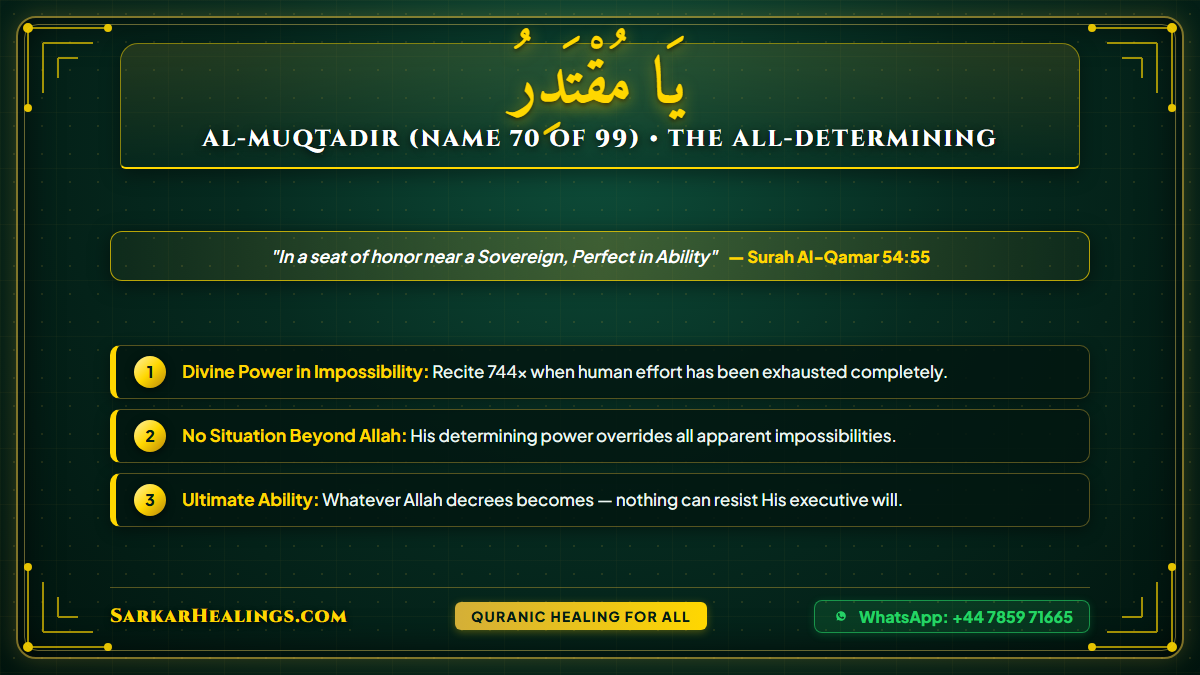
Al-Muqtadir Meaning & Ya Muqtadir Benefits (Name 70 of 99)
Sarkar Healings · 99 Names of Allah · Name 70 of 99
الْمُقْتَدِر
Al-Muqtadir — The All-Determining, The Omnipotent
Al-Muqtadir Meaning & Ya Muqtadir Benefits
The One whose power prevails over all things; nothing can frustrate His decree.
Al-Muqtadir (The All-Determining) is the 70th of the 99 Names, from the root q-d-r (power, decree). The intensive pattern (faʿīl) denotes overwhelming, prevailing power that nothing can resist. The exact Name Al-Muqtadir does not appear verbatim in the Quran, but the participle muqtadir occurs in 18:45 and 54:42. Invoked for victory over impossible odds, protection from tyranny, and surrender to divine decree.
Key Facts at a Glance
| Name in Arabic | الْمُقْتَدِر |
|---|---|
| Transliteration | Al-Muqtadir (invoked as Ya Muqtadir) |
| English Meaning | The All-Determining, The Omnipotent |
| Position | 70th of the 99 Names (Asma-ul-Husna) |
| Arabic Root | ق-د-ر |
| Quran Occurrences | The exact Name Al-Muqtadir (الْمُقْتَدِر) with the definite article does not appear verbatim in the Quran. The intensive active participle muqtadir (مُقْتَدِر) occurs twice: Surah Al-Kahf 18:45 (wa kāna Llāhu ʿalā kulli shayʾin muqtadir — ‘And Allah is over all things Omnipotent’) and Surah Al-Qamar 54:42 (fī maqʿadi ṣidqin ʿinda malikin muqtadir — ‘In a seat of truth near an Omnipotent King’). Classical authorities include it in the 99 Names based on the root q-d-r and the intensive pattern denoting absolute, prevailing power. |
| Invoked For | Overcoming impossible situations, victory over oppression, acceptance of divine decree, protection from harm, strengthening resolve |
| Related Names | Al-Qadir · Al-Malik · Al-Qahhar |
Meaning & the Arabic Root
The root q-d-r (قَدَرَ) carries the meanings of power, ability, decree, measurement, and destiny. From it derive Al-Qadir (The Able), Al-Muqtadir (The All-Determining), and Al-Qadar (Divine Decree). The morphological pattern faʿīl (مُفْعِل) is an intensive active participle, indicating not merely the possession of ability but its overwhelming, prevailing exercise — power that determines outcomes and cannot be thwarted.
Al-Muqtadir is thus distinguished from Al-Qadir: the latter affirms that Allah has power over all things; the former affirms that His power actually prevails, executes, and determines every event without obstruction. It is the Name of the irresistible decree — what He wills occurs, what He does not will never can.
In the Quranic context, muqtadir appears coupled with ‘King’ (malik) in 54:42 and as a predicate of Allah’s universal scope in 18:45. Both verses present the quality as belonging exclusively to Allah, reinforcing that no created power can share in this determining authority.
Al-Muqtadir in the Quran
Quran
The exact Name Al-Muqtadir (الْمُقْتَدِر) with the definite article does not appear verbatim in the Quran. The intensive active participle muqtadir (مُقْتَدِر) occurs twice: Surah Al-Kahf 18:45 (wa kāna Llāhu ʿalā kulli shayʾin muqtadir — ‘And Allah is over all things Omnipotent’) and Surah Al-Qamar 54:42 (fī maqʿadi ṣidqin ʿinda malikin muqtadir — ‘In a seat of truth near an Omnipotent King’). Classical authorities include it in the 99 Names based on the root q-d-r and the intensive pattern denoting absolute, prevailing power.
Surah Al-Kahf 18:45
Wa kāna Llāhu ʿalā kulli shayʾin muqtadirā
“And Allah is over all things Omnipotent (All-Determining).”
Surah Al-Kahf 18:45
This verse concludes the parable of the two gardens, reminding the listener that worldly power and wealth are fleeting, while Allah’s determining power over all things is absolute and eternal. The word muqtadir here functions as a predicate describing Allah’s universal, prevailing authority.
Surah Al-Qamar 54:42
Fī maqʿadi ṣidqin ʿinda malikin muqtadir
“In a seat of truth near an Omnipotent King.”
Surah Al-Qamar 54:42
Describing the station of the righteous in the Hereafter, this verse pairs malik (King) with muqtadir, emphasising that the Sovereign’s rule is backed by irresistible determining power. The genitive construction malikin muqtadir presents the quality as an attribute of the King Himself.
The Hadith Foundation of the 99 Names
Hadith — graded
The primary hadith establishing the 99 Names is narrated by Abu Hurayrah: “Allah has ninety-nine names, one hundred less one; whoever enumerates them enters Paradise.” This is recorded in Sahih al-Bukhari 2736 and Sahih Muslim 2677. Al-Muqtadir is included in the traditional enumeration derived from this hadith.
A version listing the ninety-nine names individually appears in Jamiʿ at-Tirmidhi 3507, though scholars of hadith grade its chain weaker (due to the narrator al-Walid ibn Muslim’s idtirab in the list). The list in Tirmidhi includes Al-Muqtadir.
No specific, authentic hadith singling out the virtue of invoking “Ya Muqtadir” by name is established with a sound chain in the major collections. Devotional practices for this Name rest on the general encouragement to call upon Allah by His Beautiful Names (Quran 7:180) and the scholarly understanding of the Name’s meaning, transmitted through the Sufi and wazifa traditions.
Classical Commentary
Classical Scholarship — Sunni / Sufi tradition
Imam al-Ghazali on Al-Muqtadir (al-Maqsad al-Asna)
Al-Ghazali explains that Al-Qadir denotes the attribute of power itself, while Al-Muqtadir denotes the One whose power prevails (iqtidar) — nothing can resist or escape it. He writes that iqtidar implies the actualisation of power in a way that overcomes all opposition; it is power joined with complete dominance. The Muqtadir is He who determines (yaqdir) all affairs according to His will, and no will can counter His. Al-Ghazali relates this to the servant’s station: knowing Allah as Al-Muqtadir produces total surrender (taslim), for one realises that no strategy, force, or intercession can overturn what He has determined.
Ibn Arabi and the Akbarian Tradition
In the writings on the Divine Names, Ibn Arabi associates Al-Muqtadir with the station of al-qadar (decree) as the very essence of existence — each thing is ‘determined’ (muqaddar) in its reality by this Name. The Name manifests as the irreversible actualisation of the divine knowledge in the cosmos. For the knower (ʿarif), invoking Al-Muqtadir aligns the heart with the irresistible will, dissolving the illusion of independent agency.
Benefits of Reciting Ya Muqtadir
Within the devotional tradition, the following benefits are associated with the sincere and consistent remembrance of Al-Muqtadir. Each reflects the meaning of the Name itself.
- Overcoming impossible situations
Because Al-Muqtadir denotes power that prevails over all resistance, the tradition records its invocation for circumstances that appear humanly hopeless — trusting that the All-Determining can decree a way out where none is visible. - Victory over oppression and tyranny
The Name’s association with the ‘Omnipotent King’ (54:42) makes it a refuge for those facing unjust authority; believers recite it seeking the intervention of the One whose decree no tyrant can overturn. - Acceptance of divine decree (rida bil-qadar)
Meditating on Al-Muqtadir cultivates the heart’s surrender to what Allah has determined, transforming anxiety into peace — the benefit traced directly to the Name’s meaning of irresistible determining. - Protection from harm and enemies
The intensive power implied by the faʿīl pattern is invoked as a shield, believing that the One who determines all outcomes can determine safety for His servant. - Strengthening resolve and willpower
By connecting to the Source of all determining power, the reciter seeks to align their own will with divine purpose, gaining steadfastness in pursuing righteous goals. - Healing from chronic or 'incurable' conditions (alongside medical seek healing forment)
The tradition records recourse to Al-Muqtadir for ailments deemed unseek healing forable, affirming that the Determiner of all biological processes can determine seek healing for — always pursued in conjunction with qualified medical care. - Success in weighty undertakings
Before major decisions or projects, the Name is invoked to seek the determination of the One who brings affairs to their ordained conclusion, asking for a determination of good (khayr).
Traditional Wazifa Practices (with Sources)
Devotional Tradition — South Asian wazifa literature
The following practices are drawn from the South Asian Urdu wazifa manual genre (e.g., Ism-e-Azam by Alam Faqri) and Sufi silsila traditions. They are devotional customs, not prophetic prescriptions. No specific hadith establishes a fixed count or duration for Al-Muqtadir. Outcomes are never used as a means (sabab); the tradition records these as means of seeking Allah by this Name. Practices involving high counts (e.g., 313×, 1000×) or fixed durations (e.g., 40-day chilla) are traditionally undertaken with a qualified teacher’s guidance. All healing benefits are sought alongside, not instead of, professional medical seek healing forment.
- Qur'anic Dua Practice (after every fard salah)
Recite Surah Al-Kahf 18:45 (wa kāna Llāhu ʿalā kulli shayʾin muqtadirā) three times, then say: “Yā Muqtadir, ya Qādir, ya Malīk — qaddir līl-khayra wa ṣarrif ʿannīsh-sharra” (O All-Determining, O Able, O King — determine good for me and avert evil from me). This grounds the invocation in the Quranic verse where the Name’s quality appears. - Daily Wird (100× after Fajr and Maghrib)
Recite “Yā Muqtadir” 100 times after Fajr and 100 times after Maghrib, with presence of heart, asking for the Name’s light to permeate one’s affairs. This moderate count is widely cited in wazifa manuals for general well-being and surrender to decree. - For Critical Needs (313× after ʿIshāʾ for 7–40 days)
Recite “Yā Muqtadir” 313 times after ʿIshāʾ, preceded and followed by ṣalawāt (11× each), for a specific legitimate need. Manuals suggest 7, 21, or 40 days. This higher count is traditionally undertaken with a teacher’s oversight; consistency matters more than the exact number. - Protection Litany (7× with Ayat al-Kursi)
Recite Ayat al-Kursi (2:255) once, then “Yā Muqtadir” 7 times, then Ayat al-Kursi again. Say morning and evening for protection from seen and unseen harm. The combination links the Name to the Verse of the Throne, which affirms Allah’s exhaustive power.
Etiquette (Adab) of Reciting Ya Muqtadir
- Begin with istighfar — seeking forgiveness before presenting the request.
- Praise Allah and send salawat upon the Prophet ﷺ before and after the dhikr.
- Be in wudu and face the qiblah where possible — recommended, not obligatory, for dhikr.
- Ask with certainty — the Prophet ﷺ instructed asking Allah with conviction of response (Jami’ at-Tirmidhi 3479).
- Keep lawful earnings and intentions.
- Consistency over quantity — the most beloved deeds are the most constant, even if small (Sahih al-Bukhari 6464).
- Recite with hands raised in need (duʿāʾ posture), inwardly acknowledging: ‘I have no power nor strength except through You, O Determiner of all affairs.’
Frequently Asked Questions
- What does Al-Muqtadir mean?
- Al-Muqtadir means The All-Determining, The Omnipotent — the One whose power prevails over everything and whose decree nothing can resist. It is the intensive form of the root q-d-r, indicating not just ability but the actual, overwhelming execution of will.
- Does the Name Al-Muqtadir appear in the Quran?
- The exact form Al-Muqtadir (with the definite article al-) does not appear verbatim. However, the participle muqtadir occurs in two verses: 18:45 (wa kāna Llāhu ʿalā kulli shayʾin muqtadirā) and 54:42 (malikin muqtadir). Classical scholars include it in the 99 Names based on this Quranic usage and the root meaning.
- How is Al-Muqtadir different from Al-Qadir?
- Al-Qadir (The Able) affirms that Allah possesses power over all things. Al-Muqtadir (The All-Determining) affirms that His power actually prevails, determines outcomes, and cannot be thwarted — it is power in its irresistible, executive mode.
- How many times should I recite Ya Muqtadir for a specific need?
- The tradition records various counts: 100× daily for general wird, 313× after ʿIshāʾ for pressing needs (often for 7–40 days), or 7× with Ayat al-Kursi for protection. No count is prophetic; consistency, presence of heart, and a teacher’s guidance for high-count practices are emphasised.
- Can anyone recite Ya Muqtadir, or is initiation required?
- Any Muslim may recite Ya Muqtadir as a form of dhikr and duʿāʾ by Allah’s Beautiful Names (Quran 7:180). For intensive fixed-duration practices (chillas, high counts), the tradition recommends a qualified guide’s oversight to ensure correct adab and spiritual safety.
Obtain a Spiritually Prepared Ya Muqtadir Taweez
At Sarkar Healings we prepare Taweez and Naqash of Al-Muqtadir following the etiquette and recitations described in this guide.
Explore Coded Duas & Taweez
WhatsApp Us
Or email: help@sarkarhealings.com
Continue the series: Al-Qadir · Al-Malik · Al-Qahhar · All 99 Names of Allah
This is a traditional practice, not a substitute for medical treatment, legal advice, or professional care. Scholars differ on some of these practices; where they differ, that difference is noted. Benefit and outcome are from Allah alone. If you are facing a medical, psychological, or financial emergency, seek qualified professional help first.
Coded Duas based on Al-Muqtadir

Need Personal Guidance on This?
Get a confidential, free consultation with our spiritual advisor — usually replied within hours.
Complete healing path: The Complete Quran Coded Dua — all 114 Surahs & Asma-ul-Husna in one hand-written taweez.
This content and its associated Quranic recitations are offered strictly as a spiritual means (asbab) seeking Allah's guidance, protection, and barakah. Sarkar Healings does not guarantee magical outcomes or instant cures. Spiritual remedies are to be used alongside lawful personal effort and professional medical, legal, or financial advice.