Surah At-Tahrim Benefits: Authentic Virtues and Meaning
بِسْمِ اللَّهِ الرَّحْمَٰنِ الرَّحِيمِ
Surah At-Tahrim — The Chapter of Prohibition
In brief: If you carry the weight of regret, seek rest for a troubled heart, or wish to shield your loved ones from unseen harm, Surah At‑Tahrim offers a concise, prophetic prescription for sincere repentance, healing, and protection.
In pain → Healing · Feeling unsafe → Protection · Want to understand it → Station & Meaning
What Surah At‑Tahrim Is About
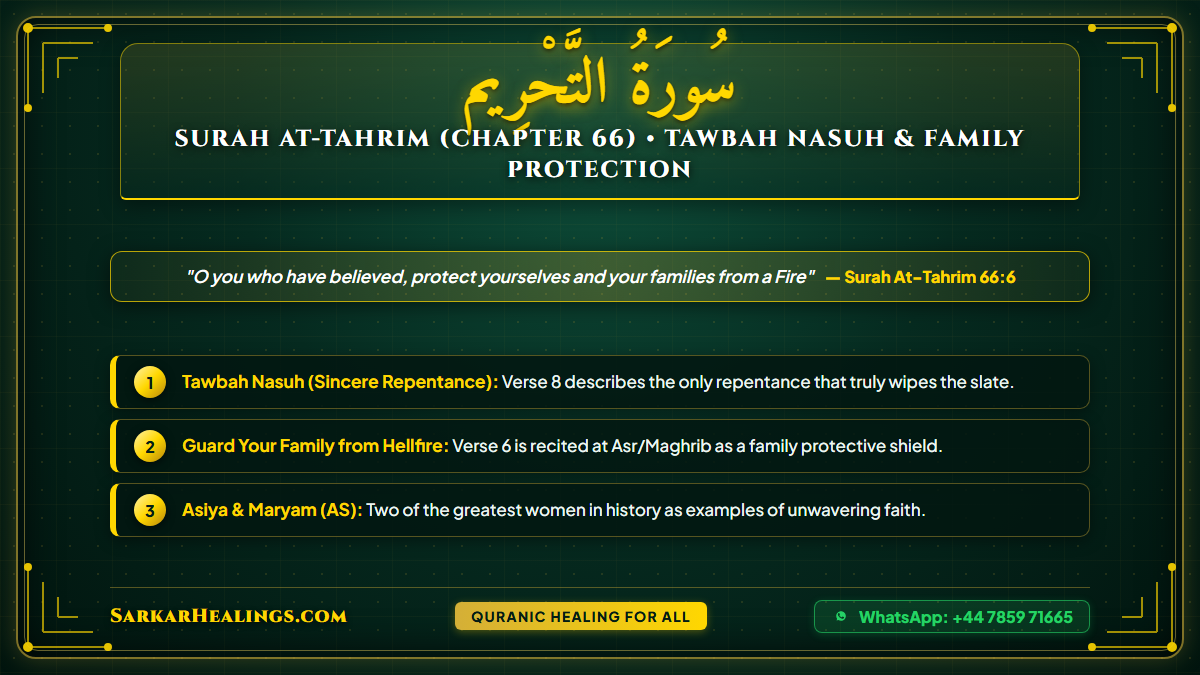
Surah At‑Tahrim, the 66th chapter of the Qur’an, takes its name from the verb “to prohibit” (tahrim) that appears in its opening verse, where the Prophet ﷺ is gently reminded not to make unlawful what Allah has permitted. Though brief, its twelve verses pack a powerful narrative about the inner struggle between desire and obedience, illustrated through the examples of the wives of Nuh and Lut (who betrayed their prophets) and the steadfast faith of Asiya, wife of Pharaoh, who prayed for a home in Paradise.
Classically known as Munjiyah — “the savior” — this Surah is a Madani revelation that emphasizes guarding oneself and one’s family from sin, turning back to Allah in sincere repentance (tawbah nasuh), and trusting in Allah’s mercy to protect the believer from both worldly afflictions and the trials of the grave.
The Benefits of Surah At‑Tahrim — Every Claim Sourced
🌿 Healing — Body & Mind
- Recitation and drinking its water cures many ailments.
- Writing the Surah on a china plate, washing it with clean water, and sprinkling it on an epileptic brings relief.
- Recitation for a scorpion bite stops the poison from spreading; likewise it alleviates palsy.
- Helps overcome insomnia and calms fear; frequent recitation eases the burden of debt.
🛡️ Protection — From Seen and Unseen Harm
- Known as Munjiyah (the savior); it saves the reciter from grave torment, and the limbs speak in defence against Munkar and Nakir.
- Its recitation is equivalent to staying awake on Laylat al‑Qadr (the Night of Decree), a mighty spiritual shield.
- When recited for deceased brothers, it reaches them like lightning, relieving grave punishment.
- Regular recitation invites Allah’s protection over the household, guarding family from evil whispers.
📖 Station & Meaning — Inner Transformation
- Recitation prompts sincere repentance (tawbah nasuh), turning the heart back to Allah.
- The reciter becomes among those who constantly seek Allah’s forgiveness.
- As Munjiyah, it grants the status of being saved — a spiritual station of safety in this life and the next.
- Its themes echo the dua of Asiya for a home in Paradise, inspiring hope and steadfastness.
🎁 Reward — Divine Gifts
- Memorization of Surah At‑Tahrim grants intercession into Paradise.
- Its recitation carries the reward of Laylat al‑Qadr, multiplying blessings manifold.
- Whoso recites it regularly, Allah facilitates a continual return to sincere repentance.
- Reciting it for the sick, the fearful, or the indebted brings tangible relief and ease.
How and When to Use — Prescription
Before any use: seek refuge (isti’adhah), begin with Bismillah, recite with tarteel (measured pace), close with Ameen.
| When | How to Use | What It Does |
|---|---|---|
| Daily prayers (after Fajr or Maghrib) | Recite Surah At‑Tahrim once, slowly, with reflection. | Instils a habit of sincere repentance and invites Allah’s mercy for the day. |
| Struggling to sleep or feeling anxious | Recite 3 times, blow gently on water, then drink. | Calms the mind, eases insomnia, and dispels fear. |
| Someone suffering from epilepsy or seizure tendencies | Write the Surah on a clean china plate, wash with pure water, sprinkle the water on the person. | Brings relief from epileptic episodes, as per Prophetic guidance. |
| Victim of a scorpion sting or suffering from palsy | Recite Surah At‑Tahrim 7 times, blow on the affected area. | Prevents poison spread and eases muscular rigidity. |
| Praying for a deceased loved one | Recite Surah At‑Tahrim, then convey the reward to the departed. | Reaches the deceased like lightning, reducing grave punishment. |
How to Get Maximum Benefit
- Intention (niyyah) – Recite solely for Allah’s pleasure, seeking repentance, healing, or protection.
- Consistency – Make it part of your daily dhikr, even if only a few verses.
- Certainty (yaqin) – Trust that Allah’s words are a source of cure and safeguard.
- Pairing with good deeds – Combine recitation with charity, kindness to family, and seeking forgiveness.
Listen to Sheikh’s Recitation — Surah At-Tahrim
Recited by Sheikh Sayed — listen with khushu, read along, then recite yourself. For personal recitation guidance, message on WhatsApp.
Frequently Asked Questions
Can I recite Surah At‑Tahrim for healing purposes?
Yes. The material mentions that recitation, especially when combined with drinking its blessed water, acts as a cure for many ailments, including epilepsy and scorpion bites.
Is there a specific time of day that is most effective?
While it can be recited at any time, many find benefit after Fajr or Maghrib prayers, or before sleep, to calm the heart and seek protection through the night.
Do I need to be in a state of wudu to recite it?
Reciting the Qur’an does not require wudu, but being in a state of purity enhances focus and reverence; if you wish to touch the physical Mushaf, wudu is obligatory.
What if I do not understand Arabic?
Understanding the meaning deepens the effect, but the mere sound of the Qur’an carries blessing. You may read a trusted translation alongside the Arabic to reflect on the message of repentance and mercy.
Where Surah At‑Tahrim Fits in Your Journey
If you are walking a path of self‑examination, seeking to mend broken habits, or yearning for a shield over your household, Surah At‑Tahrim serves as a concise waypoint. Its call to sincere repentance realigns the heart, while its promises of healing and protection offer tangible support for the body and soul. Let it be the quiet companion that reminds you — again and again — that Allah’s mercy is ever‑ready to welcome the repentant.
Cross-Links
- Forgiveness & Repentance Hub
- Protection & Safety Hub
- Marriage & Love Hub
- Continue with Surah At-Talaq
- Continue with Surah Al-Mulk
- All 114 Surahs
Get the Family Harmony – Coded Dua (Taweez) of Surah At-
WhatsApp Sheikh Sayed — Personal Guidance