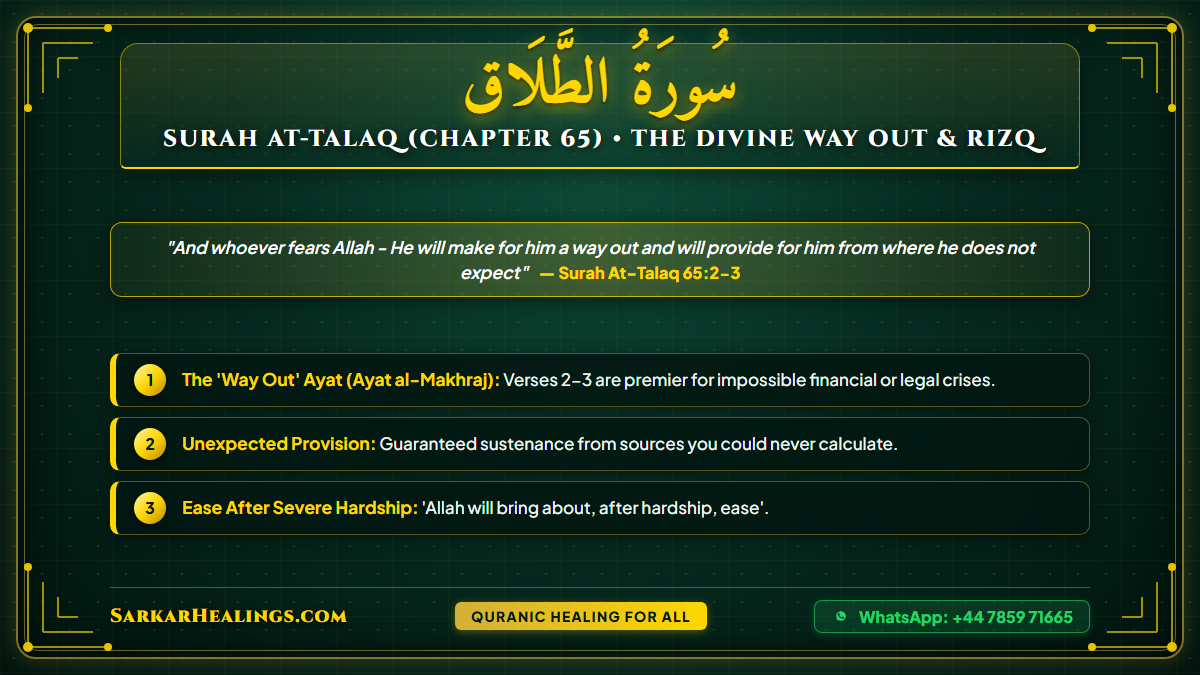
Surah At-Talaq Benefits: Authentic Virtues, Rewards & How to Recite
بِسْمِ اللَّهِ الرَّحْمَٰنِ الرَّحِيمِ
Surah At-Talaq — The Divorce
In brief: If you are navigating the complexities of marital separation, seeking divine guidance for a righteous outcome, or looking for spiritual support that eases anxiety and inspires sincere repentance, Surah At‑Talaq offers a Qur’anic framework rooted in mercy, justice, and trust in Allah’s provision.
In pain → Healing · Feeling unsafe → Protection · Want to understand it → Station & Meaning
What Surah At‑Talaq Is About
Surah At‑Talaq, the sixty‑fifth chapter of the Qur’an, is commonly known as “The Divorce” because its primary legal discourse details the procedural and ethical dimensions of ending a marriage in Islam. Revealed in Madinah, the surah addresses the believers directly, prescribing a waiting period (‘iddah) that safeguards the rights of both spouses, ensures clarity about potential pregnancy, and provides a window for reconciliation. The emphasis on counting the waiting period and fearing Allah underscores that divorce, while permissible, must be undertaken with consciousness of divine limits and a sincere desire to avoid harm.
Beyond the juridical instructions, the surah carries profound thematic teachings that resonate with every believer. It reminds us that God‑consciousness (taqwa) opens a way out of difficulty, that reliance on Allah brings provision from sources we cannot anticipate, and that the laws of divorce are framed with kindness and justice. These themes are woven throughout the twelve verses, linking the legal rulings to a broader spiritual outlook: when a person upholds taqwa, Allah facilitates relief, grants unexpected sustenance, and transforms a potentially painful situation into an opportunity for growth and mercy.
The Benefits of Surah At‑Talaq — Every Claim Sourced
🌿 Healing — Relief for Body and Mind
The material attributes several specific remedial effects to the recitation of Surah At‑Talaq, especially when combined with practical actions such as using water from a china plate or blowing over afflictions.
- Sprinkled water from a china plate cures epilepsy.
- Recited over scorpion bites stops poison spread and cures palsy/paralysis.
- Helps clear financial debt completely.
- Cures insomnia and calms fear.
- Inspires sincere repentance (Tawbatan Nasuha).
The one who recites will be given the inspiration to perform Tawbatan Nasuha (sincere repentance).
🛡️ Protection — Shield from Fear and Divine Mercy
Two narrations highlight how Surah At‑Talaq, particularly when paired with Surah At‑Tahrim, safeguards the believer from existential anxieties and secures a promised abode in the Hereafter.
- Recitation of Surah At‑Talaq together with Surah At‑Tahrim in faraa’idh protects from fear of Judgement Day and grants entry to Jannah.
- Recitation protects from fear and grief on the Day of Reckoning and leads to Paradise because these two surahs are especially linked to the Holy Prophet.
- Recitation prompts sincere repentance unto Allah.
If Surah at‑Talaq and Surah at‑Tahrim are recited in faraa’idh, the reciter will be protected from fear of Judgement Day and will enter Jannah.
🕌 Station & Meaning — Spiritual Orientation
The surah’s thematic core offers a roadmap for inner transformation, emphasizing trust in Allah’s wisdom and the ethical conduct expected even in moments of personal upheaval.
- God‑consciousness brings a way out of difficulty.
- Reliance on Allah is sufficiency; provision arrives from unexpected sources.
- The laws of divorce are framed with kindness, justice, and compassion.
- Observing the waiting period (‘iddah) protects lineage and clarifies intentions.
🎁 Reward — Divine Favour and Spiritual Gain
While the primary narrations focus on protection and healing, the material also points to the broader spiritual reward that accompanies sincere engagement with Surah At‑Talaq.
- Recitation inspires the believer to turn sincerely repentant unto Allah, opening the door to His forgiveness.
- Engaging with the surah’s teachings cultivates a mindset of trust and patience, qualities that Allah loves.
- By upholding the divinely prescribed etiquette of divorce, one preserves family dignity and societal harmony.
- The act of reciting with tarteel (measured pace) brings tranquility to the heart, aligning the reciter with the Qur’anic rhythm of peace.
How and When to Use — Prescription
Before any use: seek refuge (isti’adhah), begin with Bismillah, recite with tarteel (measured pace), close with Ameen.
| When | How to Use | What It Does |
|---|---|---|
| Daily prayer (after Fajr or Maghrib) | Recite Surah At‑Talaq once, reflecting on its meanings. | Instills God‑consciousness and prepares the heart for the day’s challenges. |
| When facing marital discord or contemplating separation | Recite the surah with tarteel, then make du’a for fairness and compassion. | Reminds the observer of the waiting period, the rights of each party, and the possibility of reconciliation. |
| Experiencing insomnia or night‑time anxiety | Recite Surah At‑Talaq, blow gently over a glass of water, and drink it before sleep. | According to the material, this practice calms fear and promotes restful sleep. |
| Suffering from epilepsy or seizure tendencies | Prepare water in a clean china plate, recite Surah At‑Talaq over it, then sprinkle the water on the patient’s forehead. | The material states that such water cures epilepsy. |
| Bitten by a scorpion or suspecting poison spread | Recite Surah At‑Talaq over the wound, then apply a clean bandage. | The material reports that this stops poison from spreading and can cure palsy/paralysis. |
How to Get Maximum Benefit
- Intention (niyyah) – Begin with a clear purpose: to seek Allah’s mercy, to uphold justice, or to request relief from a specific affliction.
- Consistency – Incorporate the recitation into a regular routine (daily, after prayers, or at times of need) rather than a one‑off act.
- Certainty (yaqeen) – Trust that Allah hears the recitation and that the means He has prescribed are effective by His will.
- Pairing with action – Combine recitation with the prescribed practical steps (e.g., using china‑plate water for epilepsy, observing ‘iddah in marital matters) as indicated in the source material.
Listen to Sheikh’s Recitation — Surah At-Talaq
Recited by Sheikh Sayed — listen with khushu, read along, then recite yourself. For personal recitation guidance, message on WhatsApp.
Frequently Asked Questions
What is the main theme of Surah At‑Talaq?
The main theme centers on the ethical and legal dimensions of divorce, emphasizing God‑consciousness, the waiting period (‘iddah), reliance on Allah for unexpected provision, and the importance of kindness and justice even in separation.
How does Surah At‑Talaq help with fear and anxiety?
The material mentions that reciting the surah calms fear and, when combined with Surah At‑Tahrim, protects from fear of Judgement Day and from fear and grief on the Day of Reckoning.
Is the narration about protection from Judgement Day authentic?
The narration appears in Fawaid‑e‑Quran with a single chain attributed to Imam Ja’far as‑Sadiq (a). As a solitary report, its authenticity should be verified through further scholarly review; the material presents it as a benefit but does not provide multiple independent chains.
Can Surah At‑Talaq be recited for financial relief?
Yes. The authenticated traditions states that reciting Surah At‑Talaq helps clear financial debt completely.
Where At‑Talaq Fits in Your Journey
Surah At‑Talaq serves as a spiritual waypoint for anyone navigating the testing waters of marital change or personal distress. Its teachings remind us that when we uphold taqwa, Allah opens doors we cannot see, provides sustenance from unseen sources, and transforms moments of hardship into opportunities for growth, repentance, and renewed trust in the Divine plan.
Cross-Links
- Wealth & Rizq Hub
- Anxiety & Distress Hub
- Guidance & Istikhara Hub
- Continue with Surah At-Taghabun
- Continue with Surah At-Tahrim
- All 114 Surahs
Get the Complete Quran Coded Dua Taweez
WhatsApp Sheikh Sayed — Personal Guidance
