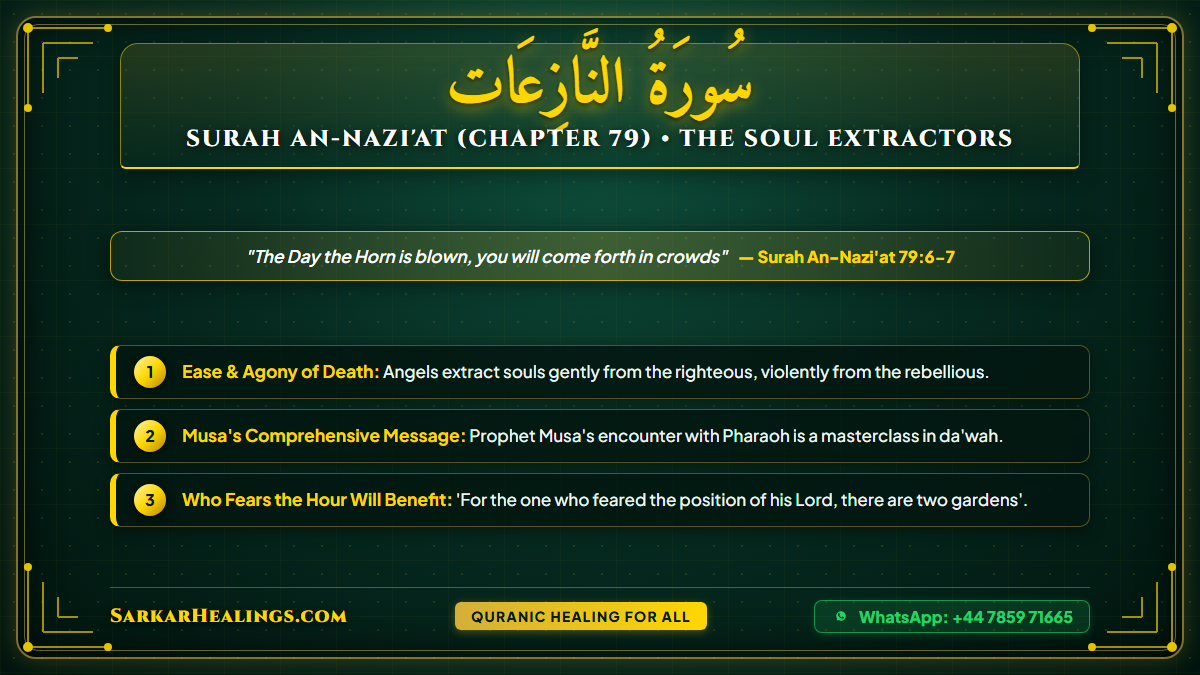
Surah An-Naziat Benefits: Authentic Virtues and Meaning
بِسْمِ اللَّهِ الرَّحْمَٰنِ الرَّحِيمِ
Surah An-Nazi’at — The Extractors
In brief: Surah An-Nazi’at vividly describes the angels who pull out souls, the stark confrontation between Musa and Pharaoh, and the call to restrain the lower self. It awakens the heart to the reality of the Hour and inspires hope for those who strive sincerely.
In pain → Healing · Feeling unsafe → Protection · Want to understand it → Station & Meaning
By those [angels] who extract [the souls] violently.
Qur’an 79:1
What Surah An-Nazi’at Is About
Surah An-Nazi’at, “The Extractors,” takes its name from the powerful imagery of angels who draw out the souls of the living at the moment of death. The surah opens with a solemn oath by these angels, emphasizing the inevitability of the transition from this world to the next.
It then recounts the story of Musa and Pharaoh as a sign of divine power and warning against arrogance, and concludes with a call to purify the soul, restrain it from base desires, and prepare for the imminent Hour.
The Benefits of Surah An-Nazi’at — Every Claim Sourced
🌿 Healing…
- Reciting Surah An-Nazi’at helps the believer restrain the soul from base desires, fostering spiritual healing.
- The surah’s depiction of the angels extracting souls encourages mindfulness of mortality, easing fear of death.
- Reflecting on the story of Musa and Pharaoh strengthens trust in divine justice, alleviating oppression‑related stress.
🛡️ Protection…
- Reciting the surah before travel invokes Allah’s protection, ensuring a safe journey.
- The surah’s reminder of the Nearness of the Hour motivates vigilance and reliance on Allah’s safeguard.
- Pairing the recitation with Surah At‑Takwir places the believer under the Prophet’s shade in Jannah, a spiritual protection.
🌟 Station & Meaning…
- The surah elevates the reciter’s station by promising to rise happy and smiling on the Day of Resurrection.
- Contemplating the extraction of souls raises awareness of the soul’s noble status, enhancing one’s spiritual rank.
- Regular recitation aligns the heart with the Quran’s message, bringing the reciter closer to the Prophet’s intercession.
🎁 Reward…
- The reward for reciting Surah An-Nazi’at is ten times the number of entities in the Heavens.
- This immense multiplier reflects Allah’s generosity toward those who engage with His words.
- Such reward motivates consistent recitation, accumulating blessings in this life and the next.
Reward is ten times the number of entities in the Heavens.
How and When to Use — Prescription
Before any use: seek refuge (isti’adhah), begin with Bismillah, recite with tarteel (measured pace), close with Ameen.
| When | How to Use | What It Does |
|---|---|---|
| Daily prayer (after Fajr or Maghrib) | Recite Surah An-Nazi’at once with tarteel. | Keeps the heart mindful of death and the Hereafter. |
| Before embarking on a journey | Recite the surah three times, then blow gently on travel provisions. | Invokes Allah’s protection for safe travel. |
| When feeling anxious about the future | Recite the surah once, reflect on its meaning, then make du’a for steadfastness. | Calms the soul by reminding of Allah’s control over the Hour. |
| Seeking success in a new venture | Write the surah on a piece of deer‑skin, keep it as a tawiz, and recite it daily. | Attracts divine assistance and success in endeavors. |
| Alongside Surah At‑Takwir | Recite both surahs together after Isha. | Earns the promise of resting under the Prophet’s shade in Jannah. |
How to Get Maximum Benefit
- Intention (niyyah): Recite solely for Allah’s pleasure, seeking His mercy and guidance.
- Consistency: Make the surah part of your daily dhikr, even if only a few verses.
- Certainty (yaqeen): Trust that Allah’s promise of reward and protection is true.
- Pairing: Combine recitation with sincere du’a and acts of kindness to amplify blessings.
Listen to Sheikh’s Recitation — Surah An-Nazi’at
Recited by Sheikh Sayed — listen with khushu, read along, then recite yourself. For personal recitation guidance, message on WhatsApp.
Frequently Asked Questions
What is the main theme of Surah An-Nazi’at?
The surah centers on the mighty angels who extract souls, the account of Musa and Pharaoh, the call to restrain the self from lust, and the imminence of the Hour.
How does Surah An-Nazi’at help with healing?
By reminding the believer of the angels who draw out souls, it nurtures mindfulness of death, which softens the heart and reduces fear. The surah also encourages restraining the lower self, leading to inner spiritual healing.
Is this narration authentic?
The statement “Reward is ten times the number of entities in the Heavens” appears in Fawaid-e-Quran by Sayyid Mustafa Musawi, attributed to the Holy Prophet (S). The work cites the Prophet but does not provide an isnad (chain of narrators). Because the transmission lacks a verifiable chain, scholars classify the report as having an unknown or weak authentication level. Nevertheless, the meaning aligns with Quranic promises of abundant reward for sincere recitation, and many scholars accept it as a beneficial encouragement rather than a legal proof.
Can Surah An-Nazi’at be recited for protection during travel?
Yes. The material notes that reciting the surah at the start of a journey ensures safe travel. Many believers recite it three times before departing, blow on their provisions, and trust in Allah’s safeguard.
Where An-Nazi’at Fits in Your Journey
Let Surah An-Nazi’at be a regular companion when you contemplate the transient nature of life, seek strength to resist temptations, or prepare for a new undertaking. Its vivid imagery pulls the heart toward accountability, while its promises of reward and divine shade offer hope for the road ahead.
Cross-Links
- Death & Hereafter Hub
- Forgiveness & Repentance Hub
- Anxiety & Distress Hub
- Continue with Surah An-Naba
- Continue with Surah Abasa
- All 114 Surahs
Get the Complete Quran Coded Dua Taweez
WhatsApp Sheikh Sayed — Personal Guidance
