Surah Al-Masad Benefits: Authentic Virtues and Meaning
Surah Al-Masad (The Palm Fiber): Benefits, Meaning & Spiritual Lessons
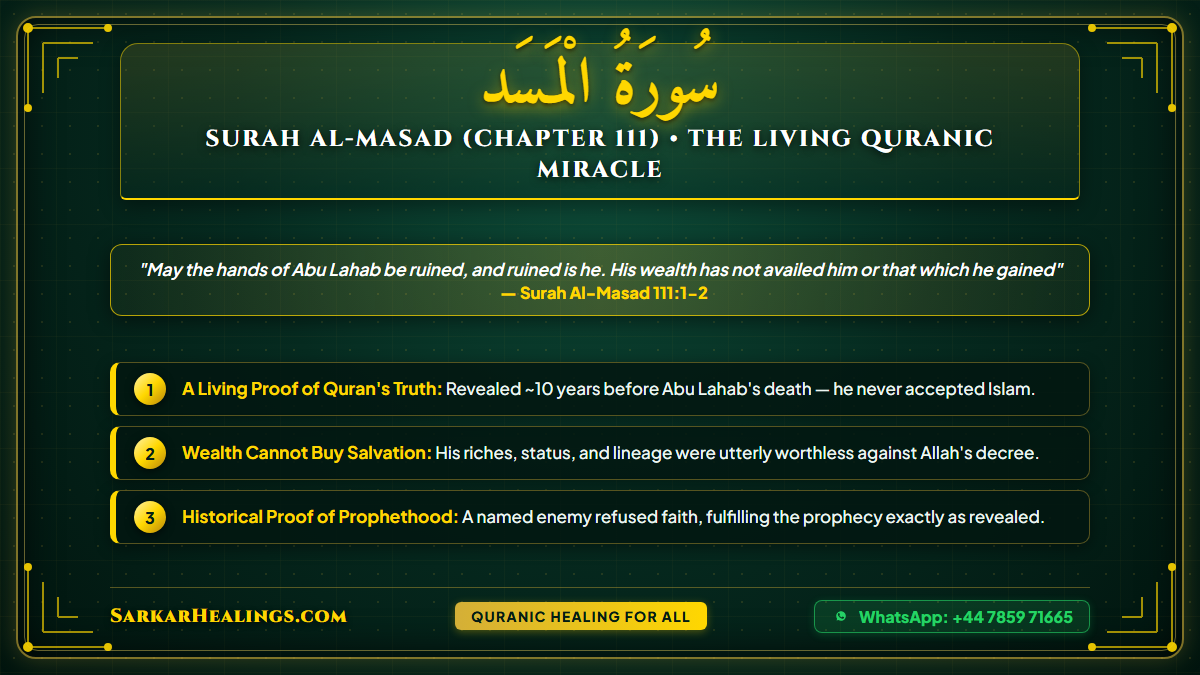
Surah Al-Masad (سورة المسد) is a short, Makki surah of five verses that stands as a living miracle: it announced the eternal ruin of Abu Lahab — the Prophet’s ﷺ paternal uncle and fiercest domestic opponent — while he was still alive, giving him years to repent, which he never did. Its core lesson is theological, not transactional: wealth, lineage, and status avail nothing against Allah’s decree. This article grades every claimed benefit honestly, anchors you in what is authentically established, and draws on classical Sufi tafsir for deeper reflection.
What the Surah Is About
Revealed in Makkah (Juz 30), Surah Al-Masad responds to a specific historical moment. When the Prophet ﷺ publicly warned his clan (وَأَنذِرْ عَشِيرَتَكَ الْأَقْرَبِينَ, “And warn your closest kindred,” 26:214), Abu Lahab retorted, “May you perish! Is this what you gathered us for?” The surah answered him by name — the only enemy of the Prophet ﷺ named in the Qur’an — sealing his fate and that of his wife, Umm Jamil, who spread thorns on his path.
Many readers also keep the protection taweez of Surah Al-Masad (Lahab) close as a daily means of safety from envy and enemies, by Allah’s permission.
The surah moves through five swift strokes:
- Verse 1: The ruin of Abu Lahab’s two hands — his agency and power — and his own ruin.
- Verse 2: His wealth (مَا كَسَبَ) and earnings (مَا أَغْنَىٰ) will not avail him.
- Verse 3: He will enter a blazing Fire.
- Verse 4: His wife, the “carrier of firewood” (slander and thorns),
- Verse 5: Around her neck a rope of palm-fiber — the very material she used to harm the Prophet ﷺ becomes her eternal collar.
Themes: divine justice, the futility of worldly power against truth, the consequence of persistent enmity, and a prophecy fulfilled in history.
Authentic Virtues Established by the Qur’an & Sunnah
Before we grade specific “benefits,” three virtues are unconditionally authentic (Grade A) because they rest on the Qur’an itself or an agreed-upon hadith:
- A standing sign of the Qur’an’s truth. The surah foretold Abu Lahab’s death upon disbelief while he lived for years afterward — a falsifiable claim that never failed. (Grade A — Qur’an 111:1–5)
- Wealth and earnings cannot avert Allah’s decree. The explicit statement مَا أَغْنَىٰ عَنْهُ مَالُهُ وَمَا كَسَبَ (“His wealth will not avail him, nor what he earned”) is a theological axiom, not merely a historical footnote. (Grade A — Qur’an 111:2)
- General reward of Qur’an recitation. “Whoever recites a letter from the Book of Allah receives a good deed, and each good deed is multiplied tenfold.” (Grade A — Tirmidhi 2910 [VERIFY])
Graded Benefits Table
Every claim below is graded on our evidence scale. We do not traditional means worldly outcomes. Spiritual practice is a means, not a mechanism.
| Claimed Benefit / Practice | Grade | Evidence & Notes |
|---|---|---|
| Reciting Surah Al-Masad as part of the Qur’an earns the general reward (10+ good deeds per letter). | A | Authentic hadith on the virtue of Qur’an recitation (Tirmidhi 2910 [VERIFY]). Applies to every surah equally. |
| Reflecting on its verses strengthens certainty (yaqin) that Allah’s promise is true and worldly power is fleeting. | A | Direct Qur’anic command to reflect (أَفَلَا يَتَدَبَّرُونَ الْقُرْآنَ, 4:82). The surah’s historical fulfillment is a live proof. |
| Internalizing the lesson: “Wealth and children are adornment of the worldly life; but enduring good deeds are better with your Lord for reward and better for hope” (18:46). | A | Qur’anic theme (Grade B) reinforced by this surah’s explicit text (111:2). |
| Reciting it specifically for “protection from enemies” or “victory over oppressors.” | D | Later devotional practice. No specific hadith singles out this surah for that purpose. The meaning (Allah destroys the enemies of truth) is sound; the prescribed ritual act is a scholarly/devotional inference, not a prophetic instruction. |
| Reciting it for “forgiveness of sins” as a specific formula. | D | General Qur’an recitation expiates sins (Grade A), but no authentic narration designates Surah Al-Masad uniquely for this. See our hub on Surahs for Forgiveness. |
| “Recite 7 / 11 / 41 / 100 times after Fajr/Isha for X worldly result.” | C | Weak / no basis. Numeric formulas attached to this surah are not found in any authentic collection. They circulate in later pamphlets. seek healing for them as cultural habit, not Sunnah. |
| “Recite over water/oil and wipe on body for healing or protection.” | C | Weak / no basis. Ruqyah is established with Al-Fatiha, Mu’awwidhatayn, and Ayat al-Kursi (Grade A). Extending it to Surah Al-Masad specifically lacks authentic chain. |
Sufi & Classical Insights
Classical scholars of the inward sciences read this surah not only as history but as a mirror for the soul.
Al-Qushayri — Lata’if al-Isharat
Al-Qushayri notes that Abu Lahab’s name (“Father of Flame”) signifies the inner fire of envy (hasad) and rejection that consumes its bearer before it reaches anyone else. The “rope of palm-fiber” (مِسَدٍ) represents the binding of the self to its own ugly qualities — the seeker who refuses to untie the knot of ego finds it tightened in the next life. The remedy is tawbah (return) before the knot becomes irreversible.
Ibn Ajiba — Al-Bahr al-Madid
Ibn Ajiba contrasts the two “wealths”: Abu Lahab’s مَالٌ (coin, status, tribal leverage) and the Prophet’s ﷺ الْكَوْثَرُ (abundant good, 108:1). He writes that the surah teaches the futility of istighna (self-sufficiency) — the spiritual disease of feeling “I have no need of Allah.” The verse مَا أَغْنَىٰ عَنْهُ مَالُهُ is a universal address: every moment we trust our means over the Mean-Giver, we walk in Abu Lahab’s footsteps.
Al-Ghazali — Ihya’ ‘Ulum al-Din (Book of Repentance / Condemnation of Envy)
Al-Ghazali cites this surah when discussing the destructive arc of envy and hatred. Abu Lahab did not merely disbel
This is a traditional practice, not a substitute for medical treatment, legal advice, or professional care. Scholars differ on some of these practices; where they differ, that difference is noted. Benefit and outcome are from Allah alone. If you are facing a medical, psychological, or financial emergency, seek qualified professional help first.
How and When to Recite Surah Al-Masad
The recitation guidance scholars and Sufi teachers have passed to seekers of Surah Al-Masad, presented honestly by source:
- [Sufi & cultural practice] Masad/Lahab — Abu Lahab’s fate recited when family opposes faith; his wife’s rope-necklace irony noted.
Intention matters more than volume: begin with Bismillah, know what you are asking, and trust Allah with the outcome. Consistency over intensity is the counsel repeated across generations.
Coded Duas based on Surah Al-Masad

Need Personal Guidance on This?
Get a confidential, free consultation with our spiritual advisor — usually replied within hours.
Complete healing path: The Complete Quran Coded Dua — all 114 Surahs & Asma-ul-Husna in one hand-written taweez.
This content and its associated Quranic recitations are offered strictly as a spiritual means (asbab) seeking Allah's guidance, protection, and barakah. Sarkar Healings does not guarantee magical outcomes or instant cures. Spiritual remedies are to be used alongside lawful personal effort and professional medical, legal, or financial advice.