virtues-benefits-surah-shura.html
Surah Ash-Shura (42): Benefits, Virtues & Spiritual Guidance — An Honest Grading
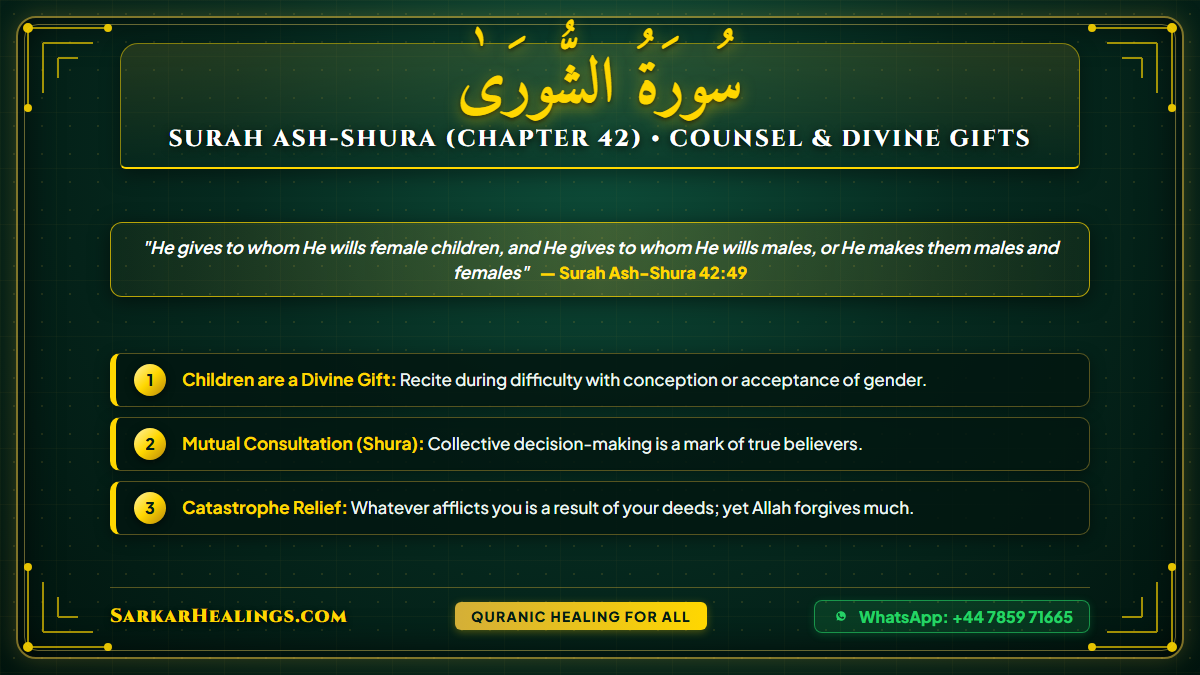
Surah Ash-Shura is a Makki surah of 53 verses that centers on divine oneness (tawhid), the principle of mutual consultation (shura), and the measured wisdom of Allah’s provision and forgiveness. Its authentic virtues are Quranic: it praises those who conduct affairs by consultation (42:38) and affirms that Allah answers the believers and increases them from His bounty (42:26). Beyond these, the general reward of Quran recitation — ten good deeds per letter — applies (Tirmidhi 2910 [VERIFY]). Popular numeric formulas (“recite N times for X”) have no authentic basis; they are devotional customs, not prophetic traditional meanss. This article grades every claim so you can engage with the surah on solid ground.
What the Surah Is About
Revealed in Makkah, Surah Ash-Shura (سورة الشورى) opens with the disjointed letters حٰمٓ عٰسٓقٓ and immediately declares that revelation comes from the Exalted, the Wise (42:1–3). Its thematic arc moves through:
- Tawhid & Revelation: Allah alone originates creation and sends guidance (42:1–6).
- Shura as Governance: “And those who respond to their Lord, establish prayer, and conduct their affairs by mutual consultation…” (42:38) — a Quranic endorsement of collective decision-making.
- Divine Response & Increase: “And He answers those who believe and do righteous deeds, and gives them increase from His bounty” (42:26).
- Forgiveness & Measured Provision: Allah pardons much (42:30, 34) and expands or restricts provision by wisdom (42:12, 27).
- The Hour & Final Return: The surah closes with scenes of the Day of Judgment and the Prophet’s ﷺ role as a warner (42:44–53).
Because it is Makki, its primary aim is creedal grounding — anchoring the heart in Allah’s oneness, justice, and wise decree — while laying the social principle of shura that would later shape the Madinan community.
Authentic Virtues (Quranic & Established)
| Virtue | Source | Grade |
|---|---|---|
| Praises those who conduct their affairs by mutual consultation (shura) | Quran 42:38 — explicit Quranic text | B |
| Affirms Allah answers the believers and increases them from His bounty | Quran 42:26 — explicit Quranic text | B |
| General reward of Quran recitation: ten good deeds per letter | Sunan al-Tirmidhi 2910 [VERIFY] | A |
Graded Benefits & Claims
The table below grades every commonly cited “benefit” of Surah Ash-Shura. Grade A = authentic hadith; Grade B = Quranic theme or agreed scholarship; Grade C = weak narration (stated as weak); Grade D = later devotional practice.
| Claimed Benefit | Evidence / Origin | Grade | Notes |
|---|---|---|---|
| Strengthens conviction in tawhid and Allah’s wise decree | Quran 42:1–6, 10–13, 27 — thematic throughout | B | Core Quranic theme; agreed by all mufassirun. |
| Encourages shura (consultation) in family, community, leadership | Quran 42:38; reinforced by 3:159 | B | Quranic principle, not a “ritual benefit” but a lived ethic. |
| Instills hope in Allah’s response to du’a and increase in provision | Quran 42:26, 19–20, 27 | B | Quranic promise; “increase” includes spiritual & worldly good. |
| Reminds of Allah’s vast forgiveness and pardon | Quran 42:25, 30, 34, 40 | B | Repeated motif: yaghfiru, ya’fu, yaghfir. |
| Ten good deeds for every letter recited | Tirmidhi 2910 [VERIFY] | A | Applies to any Quran recitation, not specific to this surah. |
| “Recite 7 times after Fajr for acceptance of du’a / removal of difficulties” | No chain in the six books; appears in later fada’il al-Qur’an works without isnad | C | Weak / no authentic basis. seek healing for as devotional habit, not prophetic prescription. |
| “Recite 41 times for wealth / marriage / healing” | Popular manuals (e.g. some waza’if collections); no isnad to the Prophet ﷺ | C | Weak / fabricated chains. Transactional numbers are not from the Sunnah. |
| Reciting on Friday night for “light in the grave” or “ease at death” | Scholarly devotional practice (some Shafi‘i / Sufi awrad); no marfu‘ hadith | D | Later practice; permissible as voluntary worship, not a used as a means (sabab) outcome. |
| Writing verses 19–20 or 26–27 as a ta‘wiz (amulet) for provision | Classical ruqya/ta‘wiz literature (e.g. Ibn al-Jazari, later manazil books) | D | Permissible if Quran-only, no shirk, but no traditional means of result. |
Sufi & Classical Insights
Classical scholars of tafsir and tasawwuf highlight the surah’s inner dimensions. These are scholarly interpretations (Grade B/D), not hadith.
- Al-Qushayri, Lata’if al-Isharat: On 42:19 (اللَّهُ لَطِيفٌ بِعِبَادِهِ — “Allah is Subtle/Knowing with His servants”), he notes that lutf (divine subtlety) means Allah brings the servant to his goal through means the servant cannot perceive. The “increase” in 42:26 is first spiritual — expansion of the heart — before it manifests outwardly.
- Ibn Ajiba, al-Bahr al-Madid: Comments on 42:38 that shura is the outward form of tawakkul (reliance): one consults created means while the heart relies on the Creator. He links 42:26 (“answers those who believe”) to the station of ijaba (divine response), which requires ikhlas (sincerity) and muwafaqa (conformity to the Sunnah).
- Al-Ghazali, Ihya’ ‘Ulum al-Din (Book of Knowledge / Adab al-Qur’an): Lists Surah Ash-Shura among surahs that cultivate ma‘rifa (gnosis) of Allah’s names al-Latif, al-Khabir, al-Wahhab. He advises reciting it with tadabbur (reflection) on the measuredness of provision (42:12, 27) to seek healing for the heart of anxiety (hirs) and despair (ya’s).
How & When to Recite
There is no authentic hadith specifying a time, count, or ritual for Surah Ash-Shura. The following are permissible, recommended frameworks (Grade D) drawn from the general Sunnah of Quran engagement:
- Daily wird (portion): Include it in a weekly Quran completion (khatm) — e.g., Juz 25 (surahs 41–45) on a set day.
- Before major decisions (istikhara context): Recite 42:38 and 42:26, then pray two rak‘at istikhara, asking Allah for shura of the heart and clarity. (See hub: Surahs for Guidance & Istikhara.)
- When anxious about provision: Reflect on 42:12, 19–20, 26–27; make du’a using the Quranic words: رَبَّنَا آتِنَا فِي الدُّنْيَا حَسَنَةً وَفِي الْآخِرَةِ حَسَنَةً وَقِنَا عَذَابَ النَّارِ. (See hub: Surahs for Wealth & Rizq.)
- For forgiveness focus: Recite 42:25, 30, 34, 40 with ta
This is a traditional practice, not a substitute for medical treatment, legal advice, or professional care. Scholars differ on some of these practices; where they differ, that difference is noted. Benefit and outcome are from Allah alone. If you are facing a medical, psychological, or financial emergency, seek qualified professional help first.
General Virtues of Reciting This Surah
No special narrated virtues are transmitted for this surah in the classical collections we checked – and we will not invent any. The general virtues of Quran recitation apply fully: the Quran will come as an intercessor for its companions (Sahih Muslim), and every letter carries reward.
Where This Fits in Your Healing Journey
This surah is one door. Walk the full path with our graded guides:
WhatsApp UsNeed Personal Guidance on This?
Get a confidential, free consultation with our spiritual advisor — usually replied within hours.
Complete healing path: The Complete Quran Coded Dua — all 114 Surahs & Asma-ul-Husna in one hand-written taweez.
⚖️ Important Notice & Spiritual Boundary Disclaimer:This content and its associated Quranic recitations are offered strictly as a spiritual means (asbab) seeking Allah's guidance, protection, and barakah. Sarkar Healings does not guarantee magical outcomes or instant cures. Spiritual remedies are to be used alongside lawful personal effort and professional medical, legal, or financial advice.
