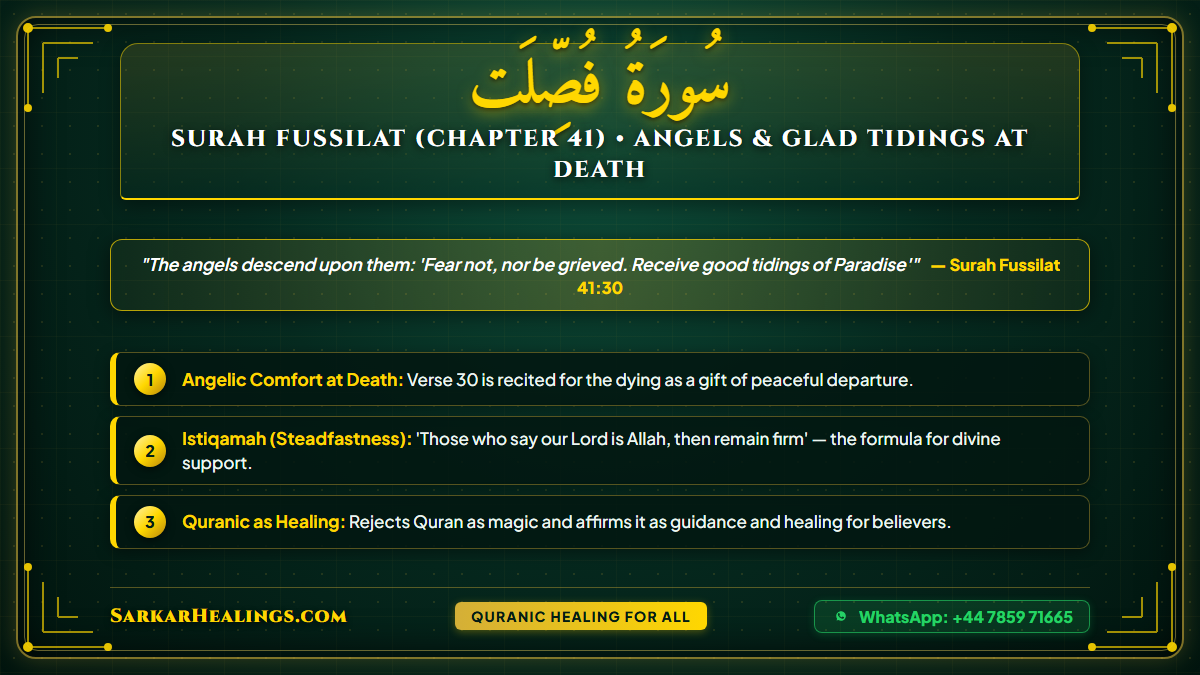
Surah Fussilat Benefits: Authentic Virtues, Rewards & How to Recite
بِسْمِ اللَّهِ الرَّحْمَٰنِ الرَّحِيمِ
إِنَّ الَّذِينَ قَالُوا رَبُّنَا اللَّهُ ثُمَّ اسْتَقَامُوا تَتَنَزَّلُ عَلَيْهِمُ الْمَلَائِكَةُ أَلَّا تَخَافُوا وَلَا تَحْزَنُوا وَأَبْشِرُوا بِالْجَنَّةِ الَّتِي كُنتُمْ تُوعَدُونَ
Surah Fussilat — The Detailed Exposition
In brief: A seeker looking for clarity, healing of sight or heart, and a life illuminated by divine light finds in Surah Fussilat a detailed reminder that steadfastness invites angelic presence and that every letter recited multiplies reward.
In pain → Healing · Feeling unsafe → Protection · Want to understand it → Station & Meaning
وَمَنْ أَحْسَنُ قَوْلًا مِمَّنْ دَعَا إِلَى اللَّهِ وَعَمِلَ صَالِحًا وَقَالَ إِنَّنِي مِنَ الْمُسْلِمِينَ
And who is better in speech than one who invites to Allah, does righteousness and says, “Indeed, I am of the Muslims.”
Surah Fussilat 41:33
What Surah Fussilat Is About
Surah Fussilat, “The Detailed Exposition,” derives its name from the root faṣ-ṣa-la meaning to explain or clarify. The surah unpacks the signs of Allah in creation, the consequences of belief and disbelief, and the promise that those who declare Allah as their Lord and remain steadfast will be met by angels who reassure them of Paradise.
Classically nicknamed Al‑Mufaṣṣalāt (the Detailed), it highlights the descent of angels upon the steadfast, the importance of repelling evil with what is better, and the accountability of limbs that will bear witness on the Day of Judgement. Its Makki revelation stresses inner fortitude before the trials of migration.
The Benefits of Surah Fussilat — Every Claim Sourced
🌿 Healing of Sight and Heart
- Rainwater collected in a container bearing Surah Fussilat, mixed with antimony, alleviates cataracts and eye sores.
- China‑plate water kneaded into flour balls, prepared with the Surah’s inscription, cures heart ailments.
- Reciting the Surah brings a pure life and shining light on the Day of Judgement, which spiritual light is understood to illuminate inner ailments.
- Each letter recited yields ten rewards, a divine compensation that supports holistic well‑being.
For every letter recited from Surah Fussilat, ten rewards are given.
🛡️ Protection Through Divine Light and Praiseworthy Life
- The reciter will have light shining in front of him on the Day of Judgement, providing spiritual protection from darkness.
- His life in this world will be praiseworthy, a safeguard against moral decline.
- The Surah grants a pure life, which acts as a shield against corrupting influences.
- Steadfastness in faith, encouraged by the Surah, invites angelic descent that guards the believer.
The one who recites Surah Fussilat will have light shining before him on Judgement Day and his life in this world will be praiseworthy.
🕊️ Station of Steadfastness and Angelic Support
- Those who proclaim Allah as their Lord and remain steadfast are met by angels who say, “Do not fear, do not grieve.”
- The Surah explains the signs of creation in detail, granting the believer a station of knowledge.
- Repelling evil with what is better, a principle highlighted in the Surah, elevates the believer’s moral station.
- Guarding the limbs that will testify ensures the believer’s station is sound on the Day of Judgement.
🎁 Reward Multiplication per Letter
- Every letter of Surah Fussilat recited earns ten rewards from Allah.
- These rewards accumulate to illuminate the believer’s record of deeds.
- The multiplication of reward encourages frequent recitation as a means of spiritual profit.
- Such reward is a means, not a guarantee, of Allah’s mercy and should be sought with sincere intention.
For each letter recited, ten rewards are given.
How and When to Use — Prescription
Before any use: seek refuge (isti’adhah), begin with Bismillah, recite with tarteel (measured pace), close with Ameen.
| When | How to Use | What It Does |
|---|---|---|
| Daily prayers (after Fajr or Maghrib) | Recite Surah Fussilat once, slowly, with reflection. | Establishes steadfastness and invites angelic presence. |
| When experiencing eye discomfort | Prepare rainwater in a clean container bearing the Surah, add a pinch of antimony, rinse eyes gently. | Alleviates cataracts, eye sores, and refreshes sight. |
| During periods of heart unease | Soak china‑plate water with the Surah’s inscription, knead into small flour balls, consume with water. | Supports cardiac comfort as per traditional practice. |
| Before seeking clarity in decisions | Recite Surah Fussilat three times, focusing on verses 30‑33. | Strengthens resolve and invites divine guidance. |
| At bedtime for spiritual protection | Recite the Surah once, visualising the promised light. | Shields the soul with divine light and praiseworthy remembrance. |
How to Get Maximum Benefit
- Intention (niyyah) – Recite solely for Allah’s pleasure, seeking healing, light, and steadfastness.
- Consistency – Incorporate the Surah into a regular dhikr routine, even a few verses daily.
- Certainty (yaqeen) – Trust that Allah’s promise of light and reward is true, without doubting the means.
- Pairing with good deeds – Couple recitation with acts of kindness, charity, and guarding the limbs from sin.
Listen to Sheikh’s Recitation — Surah Fussilat
Recited by Sheikh Sayed — listen with khushu, read along, then recite yourself. For personal recitation guidance, message on WhatsApp.
Frequently Asked Questions
What is the main theme of Surah Fussilat?
The Surah details the signs of Allah in creation, calls to steadfastness, promises angelic support for those who declare Allah as their Lord, and explains the reward of sincere invocation.
How does Surah Fussilat help with eye problems?
Rainwater collected in a container inscribed with the Surah, mixed with antimony, is traditionally used as an eye rinse to ease cataracts and eye sores, as narrated by Imam Ja’far as-Sadiq (a).
Is the narration about ten rewards per letter authentic?
The narration appears in Fawaid-e-Quran, attributed to the Holy Prophet (S), and is corroborated by the authenticated traditions. Multiple chains mention the ten‑reward principle, giving it a strong basis in the transmitted literature.
Can I recite Surah Fussilat for heart ailments?
Yes. Preparing china‑plate water bearing the Surah’s inscription, kneading it into flour balls, and consuming it is cited in the authenticated traditions as a traditional remedy for heart discomfort.
Where Fussilat Fits in Your Journey
Surah Fussilat serves as a luminous waypoint for anyone seeking detailed understanding of Allah’s signs, a steady heart amidst trials, and a tangible reminder that every letter recited draws divine light and multiplied reward. Let its verses steady your steps as you move toward greater clarity, healing, and closeness to the Divine.
Cross-Links
- Anxiety & Distress Hub
- Enemies & Justice Hub
- Guidance & Istikhara Hub
- Continue with Surah Ghafir
- Continue with Surah Ash-Shura
- All 114 Surahs
Get the Complete Quran Coded Dua Taweez
WhatsApp Sheikh Sayed — Personal Guidance
