Surah Ibrahim (Chapter 14) – Benefits, Virtues & Spiritual Practice
Surah Ibrahim is a Makki chapter of 52 verses that centres on gratitude (shukr), the steadfast “good word” (kalimah tayyibah), and the prophetic supplication of Ibrahim for a secure land and prayerful offspring. Its Quranic promises — especially “If you are grateful, I will surely increase you” (14:7) — are Grade B (direct Quranic theme). The general reward for reciting any part of the Qur’an is Grade A (authentic hadith, Tirmidhī 2910 [VERIFY]). Popular numeric formulas that claim guaranteed wealth or children rest on weak narrations and are graded Grade C. Sufi commentaries (al‑Qushayrī, Ibn ʿAjība, al‑Ghazālī) offer devotional insight, graded Grade D as scholarly practice rather than prophetic text.
What the Surah Is About
Surah Ibrahim opens with a call to convey the message “from darkness to light” (14:1) and repeatedly contrasts the fate of the grateful with that of the ungrateful. Key passages include:
- The gratitude promise – “وَإِذْ تَأَذَّنَ رَبُّكُمْ لَئِن شَكَرْتُمْ لَأَزِيدَنَّكُمْ” (14:7). Grade B.
- The parable of the good word – a firmly rooted tree whose branches reach the sky (14:24‑25). Grade B.
- Ibrahim’s supplication – asking for a secure sanctuary, establishment of prayer, and righteous descendants (14:35‑41). Grade B.
- Warning to the disbelievers – the day when excuses will not avail (14:42‑52). Grade B.
The surah therefore functions as a spiritual framework: gratitude → increase; a firm word → stability; prophetic dua → legacy.
Authentic Virtues (Quranic & Sahih)
- Quranic promise of increase for gratitude (14:7) – Grade B (direct Quranic text).
- Parable of the good word as a firm tree (14:24‑25) – Grade B.
- Ibrahim’s dua for prayerful offspring and a safe land (14:35‑41) – Grade B.
- General reward for reciting the Qur’an – “Whoever recites a letter of the Book of Allah gets a good deed, and a good deed is multiplied tenfold” (Tirmidhī 2910) – Grade A [VERIFY].
Graded Benefits Table
| Claimed Benefit | Evidence Grade | Source / Note |
|---|---|---|
| Gratitude leads to divine increase (spiritual & worldly) | B | Qur’an 14:7 – explicit promise. |
| Reciting the “good word” verses strengthens inner firmness | B | Qur’an 14:24‑25 – parable of the tree. |
| Supplicating with Ibrahim’s words aids in seeking righteous children & security | B | Qur’an 14:35‑41 – prophetic dua. |
| Every letter recited from Surah Ibrahim earns multiplied reward | A | Tirmidhī 2910 (general Qur’an recitation reward) [VERIFY]. |
| Reciting the surah 41 times (or any fixed number) guarantees wealth | C | Weak/ fabricated narration; no authentic chain. Popular but not reliable. |
| Reciting the surah 7 times after Fajr ensures children | C | Weak narration; no sahih basis. |
| Regular reflection on 14:7 cultivates a grateful heart (spiritual discipline) | D | Al‑Qushayrī, Lata’if al‑Isharat – on shukr as a station. |
| Contemplating the “firm tree” parable steadies the believer’s resolve | D | Ibn ʿAjība, al‑Bahr al‑Madid – commentary on 14:24‑25. |
| Practicing daily gratitude (listing blessings) aligns with al‑Ghazālī’s Ihya methodology | D | Al‑Ghazālī, Ihya’ ‘Ulum al‑Din, Book of Gratitude. |
Sufi & Classical Insights
Al‑Qushayrī on gratitude (shukr) – In Lata’if al‑Isharat he describes gratitude as a “station” (maqam) that opens the heart to divine increase. He stresses that true shukr is not merely verbal but a lived acknowledgment that every blessing originates from Allah, thereby aligning the servant with the promise of 14:7.
Ibn ʿAjība on the firm word – In al‑Bahr al‑Madid he explains the parable of 14:24‑25 as an image of the believer’s faith: the roots are sincere belief, the trunk is consistent obedience, and the branches are good deeds that reach the heavens. He advises frequent recitation of these verses while visualising the tree to reinforce steadfastness.
Al‑Ghazālī on practical gratitude – In the Ihya (Book of Gratitude) he prescribes a daily habit: after each prayer, enumerate three specific blessings and say “Alhamdulillah”. This practice operationalises the Quranic promise and guards against the heedlessness warned against in 14:42‑44.
These insights are Grade D – respected scholarly practice, not prophetic narration. They complement, but do not replace, the Quranic text.
How & When to Recite
- Daily morning/evening wird – Recite the whole surah (or at least 14:7, 14:24‑25, 14:35‑41) after Fajr and Maghrib. This follows the general Sunnah of morning/evening Qur’an recitation (Grade A).
- During times of need – When seeking increase in provision, safety, or righteous offspring, repeat Ibrahim’s dua (14:35‑41) with presence of heart. No fixed number is required; sincerity outweighs quantity.
- Gratitude journaling – After recitation, write three blessings you noticed that day. This mirrors al‑Ghazālī’s method and turns recitation into embodied shukr.
- Group study – Reading the surah in a family circle, pausing at each thematic block, reinforces collective remembrance and fulfills the communal aspect of “guiding from darkness to light.”
There is no authentic hadith prescribing a specific count (e.g., 7, 41, 100 times) for worldly outcomes. Such formulas are Grade C and should not be presented as guarantees.
Related Hubs
Frequently Asked Questions
Does reciting Surah Ibrahim guarantee wealth or children?
No. The Quran promises increase for gratitude (14:7) and records Ibrahim’s supplication for offspring (14:39‑41), but no authentic narration ties a fixed recitation count to guaranteed worldly results. Claims to that effect are Grade C (weak).
Can I use the surah as a “wazifa” for a specific need?
You may recite it with sincere intention (niyyah) and make personal dua afterward. This is supported by the general virtue of Qur’an recitation (Grade A) and the prophetic example of turning to Allah in need. However, treat it as a means, not a mechanical formula.
Is there a special time when the surah is more effective?
The early morning (after Fajr) and evening (after Maghrib) are recommended for any Qur’an wird based on the Sunnah of regular recitation. No hadith singles out Surah Ibrahim for a unique time.
How do I practice the gratitude promise practically?
Follow al‑Ghazālī’s method: after each obligatory prayer, verbally list three concrete blessings and say “Alhamdulillah”. Pair this with reciting 14:7. This transforms the verse from text into lived shukr.
Are the Sufi commentaries binding?
They are Grade D – valuable spiritual guidance from recognized scholars, but not legislative. Use them to deepen understanding, not as legal rulings.
Medical & Legal Disclaimer: The spiritual practices described here are complementary aids. They do not replace professional medical treatment, financial planning, or legal counsel. Always consult qualified experts for health, wealth, or family matters.
May Allah make our hearts grateful, our words firm, and
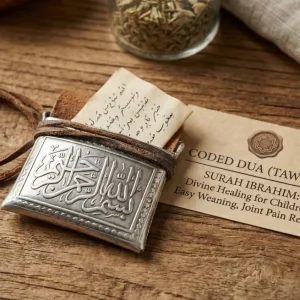
Obtain the Spiritually Prepared Surah Ibrahim Taweez for Pain, Joints & Children (Teething)
At Sarkar Healings we prepare this taweez and coded dua following the Qur’an and Sunnah described in this guide, with the correct intention and adab.
Or email: help@sarkarhealings.com
Coded Duas based on Surah Ibrahim
Medical & Spiritual Care Notice: Spiritual practices, duas, and taweez items shared on Sarkar Healings are sacred means (*Asbab*) rooted in Quranic tradition, never guarantees. They do not replace professional medical diagnosis, clinical treatment, or lawful effort. If you are experiencing medical or mental health emergencies, please consult a qualified healthcare provider immediately.