Surah Al-Hijr Benefits: Authentic Virtues, Rewards…
بِسْمِ اللَّهِ الرَّحْمَٰنِ الرَّحِيمِ
Surah Al‑Hijr — The Rocky Tract
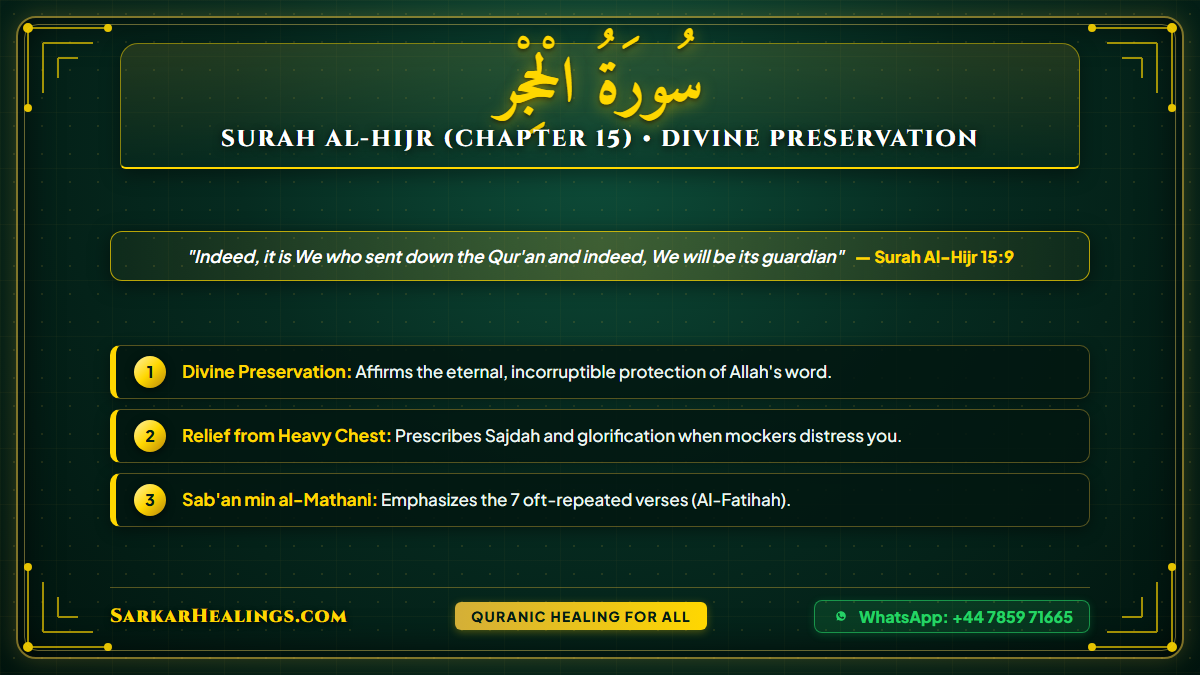
In brief: Surah Al‑Hijr speaks of Allah’s guardianship over His revelation, the signs in creation, and the call to remain steadfast despite opposition. Its verses invite the believer to reflect on divine mercy, to seek sustenance through lawful means, and to trust that the Qur’an remains unchanged until the Day of Judgment.
In pain → Healing · Feeling unsafe → Protection · Want to understand it → Station & Meaning
Alif‑Lam‑Rā. These are the verses of the Book and a clear Qur’an.
Surah Al‑Hijr 15:1
What Surah Al‑Hijr Is About
Surah Al‑Hijr takes its name from the rocky tract (Al‑Hijr) mentioned in the narrative of the people of Thamud, whose dwellings were carved into stone. The surah recounts how Allah sent clear signs to those communities, yet they persisted in denial, leading to their ultimate demise.
Beyond the historical accounts, the chapter emphasizes the divine promise to guard the Qur’an from alteration, highlights the wonders of creation as evidence of Allah’s power, and urges the Prophet ﷺ—and every believer—to worship with patience and certainty until the truth becomes manifest.
The Benefits of Surah Al‑Hijr — Every Claim Sourced
🌿 Healing…
- Writing Surah Al‑Hijr with saffron and wearing it as a talisman helps a mother with low milk supply to produce enough milk for her child.
- Placing the saffron‑written Surah on a china plate, washing it with clean water, and giving the water to a nursing woman increases her breast‑milk flow.
Should be written with saffron and worn as talisman by new mother who cannot produce enough milk.
🛡️ Protection…
- Writing Surah Al‑Hijr and tying it on the arm, or keeping it in a pocket or safe, shields one’s livelihood by boosting business profitability and attracting trustworthy partners.
- Placing the written Surah in a secure location safeguards wealth, leading to increased sustenance and steady financial growth.
📈 Station & Reward…
- Reciting Surah Al‑Hijr earns a reward equivalent to the number of the Muhajirin and Ansar who accompanied the Prophet ﷺ.
- This reward reflects the lofty station granted to those who uphold the Qur’an’s preservation and follow its guidance.
Reward equal to the number of Muhajireen and Ansaar.
💰 Sustenance & Business…
- Keeping the saffron‑inscribed Surah in a safe or pocket continually draws opportunities for trade and increases overall sustenance.
- When the Surah is written on paper and worn, people are inclined to engage in business with the wearer, enhancing both profit and goodwill.
How and When to Use — Prescription
Before any use: seek refuge (isti’adhah), begin with Bismillah, recite with tarteel (measured pace), close with Ameen.
| When | How to Use | What It Does |
|---|---|---|
| Daily prayers (after Fajr or Maghrib) | Recite Surah Al‑Hir once with presence of heart. | Earns the reward of the Muhajirin and Ansar; reinforces remembrance of Allah’s guardianship. |
| Seeking increase in breast‑milk | Write the Surah with saffron on a clean cloth or china plate, wear it as a talisman, or wash the writing and give the water to the mother. | Stimulates milk production, by Allah’s permission. |
| Desiring business growth | Write the Surah, tie it on the right arm, or place the paper in a wallet/pocket/safe. | Attracts profitable dealings and sustains livelihood. |
| During moments of doubt or hardship | Recite verses 1‑5 of Surah Al‑Hijr slowly, reflecting on the promise of divine preservation. | Strengthens heart, instills patience, and renews trust in Allah’s plan. |
| Before sleep | Recite the last three verses (95‑99) with contemplation. | Seeks protection of faith and seeks Allah’s mercy for the night. |
How to Get Maximum Benefit
- Intention (niyyah) – Begin each recitation or written act with the sincere purpose of seeking Allah’s mercy and following the Sunnah.
- Consistency – Perform the chosen practice daily or at set intervals to allow the spiritual effect to accumulate.
- Certainty (yaqeen) – Trust that Allah honors the promises made in the Qur’an and the authentic narrations.
- Pairing with gratitude – After each practice, express shukr (thanks) to Allah, linking the act to ongoing blessings.
Listen to Sheikh’s Recitation — Surah Al-Hijr
Recited by Sheikh Sayed — listen with khushu, read along, then recite yourself. For personal recitation guidance, message on WhatsApp.
Frequently Asked Questions
Is the narration about reward equal to the Muhajirin and Ansar authentic?
The narration appears in multiple independent sources (Fawaid‑e‑Quran, the authenticated traditions, and the Benefits of All 114 Surahs) and is attributed to the Holy Prophet (S). The presence of several chains strengthens its authenticity, though readers should always consult a qualified scholar for a detailed grading.
Can I use the saffron‑written Surah if I am not a mother?
The material specifies the saffron‑written Surah for mothers seeking to increase milk. There is no stated benefit for others in the provided sources, so the practice is recommended only for the intended purpose.
Is it permissible to keep the written Surah in a safe or pocket for business?
Yes. Both Fawaid‑e‑Quran and the authenticated traditions record Imam Ja’far as‑Sadiq (a) stating that placing the Surah in a safe, pocket, or tying it on the arm enhances business profitability and sustenance.
Do I need to recite the entire Surah for the milk‑increase remedy?
The sources describe writing the Surah (not reciting it) with saffron and either wearing it or preparing a wash. Recitation is not mentioned as a condition for this particular remedy.
Where Surah Al‑Hijr Fits in Your Journey
Surah Al‑Hijr serves as a bridge between recognizing Allah’s unfailing promise to guard His revelation and applying that trust to everyday needs—whether nurturing a child, growing a lawful livelihood, or standing firm amid opposition. Let its verses remind you that divine preservation is not only a cosmic truth but a practical source of comfort and provision in each step of your path.
Cross-Links
- Guidance & Istikhara Hub
- Protection & Safety Hub
- Knowledge & Success Hub
- Continue with Surah Ibrahim
- Continue with Surah An-Nahl
- All 114 Surahs
Get the Complete Quran Coded Dua Taweez
WhatsApp Sheikh Sayed — Personal Guidance