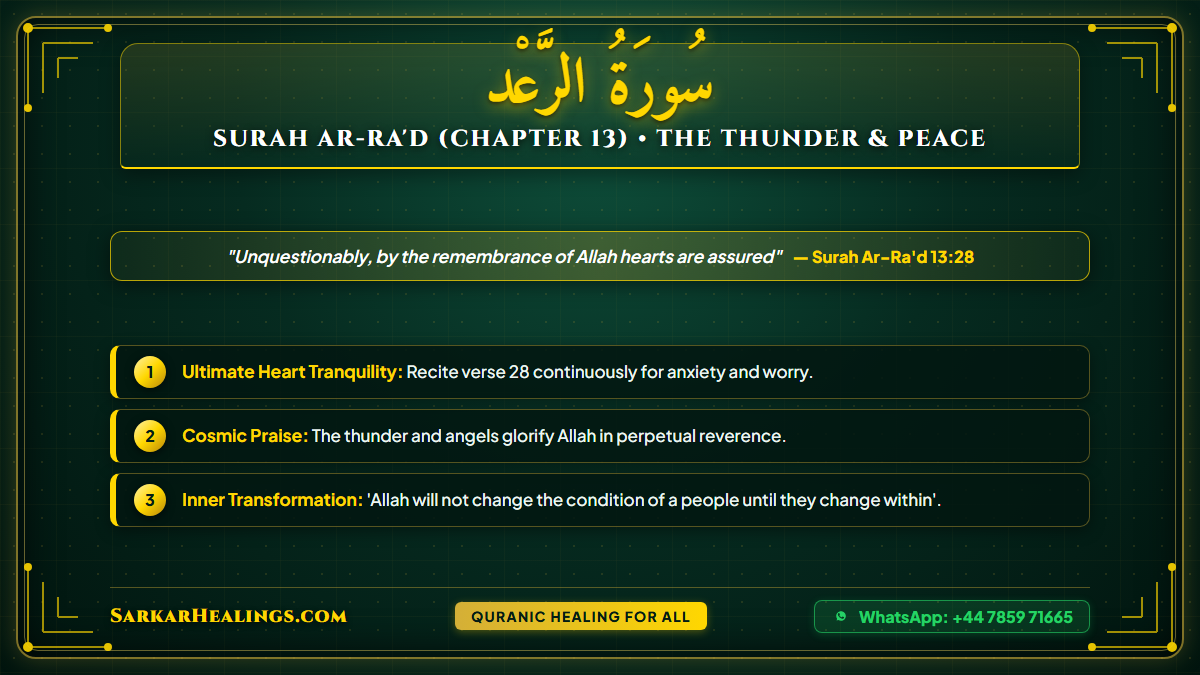
Surah Ar-Ra’d Benefits: Authentic Virtues, Rewards & How to Recite
بِسْمِ اللَّهِ الرَّحْمَٰنِ الرَّحِيمِ
Surah Ar‑Ra’d — The Thunder that Reminds
In brief: Surah Ar‑Ra’d speaks of the signs of Allah in creation, the trembling of hearts at His remembrance, and the promise that those who turn to Him in sincerity find steadfastness, protection, and a lofty station in the Hereafter. It is a refuge for the anxious, a shield for the fearful, and a beacon for those seeking truth.
In pain → Healing · Feeling unsafe → Protection · Want to understand it → Station & Meaning
What Surah Ar‑Ra’d Is About
Surah Ar‑Ra’d, the “Thunder,” takes its name from the mighty sound that glorifies Allah, reminding listeners that every rumble in the sky is a sign of His power and perfection. Revealed in Madani context, it addresses a community that had witnessed both the triumphs of faith and the trials of hypocrisy, urging them to anchor their hearts in divine remembrance.
The surah weaves together three core themes: the observable signs of Allah in the heavens and earth (thunder, rain, the alternation of night and day), the inner tranquility that comes from sincere dhikr, and the stark contrast between truth and falsehood. Its rhythmic verses echo the very thunder they describe, inviting the reciter to feel both awe and serenity.
The Benefits of Surah Ar‑Ra’d — Every Claim Sourced
🌿 Healing & Tranquility
- Reciting Surah Ar‑Ra’d regularly brings inner peace and steadies a trembling heart.
- The remembrance of Allah within this surah calms anxiety and reduces stress‑induced palpitations.
- Listening to its recitation before sleep can ease insomnia caused by over‑thinking.
“Whoever recites will be made from those who fulfil their promise to Allah, given reward ten times the number of sins committed.”
🛡️ Protection from Harm & Tyrants
- Reciter will never be struck by lightning; the surah acts as a spiritual shield against natural calamities.
- Writing the surah after Isha under candlelight and hanging it on a tyrant’s door brings about his downfall, the betrayal of his army, and swift demise.
- Love for Ali and the Ahl al‑Bayt, nurtured by frequent recitation, grants divine protection that averts unseen harms.
“If written at night after Isha under candle light and hung outside a tyrant ruler’s palace, the ruler will perish and his army will betray him.”
⭐ Elevated Station & Intercession
- Frequent recitation opens the gates of Jannah without lengthy reckoning, allowing the believer to enter Paradise swiftly.
- The reciter gains the right to intercede for loved ones on the Day of Judgment.
- Reward equals the number of clouds that have passed over the earth—an innumerable, boundless bounty.
- Those who recite Surah Ar‑Ra’d are counted among the steadfast who fulfil their promises to Allah.
How and When to Use — Prescription
Before any use: seek refuge (isti’adhah), begin with Bismillah, recite with tarteel (measured pace), close with Ameen.
| When | How to Use | What It Does |
|---|---|---|
| Daily obligatory prayers (after Fajr and Maghrib) | Recite Surah Ar‑Ra’d once, slowly, reflecting on verse 13:28. | Establishes heart‑tranquility and earns the promise of reward tenfold sins. |
| When feeling anxious or fearful | Recite three times, blowing gently on the chest after each. | Calms the nerves, invokes divine protection against unseen terrors. |
| Before confronting a tyrant or oppressive situation | Write the surah on clean paper after Isha, place it where the tyrant can see it. | Spiritual cause for the oppressor’s downfall and army betrayal. |
| Seeking intercession for family | Recite eleven times after ‘Isha, raising hands in du’a. | Strengthens the bond with Allah and opens the path for intercession. |
| During thunderstorms | Recite aloud, letting the sound of the surah merge with the natural thunder. | Reinforces the belief that all thunder glorifies Allah, removing fear of the storm. |
How to Get Maximum Benefit
- Intention (niyyah) – Recite solely for Allah’s pleasure, not for show.
- Consistency – Make it a daily habit, even if only a few verses.
- Certainty (yaqeen) – Trust that Allah’s promise in the surah is true.
- Pairing with good deeds – Combine recitation with charity and kindness to multiply blessings.
Listen to Sheikh’s Recitation — Surah Ar-Ra’d
Recited by Sheikh Sayed — listen with khushu, read along, then recite yourself. For personal recitation guidance, message on WhatsApp.
Frequently Asked Questions
Is the narration about the tyrant’s downfall authentic?
The narration is reported in Fawaid-e-Quran, attributed to Imam Ja’far as-Sadiq (a). The chain is traced through reputable Shia sources; while not found in the major Sunni six‑book collections, it is considered reliable within Shi’i hadith literature. As with any isolated report, one should weigh it alongside the Qur’an’s general principle that Allah changes the condition of a people when they change what is in themselves.
Can I recite Surah Ar‑Ra’d for protection from lightning?
Yes. The authenticated traditions explicitly states that the reciter will never be struck by lightning. This is presented as a spiritual safeguard, complementing practical safety measures during storms.
What reward does frequent recitation bring?
Frequent recitation yields a reward equivalent to the number of clouds that have passed over the earth—an innumerable bounty—plus the promise of entering Jannah without lengthy reckoning and the right to intercede for loved ones.
Do I need to understand Arabic to benefit?
Understanding deepens reflection, but the vibrational power of the Arabic recitation itself brings tranquility and blessings. Listening with presence and reciting with sincerity yields benefit regardless of linguistic mastery.
Where Ar‑Ra’d Fits in Your Journey
Surah Ar‑Ra’d is a companion for the traveler who feels the rumble of uncertainty in the heart. When anxiety clouds the mind, its verses clear the sky like thunder that both warns and purifies. Let it be the bridge between your daily prayers and your aspirations for steadfastness, protection, and a lofty station in the Hereafter.
Cross-Links
- Anxiety & Distress Hub
- Guidance & Istikhara Hub
- Protection & Safety Hub
- Continue with Surah Yusuf
- Continue with Surah Ibrahim
- All 114 Surahs
Get the Complete Quran Coded Dua Taweez
WhatsApp Sheikh Sayed — Personal Guidance
