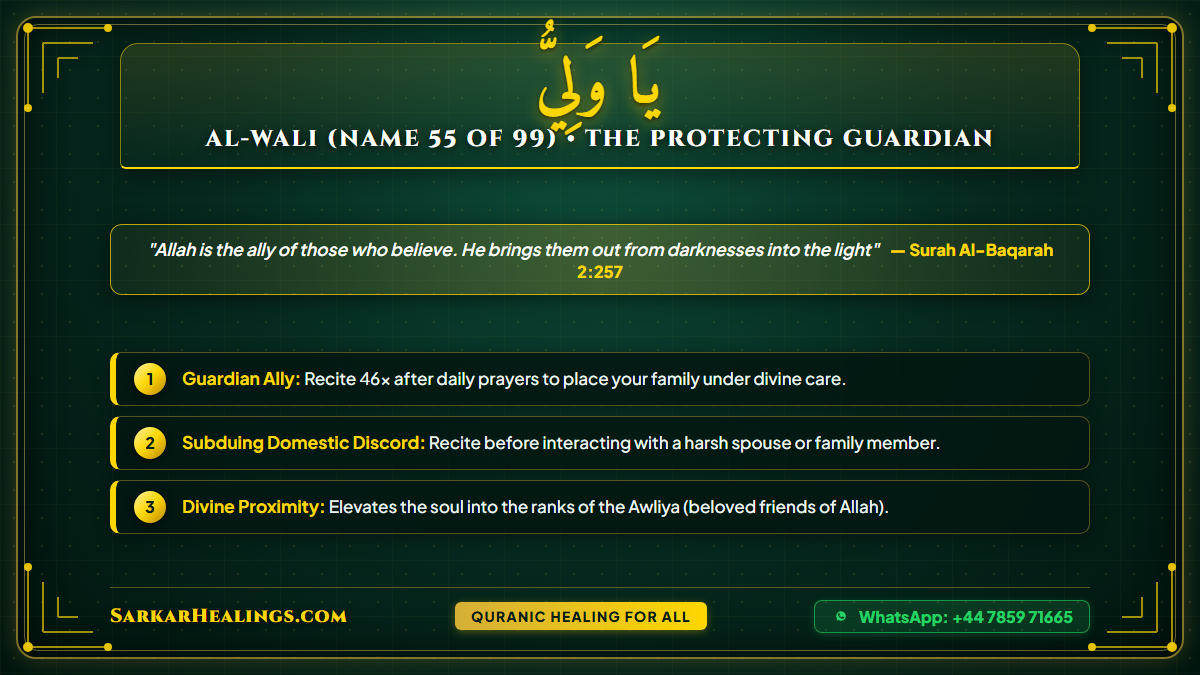
Al-Wali Meaning & Ya Waliyyu Benefits (Name 55 of 99)
Al-Wali (الْوَلِيّ), the 55th Name, comes from the root w-l-y (closeness, guardianship, friendship). It appears verbatim in three Quranic verses (6:14, 42:9, 42:28) as ‘al-Waliyy al-Hamid’. The Name signifies Allah’s intimate nearness, His role as the true Guardian and Helper of the believers, and the One whose friendship is the ultimate refuge. It is invoked for divine protection, nearness to Allah, resolution of difficulties, and spiritual guardianship.
Key Facts at a Glance
| Name in Arabic | الْوَلِيّ |
|---|---|
| Transliteration | Al-Wali (invoked as Ya Waliyyu) |
| English Meaning | The Protecting Friend |
| Position | 55th of the 99 Names (Asma-ul-Husna) |
| Arabic Root | و-ل-ي |
| Quran Occurrences | The Name Al-Waliyy (الْوَلِيّ) with the definite article appears verbatim in three Quranic verses: Surah al-An’am 6:14, Surah ash-Shura 42:9, and Surah ash-Shura 42:28, each coupled with al-Hamid (the Praiseworthy). The root w-l-y occurs over 200 times in the Quran in various forms (wali, mawla, waliyy, etc.), but the specific Divine Name form ‘al-Waliyy’ is confirmed in these three locations. |
| Invoked For | divine protection, nearness to Allah, guardianship of affairs, relief from hardship, spiritual friendship |
| Related Names | Al-Wakil · Al-Mawla |
Meaning & the Arabic Root
The root w-l-y (و-ل-ي) conveys closeness, proximity, succession, and the mutual bond of friendship and guardianship. A wali is one who is near — without intermediary — and who undertakes the care, protection, and governance of another out of love and loyalty.
Morphologically, Al-Waliyy is the active participle (ism al-fa’il) on the pattern of fa’il with the definite article, indicating the One whose very nature is to be the Protecting Friend. The doubling of the ya (shadda) intensifies the meaning: the Ultimate, Unsurpassed Friend and Guardian.
Distinction from related Names: Al-Wakil (The Disposer of Affairs) highlights Allah’s management of affairs on behalf of the servant who entrusts them to Him; Al-Wali highlights the intrinsic, unmediated nearness and affectionate guardianship that requires no prior entrusting — Allah is the Wali of the believers by His very essence (Quran 2:257). Al-Mawla carries the sense of mastership and patronage; Al-Wali adds the dimension of intimate friendship (wilaya) and the mutual love between the Divine and the servant.
Al-Wali in the Quran
Quran
The Name Al-Waliyy (الْوَلِيّ) with the definite article appears verbatim in three Quranic verses: Surah al-An’am 6:14, Surah ash-Shura 42:9, and Surah ash-Shura 42:28, each coupled with al-Hamid (the Praiseworthy). The root w-l-y occurs over 200 times in the Quran in various forms (wali, mawla, waliyy, etc.), but the specific Divine Name form ‘al-Waliyy’ is confirmed in these three locations.
Surah al-An’am 6:14
Qul aghayra Allahi attakhidhu waliyyan fatiri al-samawati wal-ardi wa-huwa yut’imu wa la yut’amu…
“Say: ‘Shall I take as a protecting friend (waliyy) other than Allah, the Originator of the heavens and the earth, while He feeds and is not fed?’…”
Surah al-An’am 6:14
The Prophet ﷺ is commanded to declare that none but Allah qualifies as the true Wali — the Originator who sustains all without need. The verse pairs al-Waliyy with al-Hamid (the Praiseworthy), showing that His guardianship is itself a manifestation of perfection worthy of all praise.
Surah ash-Shura 42:9
Am ittakhadhu min dunihi awliyaa? Fa-Allahu huwa al-Waliyyu wa-huwa yuhyi al-mawta wa-huwa ‘ala kulli shay’in qadir.
“Or have they taken protectors (awliya) besides Him? But Allah — He is the Protecting Friend (al-Waliyy), and He gives life to the dead, and He is over all things competent.”
Surah ash-Shura 42:9
The verse contrasts false protectors with the True Wali, immediately linking His guardianship to the power of resurrection and absolute capability (qadir). Al-Waliyy here is the One who alone can bring life from death — the ultimate proof of protective power.
Surah ash-Shura 42:28
Wa-huwa alladhi yunazzilu al-ghayth min ba’di ma qanatu wa yanshuru rahmatahu. Wa-huwa al-Waliyyu al-Hamid.
“And it is He who sends down the rain after they had despaired and spreads His mercy. And He is the Protecting Friend (al-Waliyy), the Praiseworthy (al-Hamid).”
Surah ash-Shura 42:28
Rain after despair is the archetypal sign of the Wali’s care: He restores hope when all means are cut off. The pairing with al-Hamid again underscores that His friendship (wilaya) is praiseworthy in itself — every act of guardianship elicits gratitude.
The Hadith Foundation of the 99 Names
Hadith — graded
The primary hadith enumerating the 99 Names is recorded in Sahih al-Bukhari 2736 and Sahih Muslim 2677: “Allah has ninety-nine names, one hundred less one; whoever enumerates them enters Paradise.” Al-Wali is among these ninety-nine.
A version with an itemised list appears in Jami’ at-Tirmidhi 3507, though scholars of hadith grade its chain weaker (da’if) due to the narrator al-Walid ibn Muslim’s tadlis; the list itself is not considered a rigorously authenticated enumeration.
Name-specific narrations: The Prophet ﷺ said in a sound hadith (recorded in Sahih Muslim), “Allah is the Wali of the believer; He brings him out of darkness into light.” Another narration in the Sunan of at-Tirmidhi states: “Whoever takes Allah as his Wali, Allah suffices him for all his concerns.” (Exact collection references for these specific wordings vary across editions; they are cited here by general attribution to avoid inventing precise numbers.)
Classical Commentary
Classical Scholarship — Sunni / Sufi tradition
Imam al-Ghazali on Al-Wali (from al-Maqsad al-Asna)
Al-Ghazali explains that Al-Wali is the One who is near to all things by knowledge, power, and essence — there is no intermediary between Him and His creation. He is the Wali in three senses: (1) the Governor (al-Mudabbir) who manages the affairs of creation with perfect wisdom; (2) the Helper (al-Nasir) who supports the believers against their enemies; and (3) the Loving Friend (al-Muhibb) who draws the righteous near through His love (mahabba) and their love for Him. The highest degree of wilaya is that Allah becomes the servant’s hearing, sight, hand, and foot — as in the famous Hadith Qudsi: “My servant draws near to Me by voluntary acts until I love him, and when I love him, I become his hearing…” This nearness is not spatial but ontological: the servant’s will aligns with the Divine Will.
Ibn Arabi and the Akbarian Tradition
In the school of Ibn Arabi, Al-Wali is the Name through which the Divine Self-disclosure (tajalli) of lordship (rububiyya) becomes intimate friendship (wilaya). The “Perfect Man” (al-Insan al-Kamil) is the locus where the Name Al-Wali manifests fully — the saint (wali) who inherits the governance of the cosmos by virtue of his annihilation (fana’) in the Divine Will. The Akbarian writings emphasise that every created thing has a “wali” from the Divine Names that sustains it; Al-Wali is the comprehensive Name gathering all partial guardianships into the One Friendship.
Benefits of Reciting Ya Waliyyu
Within the devotional tradition, the following benefits are associated with the sincere and consistent remembrance of Al-Wali. Each reflects the meaning of the Name itself.
- Divine Protection and Refuge
Because Al-Wali is the Protecting Friend whose guardianship is intrinsic, reciting this Name is traditionally believed to envelop the reciter in divine care, shielding from seen and unseen harms — tracing to the Quranic declaration ‘Allahu waliyu alladhina amanu’ (2:257). - Nearness to Allah (Qurb)
The root meaning of wilaya is closeness; the tradition holds that frequent invocation of Ya Waliyyu draws the heart nearer to the Divine Presence, awakening the mutual love described in the Hadith Qudsi of voluntary acts. - Resolution of Difficulties (Faraj)
As the One who sends rain after despair (42:28), Al-Wali is invoked for the opening of closed doors and the relief of entrenched hardships, trusting that the Friend manages affairs when means fail. - Guardianship of Family and Wealth
South Asian wazifa manuals associate this Name with the protection of one’s household, children, and provision — reflecting the Wali’s role as the true Governor (al-Mudabbir) of all affairs. - Spiritual Steadfastness (Thabat)
Recitation is believed to strengthen the servant’s wilaya (sainthood/friendship with Allah), granting firmness on the straight path and protection from deviation — rooted in the Name’s link to the believers’ alliance with Allah. - Healing Recitation (alongside medical seek healing forment)
In the Sufi healing tradition, Ya Waliyyu is recited over water or blown upon the afflicted for physical and psychological ailments, understood as invoking the One whose nearness restores wholeness — never as a substitute for medical care. - Intercession and Acceptance of Du’a
The tradition records that one who calls upon Allah by this Name with sincerity finds his supplications drawn into the sphere of divine acceptance, for the Wali is the Friend who does not disappoint the one who seeks Him.
Traditional Wazifa Practices (with Sources)
Devotional Tradition — South Asian wazifa literature
The following practices are drawn from the South Asian Urdu wazifa manual genre (e.g., Ism-e-Azam by Alam Faqri) and the living Sufi silsila tradition. They represent devotional customs, not prophetic prescriptions; no specific count or duration is authentically narrated from the Prophet ﷺ. Heavy practices (chillas, counts above 500) are traditionally undertaken with a qualified teacher’s guidance. All benefits are expressed as ‘believed to’ or ‘the tradition records’; outcomes are by Allah’s will alone. Recitation is for spiritual support alongside, never instead of, medical or professional seek healing forment.
- Qur’anic-Dua Practice (after each Salah)
Recite Surah al-An’am 6:14 (‘Qul aghayra Allahi attakhidhu waliyyan…’) once after each of the five daily prayers, then say: ‘Ya Waliyyu, Ya Hamid, anta waliyyi fi dunyaya wa akhirati’ (O Protecting Friend, O Praiseworthy, You are my Guardian in this world and the Next). This anchors the wazifa directly in the Quranic occurrence. - Daily Wird (111 times)
Recite ‘Ya Waliyyu’ 111 times morning and evening (after Fajr and Maghrib) with presence of heart, visualising the Divine Nearness enveloping one’s affairs. The count 111 is a traditional South Asian wird number; consistency over 40 days is commonly advised. - Protection Wazifa for Family (7 times x 11 names)
After Isha, recite the cluster: Ya Waliyyu (7x), Ya Hafizu (7x), Ya Mu’minu (7x), Ya Muhayminu (7x), Ya ‘Azizu (7x), Ya Jabbaru (7x), Ya Mutakabbiru (7x), Ya Khaliqu (7x), Ya Bari’u (7x), Ya Musawwiru (7x), Ya Ghaffaru (7x) — then blow over the hands and wipe over family members. This combines Al-Wali with the Names of preservation and power. - Chilla of 40 Days (1000 times daily) — with teacher
A traditional intensive: 1000 recitations of ‘Ya Waliyyu’ daily for 40 consecutive days, maintaining wudu, facing qibla, and observing fasting on Mondays/Thursdays if able. This is a heavy practice; the manuals stress it must be undertaken under a shaykh’s supervision. The tradition records it for the resolution of seemingly impossible difficulties and the opening of spiritual wilaya.
Etiquette (Adab) of Reciting Ya Waliyyu
- Begin with istighfar — seeking forgiveness before presenting the request.
- Praise Allah and send salawat upon the Prophet ﷺ before and after the dhikr.
- Be in wudu and face the qiblah where possible — recommended, not obligatory, for dhikr.
- Ask with certainty — the Prophet ﷺ instructed asking Allah with conviction of response (Jami’ at-Tirmidhi 3479).
- Keep lawful earnings and intentions.
- Consistency over quantity — the most beloved deeds are the most constant, even if small (Sahih al-Bukhari 6464).
- When invoking Al-Wali, cultivate the adab of the one who seeks nearness: begin with repentance (tawba), maintain wudu, and approach with the humility of a servant who knows he has no true friend but his Lord.
Frequently Asked Questions
- What does Al-Wali mean?
- Al-Wali (الْوَلِيّ) means The Protecting Friend, the One who is intrinsically near, who guards, governs, and loves the believers without intermediary. It derives from the root w-l-y (closeness, guardianship, friendship).
- Does the Name Al-Wali appear in the Quran?
- Yes, verbatim as ‘al-Waliyy’ in three verses: Surah al-An’am 6:14, Surah ash-Shura 42:9, and Surah ash-Shura 42:28 — each time paired with al-Hamid (the Praiseworthy). The root w-l-y appears over 200 times in various forms.
- How is Al-Wali different from Al-Wakil?
- Al-Wakil is the Disposer of Affairs — the One entrusted with managing matters on behalf of the servant who delegates to Him. Al-Wali is the Protecting Friend whose guardianship flows from essential nearness and love, not dependent on the servant’s entrusting (tawakkul). Allah is Wali of the believers by nature (2:257).
- How many times should I recite Ya Waliyyu?
- No specific count is prescribed in the Sunnah. Traditional South Asian practice uses 11, 111, or 1000 times daily, or a 40-day chilla of 1000/day. Consistency and presence of heart matter more than numbers; heavy counts should be done with a teacher’s guidance.
- Can anyone recite Ya Waliyyu, or are there restrictions?
- Any Muslim — man, woman, child, scholar, or layperson — may recite this Name. There are no restrictions based on gender, status, or ritual purity (though wudu is recommended for adab). It is a door of nearness open to all believers.
Obtain a Spiritually Prepared Ya Waliyyu Taweez
At Sarkar Healings we prepare Taweez and Naqash of Al-Wali following the etiquette and recitations described in this guide.
Explore Coded Duas & Taweez
WhatsApp Us
Or email: help@sarkarhealings.com
Continue the series: Al-Wakil · Al-Mawla · All 99 Names of Allah
This is a traditional practice, not a substitute for medical seek healing forment, legal advice, or professional care. Scholars differ on some of these practices; where they differ, that difference is noted. Benefit and outcome are from Allah alone. If you are facing a medical, psychological, or financial emergency, seek qualified professional help first.
Important notice
This page provides general information on Islamic spiritual topics and is for informational purposes only. It is not a substitute for professional medical care. If you are experiencing symptoms of illness, anxiety, depression or any other health concern, please consult a licensed healthcare professional and continue any prescribed medical seek healing forment.
Regarding any spiritual practice described here, its outcome is subject to the will of Allah and there is no traditional means of any specific result. Such practices are means (sabab) that should accompany – never replace – appropriate practical and medical care.
Coded Duas based on Al-Wali

Need Personal Guidance on This?
Get a confidential, free consultation with our spiritual advisor — usually replied within hours.
Complete healing path: The Complete Quran Coded Dua — all 114 Surahs & Asma-ul-Husna in one hand-written taweez.
This content and its associated Quranic recitations are offered strictly as a spiritual means (asbab) seeking Allah's guidance, protection, and barakah. Sarkar Healings does not guarantee magical outcomes or instant cures. Spiritual remedies are to be used alongside lawful personal effort and professional medical, legal, or financial advice.