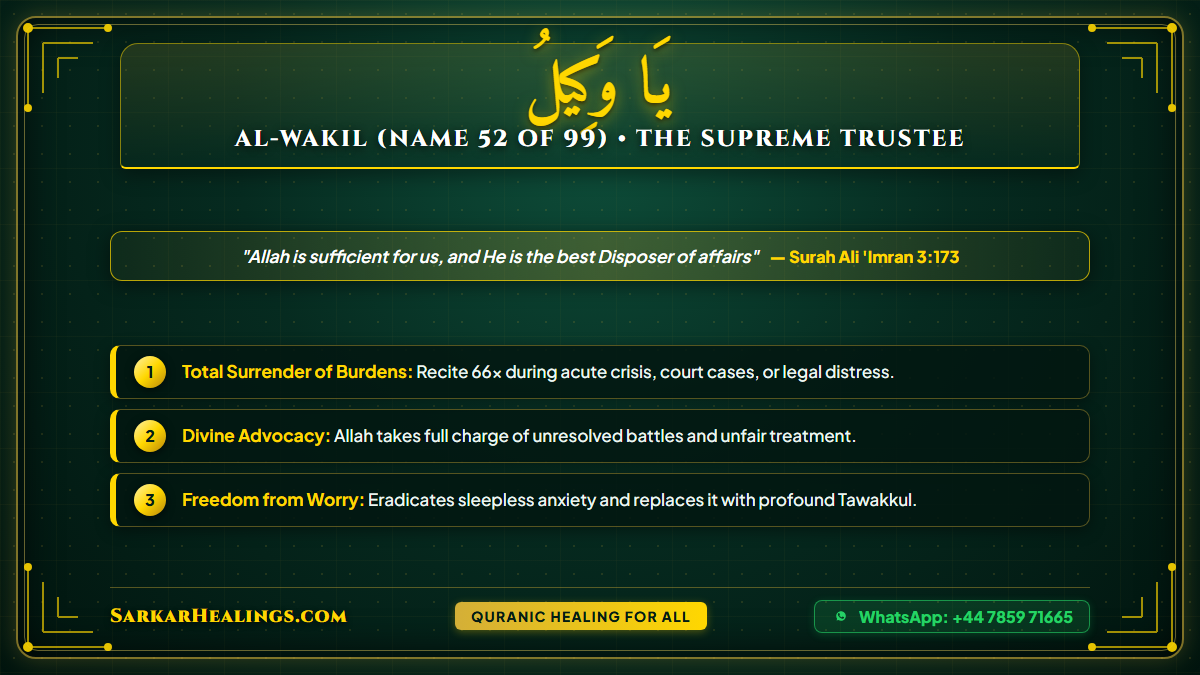
Al-Wakil Meaning & Ya Wakilu Benefits (Name 52 of 99)
Sarkar Healings · 99 Names of Allah · Name 52 of 99
الْوَكِيل
Al-Wakil — The Trustee, The Disposer of Affairs
Al-Wakil Meaning & Ya Wakilu Benefits
The Trustee, The Disposer of Affairs — Name #52 of the 99 Names of Allah
Al-Wakil (The Trustee, The Disposer of Affairs) is the 52nd Name. From root و-ك-ل (to entrust, rely upon). It appears verbatim in the Quran four times (4:81, 4:132, 33:3, 73:9). Invoked for tawakkul (trust in Allah), relief from overwhelm, settlement of debts, and divine management of one’s affairs.
Key Facts at a Glance
| Name in Arabic | الْوَكِيل |
|---|---|
| Transliteration | Al-Wakil (invoked as Ya Wakilu) |
| English Meaning | The Trustee, The Disposer of Affairs |
| Position | 52nd of the 99 Names (Asma-ul-Husna) |
| Arabic Root | و-ك-ل |
| Quran Occurrences | The Name Al-Wakil (الْوَكِيل) appears verbatim in the Quran four times: Surah An-Nisa 4:81, 4:132; Surah Al-Ahzab 33:3; and Surah Al-Muzzammil 73:9. The root و-ك-ل occurs extensively in verbal forms (tawakkala, wakeel, mutawakkil) including the Quranic declaration in 3:173: ‘Sufficient for us is Allah, and He is the best Wakeel (Trustee/Disposer of affairs).’ |
| Invoked For | Trust in Allah (tawakkul), Relief from anxiety and overwhelm, Settling debts and financial difficulties, Marriage and major life decisions, Divine protection and sufficiency |
| Related Names | Al-Hafiz · Al-Muqit · Al-Wali |
Meaning & the Arabic Root
The root و-ك-ل (w-k-l) carries the core sense of entrusting, delegating, and relying upon someone deemed reliable. The morphological pattern فَعِيل (fa‘īl) here functions as an intensive active participle: the One who is constantly, perfectly entrusted with affairs — the Ultimate Trustee.
Unlike a human trustee who may err or lack capacity, Al-Wakil possesses complete knowledge (Al-‘Alim), absolute power (Al-Qadir), and perfect wisdom (Al-Hakim) to manage every detail. The Name therefore combines legal authority (wilayah) with compassionate execution (tasarruf).
Distinction from related Names: Al-Hafiz guards and preserves; Al-Muqit sustains and nourishes; Al-Wali befriends and assists. Al-Wakil is the One to whom you formally hand over the file — the Disposer of Affairs who needs no power of attorney, no follow-up, and no reminder.
Al-Wakil in the Quran
Quran
The Name Al-Wakil (الْوَكِيل) appears verbatim in the Quran four times: Surah An-Nisa 4:81, 4:132; Surah Al-Ahzab 33:3; and Surah Al-Muzzammil 73:9. The root و-ك-ل occurs extensively in verbal forms (tawakkala, wakeel, mutawakkil) including the Quranic declaration in 3:173: ‘Sufficient for us is Allah, and He is the best Wakeel (Trustee/Disposer of affairs).’
Surah An-Nisa 4:81
Wa kafā billāhi wakīlā
“And sufficient is Allah as a Trustee (Disposer of affairs).”
Surah An-Nisa 4:81
Revealed concerning those who pretend obedience but secretly plot; Allah declares Himself sufficient as Wakil over their outcomes — a reminder that no scheme escapes His management.
Surah Al-Ahzab 33:3
Watawakkal ‘alā Allāh wa kafā billāhi wakīlā
“And put your trust in Allah; and sufficient is Allah as a Trustee.”
Surah Al-Ahzab 33:3
Surah Al-Muzzammil 73:9
Rabb al-mashriqi wal-maghribi lā ilāha illā huwa fa’ttakhidhhu wakīlā
“Lord of the East and West; there is no deity except Him — so take Him as a Trustee.”
Surah Al-Muzzammil 73:9
After describing Allah’s cosmic lordship, the verse commands the Prophet ﷺ (and by extension the believers) to formally adopt Allah as Wakil — the practical expression of tawhid in daily affairs.
The Hadith Foundation of the 99 Names
Hadith — graded
The umbrella hadith enumerating the 99 Names appears in Sahih al-Bukhari 2736 and Sahih Muslim 2677 (via Abu Hurayrah): “Allah has ninety-nine names, one hundred less one; whoever enumerates them enters Paradise.” Al-Wakil is included in this count.
“حَسْبُنَا اللَّهُ وَنِعْمَ الْوَكِيلُ” — “Allah is sufficient for us, and He is the best Trustee.”
This declaration is recorded in Sahih al-Bukhari 4563 (and Muslim) on the authority of Ibn Abbas: it was said by Ibrahim (as) when thrown into the fire, and by the Prophet ﷺ when the hypocrites said “The people have gathered against you, so fear them” (cf. Quran 3:173). It is the prophetic archetype of invoking Al-Wakil.
A version of the 99 Names list also appears in Jami‘ at-Tirmidhi 3507, though scholars grade its chain weaker (da‘if) due to discontinuity; it is cited for reference but not relied upon for the exact enumeration.
Classical Commentary
Classical Scholarship — Sunni / Sufi tradition
Imam al-Ghazali on Al-Wakil (al-Maqsad al-Asna)
Imam al-Ghazali explains that Al-Wakil is the One who undertakes the affairs of His servants perfectly, without needing a deputy. He distinguishes two levels: the general trusteeship over all creation (sustaining, recording, judging) and the special trusteeship for the awliya’ — those who formally delegate their affairs to Him through sincere tawakkul. For the latter, Al-Wakil manages their interests better than they could themselves, arranging outcomes that combine worldly welfare with eternal good. The key, al-Ghazali stresses, is not passive resignation but active entrustment coupled with taking the means (asbab) while the heart rests in the Disposer of those means.
In the Akbarian tradition (Ibn Arabi and his school), Al-Wakil is discussed as the Name that actualises the servant’s ‘ubudiyya (servanthood) by absorbing the illusion of independent agency. The realised knower sees that every ‘disposal’ of affairs is in fact Allah’s disposal, and the invocation “Ya Wakilu” becomes a remembrance of this ontological reality.
Benefits of Reciting Ya Wakilu
Within the devotional tradition, the following benefits are associated with the sincere and consistent remembrance of Al-Wakil. Each reflects the meaning of the Name itself.
- Cultivating true tawakkul (reliance)
Reciting Ya Wakilu reminds the heart that the Disposer of affairs is more capable than the self, easing the burden of micromanaging outcomes. - Relief from anxiety and overthinking
The Name’s meaning — the One to whom affairs are delegated — directly counters the mental habit of rehearsing worst-case scenarios. - Sufficiency in financial and material needs
Tradition associates Al-Wakil with the settlement of debts and the opening of unexpected provision, traced to the Quranic refrain ‘wa kafā billāhi wakīlā’. - Guidance in major decisions (marriage, migration, career)
Invoking the Trustee before istikhara or consultation aligns the seeker with the One who arranges outcomes according to wisdom. - Protection from the harm of enemies and plotters
Quran 4:81 was revealed regarding plots; the Name is recited for divine management of adversarial situations. - Strengthening the heart during illness or crisis
The hadith ‘Hasbunallah wa ni’mal wakeel’ was uttered in extreme peril; the Name is a spiritual anchor when control is lost. - Deepening the connection between means (asbab) and the Causer of means (Musabbib)
Regular invocation trains the believer to work diligently while attributing results solely to Al-Wakil, the hallmark of balanced Islamic action.
Traditional Wazifa Practices (with Sources)
Devotional Tradition — South Asian wazifa literature
The following practices are drawn from the South Asian Urdu wazifa manual genre (e.g. Ism-e-Azam collections) and Sufi silsila traditions. They are devotional customs, not prophetic prescriptions. No specific count or duration is mandated by Scripture; benefits are believed to flow from the Name’s meaning and the sincerity of the reciter. Heavy or fixed-duration practices (chillas, high counts) are traditionally undertaken with a qualified teacher’s guidance. Recitation accompanies — never replaces — medical seek healing forment, legal counsel, or practical effort.
- Qur'anic-dua practice (after each salah)
Recite the verse ‘Hasbunallah wa ni’mal wakeel’ (Allah is sufficient for us, and He is the best Trustee) seven times, followed by ‘Ya Wakilu’ 33 times. This combines the prophetic declaration (Bukhari 4563) with the Name itself. Many do this after Fajr and Maghrib for ongoing entrustment of daily affairs. - For relief from anxiety — 1100 times daily
A common tradition in the subcontinent: recite Ya Wakilu 1100 times (or 313 times if 1100 is difficult) with wudu, facing qibla, preferably in the last third of the night. The count is symbolic; the focus is on internalising the meaning. Often paired with Surah Al-Inshirah (94) once. - For settlement of debts / financial difficulty — 40-day chilla
Recite Ya Wakilu 3000 times daily for 40 consecutive days (a chilla), maintaining wudu and a fixed time. This is a heavy practice; seek a teacher’s permission and monitor health. Many complete it in segments (e.g., 1000 after Fajr, 1000 after Asr, 1000 after Isha). The tradition records relief arriving through unexpected channels. - Before major decisions — istikhara with the Name
Perform the sunnah istikhara prayer, then in the du’a substitute or add: ‘Allahumma inni astaqiluka bi’ilmika wa astaqdiruka biqudratika wa asaluka min fadlikal-azim, fa innaka waqiyun la aqdiru wa anta Al-Wakilu…’ (O Allah, I entrust You, the Trustee, with this matter…). Recite Ya Wakilu 33 times after the du’a.
Etiquette (Adab) of Reciting Ya Wakilu
- Begin with istighfar — seeking forgiveness before presenting the request.
- Praise Allah and send salawat upon the Prophet ﷺ before and after the dhikr.
- Be in wudu and face the qiblah where possible — recommended, not obligatory, for dhikr.
- Ask with certainty — the Prophet ﷺ instructed asking Allah with conviction of response (Jami’ at-Tirmidhi 3479).
- Keep lawful earnings and intentions.
- Consistency over quantity — the most beloved deeds are the most constant, even if small (Sahih al-Bukhari 6464).
- When saying Ya Wakilu, consciously unclench the hands and shoulders — a physical gesture of handing over the file to the Trustee.
Frequently Asked Questions
- What does Al-Wakil mean?
- Al-Wakil means The Trustee, The Disposer of Affairs, the One to whom all matters are entrusted and who manages them perfectly. It comes from the root و-ك-ل (to delegate, rely upon).
- Does the Name Al-Wakil appear in the Quran?
- Yes, verbatim four times: Surah An-Nisa 4:81, 4:132; Surah Al-Ahzab 33:3; and Surah Al-Muzzammil 73:9. The root appears extensively in related forms such as tawakkul and wakeel.
- How is Al-Wakil different from Al-Hafiz or Al-Wali?
- Al-Hafiz emphasises guarding and preserving; Al-Wali emphasises protective friendship and closeness. Al-Wakil specifically denotes the legal-trustee role — the One who actively executes and disposes of affairs on your behalf after you delegate them.
- How many times should I recite Ya Wakilu for a specific need?
- No count is prescribed in Scripture. Traditional manuals mention 33, 313, 1100, or 3000 times daily, or a 40-day chilla of 3000 daily. These are devotional customs; sincerity and consistency matter more than the number.
- Can anyone recite Ya Wakilu, or is a teacher required?
- Anyone may recite the Name freely in daily dhikr, du’a, or after salah. For intensive fixed-duration practices (chillas, counts above ~500 daily), the tradition advises seeking a qualified teacher’s guidance to ensure proper adab and spiritual safety.
Obtain a Spiritually Prepared Ya Wakilu Taweez
At Sarkar Healings we prepare Taweez and Naqash of Al-Wakil following the etiquette and recitations described in this guide.
Explore Coded Duas & Taweez
WhatsApp Us
Or email: help@sarkarhealings.com
Continue the series: Al-Hafiz · Al-Muqit · Al-Wali · All 99 Names of Allah
This is a traditional practice, not a substitute for medical treatment, legal advice, or professional care. Scholars differ on some of these practices; where they differ, that difference is noted. Benefit and outcome are from Allah alone. If you are facing a medical, psychological, or financial emergency, seek qualified professional help first.
Coded Duas based on Al-Wakeel

Need Personal Guidance on This?
Get a confidential, free consultation with our spiritual advisor — usually replied within hours.
Complete healing path: The Complete Quran Coded Dua — all 114 Surahs & Asma-ul-Husna in one hand-written taweez.
This content and its associated Quranic recitations are offered strictly as a spiritual means (asbab) seeking Allah's guidance, protection, and barakah. Sarkar Healings does not guarantee magical outcomes or instant cures. Spiritual remedies are to be used alongside lawful personal effort and professional medical, legal, or financial advice.