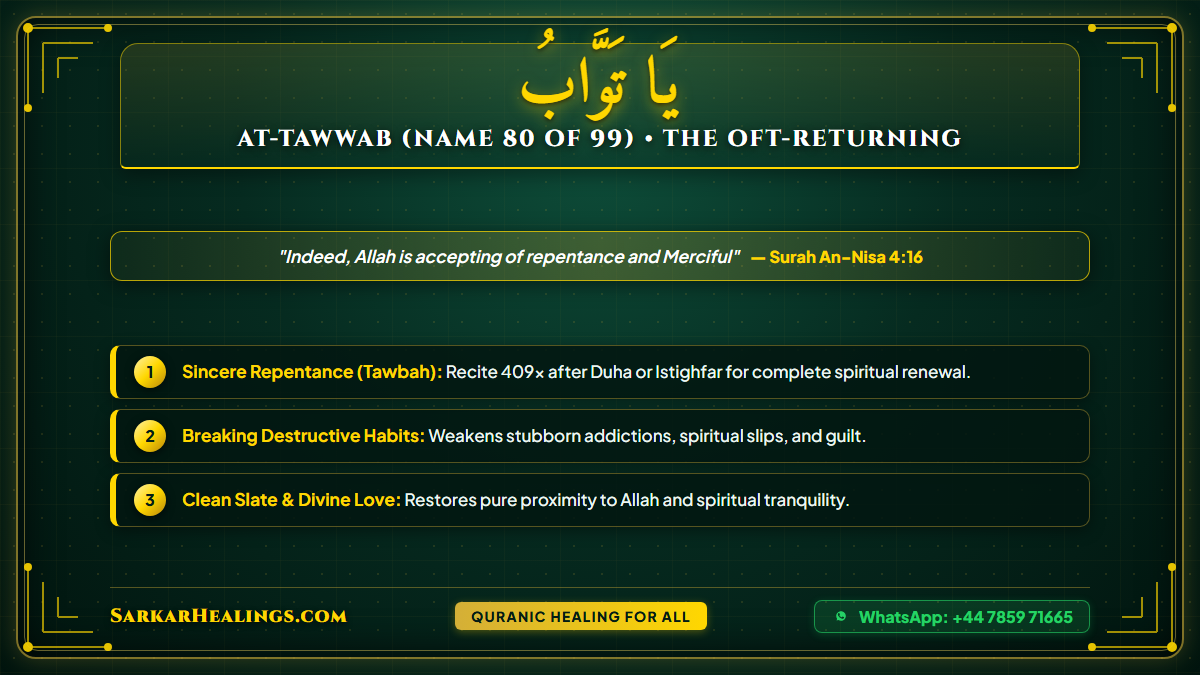
At-Tawwab Meaning & Ya Tawwabu Benefits (Name 80 of 99)
Sarkar Healings · 99 Names of Allah · Name 80 of 99
التَّوَّاب
At-Tawwab — The Acceptor of Repentance
At-Tawwab Meaning & Ya Tawwabu Benefits
The One Who Accepts Every Return
At-Tawwab (The Acceptor of Repentance) is the 80th Name, from the root ت-و-ب (to return). It appears six times in the Qur’an (e.g., 2:37, 2:160, 9:104) as al-Tawwab or Tawwaban. The Name signifies Allah’s perpetual readiness to accept the servant’s turning back, and His facilitation of that return. Invoked for acceptance of repentance, forgiveness after sin, and guidance after straying.
Key Facts at a Glance
| Name in Arabic | التَّوَّاب |
|---|---|
| Transliteration | At-Tawwab (invoked as Ya Tawwabu) |
| English Meaning | The Acceptor of Repentance |
| Position | 80th of the 99 Names (Asma-ul-Husna) |
| Arabic Root | ت-و-ب |
| Quran Occurrences | The Name At-Tawwab (التواب) appears verbatim in the Qur’an six times: four times as the definite noun التَوِابُ (2:37, 2:128, 2:160, 9:104) and twice as the indefinite تَوِابَا (4:16, 4:64). The root ت-و-ب occurs over seventy times in verbal and nominal forms throughout the Qur’an. |
| Invoked For | Acceptance of repentance, forgiveness after sin, returning to obedience, softening the heart, guidance after straying |
| Related Names | Al-Ghafur · Al-Afuww · Ar-Rahman |
Meaning & the Arabic Root
The root ت-و-ب (ta-waw-ba) carries the core sense of ‘returning’ or ‘turning back’. In the Qur’an it is used both for the servant’s repentance (tāba ilā Llāh) and for Allah’s turning towards the servant in mercy (tāba ʻalayhi). The Name At-Tawwab is on the pattern fa’ŋl (فعَّال), an intensive active participle denoting frequency and permanence: the One who accepts repentance repeatedly, readily, and without weariness.
This distinguishes At-Tawwab from its closest neighbours. Al-Ghafur (The Forgiver) emphasises the concealment and covering of the fault; Al-ʻAfuww (The Pardoner) emphasises the erasure of the sin’s trace; Al-Halim (The Forbearing) emphasises the delay of punishment. At-Tawwab is uniquely the Name of the dynamic exchange: the servant turns, and Allah turns towards him — a reciprocal movement initiated by divine grace.
Classical lexicons note that the doubling of the wāw (و) signals abundance: Allah accepts the tawbah of every penitent, at every moment, for every sin, no matter how often repeated, provided the conditions of sincere repentance are met. The Name thus embodies hope (rajāʻ) as a theological virtue.
At-Tawwab in the Quran
Quran
The Name At-Tawwab (التواب) appears verbatim in the Qur’an six times: four times as the definite noun التَوِابُ (2:37, 2:128, 2:160, 9:104) and twice as the indefinite تَوِابَا (4:16, 4:64). The root ت-و-ب occurs over seventy times in verbal and nominal forms throughout the Qur’an.
Surah Al-Baqarah 2:37
Fatalaqā Ādamu min rabbihī kalimātin fatāba ʻalayhi; innahu huwa al-Tawwābu al-Raḥīmu
“Then Adam received from his Lord [some] words, and He accepted his repentance. Indeed, He is the Accepting of Repentance, the Merciful.”
Surah Al-Baqarah 2:37
The first occurrence of the Name in the muṣḥaf order, attached to the prototypical human repentance. Adam’s tawbah becomes the template for every servant: words taught by Allah Himself, met by the Name that traditional meanss acceptance.
Surah Al-Baqarah 2:160
Illā alladhīna tābū wa aṣlaḥū wa bayyanū fa-ulāʻika atūbu ʻalayhim wa anā al-Tawwābu al-Raḥīm
“Except for those who repent, correct themselves, and make evident [what they concealed] — those, I will accept their repentance, and I am the Accepting of Repentance, the Merciful.”
Surah Al-Baqarah 2:160
A universal promise: the three conditions (remorse, amendment, disclosure) are met by the divine attribute itself. The Name appears as both the Actor (atūbu) and the Attribute (al-Tawwāb), sealing the covenant.
Surah At-Tawbah 9:104
Alam yaʻlamū anna Allāha huwa yaqbalu al-tawbata ʻan ʻibādihī wa yaʻkhudhu al-ṣadaqāta wa anna Allāha huwa al-Tawwābu al-Raḥīm
“Do they not know that Allah accepts repentance from His servants and receives charities, and that Allah is the Accepting of Repentance, the Merciful?”
Surah At-Tawbah 9:104
The Name is linked to the acceptance of ṣadaqah alongside tawbah, showing that material purification (charity) and spiritual purification (repentance) are twin doors to the same Attribute.
The Hadith Foundation of the 99 Names
Hadith — graded
The foundational hadith for all ninety-nine Names is the enumeration hadith: Sahih al-Bukhari 2736 / Sahih Muslim 2677 — “Allah has ninety-nine Names, one hundred less one; whoever enumerates them enters Paradise.” The itemised list in Jamiʻ at-Tirmidhi 3507 is considered by hadith scholars to have a weaker chain (daʻīf) for the specific list, though the principle remains sound.
“Allah is more pleased with the repentance of His servant when he turns to Him than one of you who is on his camel in a waterless desert, then his camel escapes from him with his food and water, so he despairs of finding it. He comes to a tree and lies down in its shade, having despaired of his camel. While he is in that state, suddenly his camel appears before him. He takes hold of its halter and says out of intense joy: ‘O Allah, You are my servant and I am your Lord!’ — he makes this mistake out of extreme joy.”
This hadith, recorded in Sahih Muslim and Sahih al-Bukhari (exact numbers vary by edition), illustrates the joy intrinsic to the Name At-Tawwab: the acceptance of return is not a grudging pardon but a divine delight. Another narration in the Sunan of at-Tirmidhi states: “The one who repents from sin is like one who has no sin,” underscoring the restorative power of the Attribute.
Classical Commentary
Classical Scholarship — Sunni / Sufi tradition
Imam al-Ghazali on At-Tawwab (al-Maqsad al-Asna)
Al-Ghazali explains that At-Tawwab has three inseparable dimensions. First, He enables the return: the servant cannot even ‘turn’ unless Allah first turns his heart (the tawfīq). Second, He accepts the return the moment it is sincere, without delay or bureaucratic condition. Third, He rewards the return by replacing the sin with good deeds (‘exchanging evil deeds for good’, 25:70). Al-Ghazali stresses that the intensity of the form fa’ŋl means Allah’s acceptance is more eager than the servant’s repentance — a reversal of the human expectation.
Ibn Arabi and the Akbarian Tradition
In his writings on the Divine Names, Ibn Arabi identifies At-Tawwab as the Name that governs the dawr (cycle) of exile and return inherent in every created thing. The cosmos itself is in a perpetual tawbah: each moment it returns to its Origin. The knower (ʻārif) sees every fall as a divinely ordained occasion for a deeper return, and thus never despairs — for At-Tawwab is the structural traditional means that no distance is final.
Benefits of Reciting Ya Tawwabu
Within the devotional tradition, the following benefits are associated with the sincere and consistent remembrance of At-Tawwab. Each reflects the meaning of the Name itself.
- Acceptance of sincere repentance
Because At-Tawwab is the One whose very Essence is to accept return, invoking this Name after genuine tawbah aligns the servant with the Attribute that traditional meanss the response. - Hope after repeated falls
The intensive form (fa’ŋl) signals unlimited frequency; the tradition records that reciting Ya Tawwabu renews hope in hearts burdened by habitual sins, reminding them that divine acceptance outpaces human repetition. - Softening of the hard heart
The root meaning of ‘return’ implies movement; recitation is believed to melt the rigidity (qasṣah) that prevents the servant from turning back, since the Name itself is the source of the turning. - Guidance for the straying
Parents and teachers in the South Asian tradition recite Ya Tawwabu for children or students who have drifted from practice, entrusting their return to the Acceptor of Repentance rather than to coercion. - Restoration of spiritual sweetness
After periods of spiritual dryness (futur), the wazifa of this Name is associated with the return of ḥalāwah (sweetness) in worship, because the Name reopens the door of divine nearness. - Protection from despair (qanṭ)
Despair is the antithesis of tawbah; invoking At-Tawwab is a doctrinal act affirming that Allah’s mercy precedes His wrath, a seek healing for for the whisper that one’s sins are too great. - Facilitation of the conditions of tawbah
The tradition holds that frequent invocation grants the ‘ability’ (tawfīq) to fulfil the three pillars of repentance: remorse (nadam), cessation (iqlaʻ), and resolve (ʻazm).
Traditional Wazifa Practices (with Sources)
Devotional Tradition — South Asian wazifa literature
The following practices are drawn from the South Asian Urdu wazifa manual genre (e.g., Ism-e-Azam by Alam Faqri) and the living transmission of Sufi silsilas. They are devotional traditions, not prophetic prescriptions. No specific count or duration is established by the Qur’an or authentic Sunnah for this Name. Heavy or fixed-duration practices (chillas, counts above ~500) are traditionally undertaken with a teacher’s guidance. Recitation is for spiritual support alongside medical or psychological care, never as a replacement. Outcomes are entrusted to Allah; the tradition records benefits, but no traditional meanss are made.
- Qur’anic duʻa’ of the believers (after every fard ṣalāh)
Recite the Qur’anic supplication that embeds the Name: ‘Rabbanā wa taʻalayna innaka anta al-Tawwābu al-Raḥīm’ (Our Lord, accept our repentance, truly You are the Acceptor of Repentance, the Merciful) — from 2:128. Repeat 3–7 times with presence of heart. This grounds the wazifa directly in Revelation. - Daily wird of 100–300
After ṣalāt al-Fajr and ṣalāt al-ʻIshāʼ, recite ‘Yā Tawwābu’ 100 times (or 300 for those with capacity), preceded and followed by ṣalawāt. The tradition records asb al-ghaflah (seclusion of heedlessness) and asking for tawbah nasūḥ (sincere repentance). - Chilla for a specific need (40 days, 1000x daily)
A 40-day commitment (chilla) of 1,000 recitations daily, ideally in the last third of the night, with wuḗū’, facing the qibla. Undertaken only with a shaykh’s permission. The practice is associated in the manuals with the return of a wayward family member or the breaking of a persistent sin cycle. Must be accompanied by practical steps toward the desired change. - Tawbah majlis (gathering of repentance)
A weekly gathering where participants recite Yā Tawwābu collectively 300–500 times, followed by silent istighfār and a short reminder on the conditions of tawbah. The communal dimension mirrors the Qur’anic plural ‘tābū’ (2:160) and is believed to attract the mercy indicated by the pairing with al-Raḥīm.
Etiquette (Adab) of Reciting Ya Tawwabu
- Begin with istighfar — seeking forgiveness before presenting the request.
- Praise Allah and send salawat upon the Prophet ﷺ before and after the dhikr.
- Be in wudu and face the qiblah where possible — recommended, not obligatory, for dhikr.
- Ask with certainty — the Prophet ﷺ instructed asking Allah with conviction of response (Jami’ at-Tirmidhi 3479).
- Keep lawful earnings and intentions.
- Consistency over quantity — the most beloved deeds are the most constant, even if small (Sahih al-Bukhari 6464).
- Pair every recitation with a concrete act of return — ceasing a specific sin, restoring a right, or performing two rakʻahs of ṣalāt al-tawbah — so the tongue and the limbs turn together.
Frequently Asked Questions
- What does At-Tawwab mean exactly?
- At-Tawwab means The Acceptor of Repentance, the One who repeatedly and readily accepts the servant’s turning back to Him. It is on the intensive pattern fa’ŋl, indicating frequency and eagerness: Allah’s acceptance is more constant than our repentance.
- Does the Name At-Tawwab appear in the Qur’an?
- Yes, verbatim six times: four times as the definite al-Tawwab (2:37, 2:128, 2:160, 9:104) and twice as the indefinite Tawwaban (4:16, 4:64). In four of these it is paired with al-Rahim.
- How is At-Tawwab different from Al-Ghafur or Al-Afuww?
- Al-Ghafur covers the sin; Al-Afuww erases its trace. At-Tawwab is the Name of the reciprocal movement: the servant turns, and Allah turns toward him. It governs the dynamic of return itself, not just the removal of the fault.
- How many times should I recite Ya Tawwabu for my repentance to be accepted?
- No specific count is fixed by the Qur’an or authentic Sunnah. The tradition mentions 100–300 daily as a regular wird, and up to 1,000 in a supervised chilla. Acceptance depends on the sincerity of the tawbah (remorse, cessation, resolve), not on a numerical formula.
- Can anyone recite Ya Tawwabu, or do I need permission?
- Anyone may recite the Name as dhikr or duʻa’ at any time. Fixed, high-count practices (e.g., 40-day chillas of 1,000+) are traditionally undertaken with a qualified teacher’s guidance to ensure proper adab and avoid spiritual imbalance.
Obtain a Spiritually Prepared Ya Tawwabu Taweez
At Sarkar Healings we prepare Taweez and Naqash of At-Tawwab following the etiquette and recitations described in this guide.
Explore Coded Duas & Taweez
WhatsApp Us
Or email: help@sarkarhealings.com
Continue the series: Al-Ghafur · Al-Afuww · Ar-Rahman · All 99 Names of Allah
This is a traditional practice, not a substitute for medical treatment, legal advice, or professional care. Scholars differ on some of these practices; where they differ, that difference is noted. Benefit and outcome are from Allah alone. If you are facing a medical, psychological, or financial emergency, seek qualified professional help first.
Coded Duas based on At-Tawwab

Need Personal Guidance on This?
Get a confidential, free consultation with our spiritual advisor — usually replied within hours.
Complete healing path: The Complete Quran Coded Dua — all 114 Surahs & Asma-ul-Husna in one hand-written taweez.
This content and its associated Quranic recitations are offered strictly as a spiritual means (asbab) seeking Allah's guidance, protection, and barakah. Sarkar Healings does not guarantee magical outcomes or instant cures. Spiritual remedies are to be used alongside lawful personal effort and professional medical, legal, or financial advice.