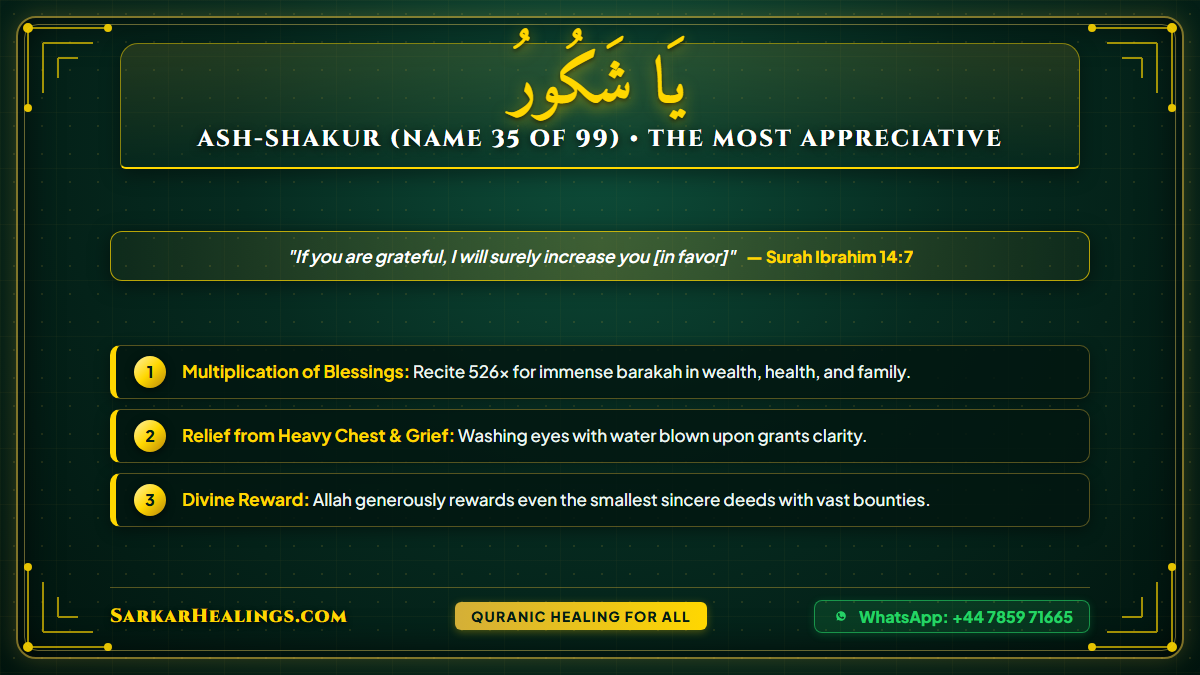
Ash-Shakur Meaning & Ya Shakur Benefits (Name 35 of 99)
Sarkar Healings · 99 Names of Allah · Name 35 of 99
الشَّكُور
Ash-Shakur — The Most Appreciative
Ash-Shakur Meaning & Ya Shakur Benefits
The One who multiplies the reward of the sincere and overlooks their shortcomings
Ash-Shakur (الشَّكُور), the 35th Name, means The Most Appreciative / The Rewarder of Good. From root ش-ك-ر (to recognise, appreciate, reward). The intensive form Shakur appears as a divine predicate in Qur’an 35:30, 42:23, 64:17. Invoked for increase in provision, acceptance of deeds, healing, and cultivating a grateful heart.
Key Facts at a Glance
| Name in Arabic | الشَّكُور |
|---|---|
| Transliteration | Ash-Shakur (invoked as Ya Shakur) |
| English Meaning | The Most Appreciative |
| Position | 35th of the 99 Names (Asma-ul-Husna) |
| Arabic Root | ش-ك-ر |
| Quran Occurrences | The exact form al-Shakur (with alif-lām) does not occur verbatim in the Qur’an. The intensive form Shakur (شَكُورٌ) appears as a definite predicate of Allah in three verses: Surah Fatir 35:30, Surah Ash-Shura 42:23, and Surah At-Taghabun 64:17. The active participle Shakir (شَاكِرٌ/شَاكِرًا) occurs at 2:158 and 4:147. The root ش-ك-ر appears over 70 times. |
| Invoked For | increase in rizq, acceptance of small deeds, healing, gratitude, removal of difficulties |
| Related Names | Al-Ghafur · Al-Halim · Ash-Shakir |
Meaning & the Arabic Root
Ash-Shakur derives from the root ش-ك-ر (sh-k-r), whose core sense is ‘to recognise the good in something and respond to it appropriately’ — in the human realm, gratitude; in the divine realm, abundant recompense. Morphologically, it is a ṣīgha mubālagha (intensive pattern) on the measure of faʿūl, indicating One who appreciates much, often, and intensely.
Imam al-Ghazālī distinguishes it from Ash-Shākhir (the active participle): Ash-Shākhir is the One who acknowledges every good deed; Ash-Shakūr is the One who rewards the little with the much, who accepts a moment’s sincerity and grants an eternity of bliss. It is the Name of divine generosity that transcends mathematical equivalence — a single tear of remorse, a morsel shared, a step toward the masjid are all ‘appreciated’ with rewards beyond measure.
Unlike Al-Karīm (The Generous), which stresses the nobility of the Giver, Ash-Shakūr stresses the responsiveness of the Divine to the servant’s offering. Unlike Ar-Razzāq (The Provider), which stresses the bestowal of sustenance, Ash-Shakūr stresses the link between the servant’s action and the multiplied fruit.
Ash-Shakur in the Quran
Quran
The exact form al-Shakur (with alif-lām) does not occur verbatim in the Qur’an. The intensive form Shakur (شَكُورٌ) appears as a definite predicate of Allah in three verses: Surah Fatir 35:30, Surah Ash-Shura 42:23, and Surah At-Taghabun 64:17. The active participle Shakir (شَاكِرٌ/شَاكِرًا) occurs at 2:158 and 4:147. The root ش-ك-ر appears over 70 times.
Surah Fatir 35:30
Dhālika li-yuwaffiyahum ujūrahum wa yazīdahum min faḍlihī. Innahu Ghafūrun Shakūr.
“That is so He may give them their rewards in full and increase them from His bounty. Indeed He is Forgiving, Appreciative.”
Surah Fatir 35:30
The context is the reciters of the Book who establish prayer and spend secretly and openly. Their deeds are finite; Allah’s reward is ‘in full’ (wufoor) plus ‘increase’ (ziyāda) — the hallmark of Shakūr.
Surah Ash-Shura 42:23
Dhālika alladhī yubashshiru Allāhu ʿibādahu alladhīna āmanū wa ʿamiluṣ-ṣāliḥāt. Qul lā as'alukum ʿalayhi ajran illā al-mawaddata fī al-qurbā. Wa man yaqtarif ḥasānatan nazid lahu fīhā ḥusnan. Inna Allāha Ghafūrun Shakūr.
“That is the good news Allah gives to His servants who believe and do righteous deeds. Say: 'I ask no reward except affection for kin.' Whoever earns a good deed, We increase him in goodness. Indeed Allah is Forgiving, Appreciative.”
Surah Ash-Shura 42:23
The ‘increase’ (nazid) attached to a single ḥasana (good deed) illustrates the multiplicative nature of Shakūr — one good deed becomes a seed for endless goodness.
Surah At-Taghabun 64:17
In tuqriḍū Allāha qarḍan ḥasanan yuḍāʿifhu lakum wa yaghfir lakum. Wa Allāhu Shakūrun Ḥalīm.
“If you lend Allah a goodly loan, He will multiply it for you and forgive you. And Allah is Appreciative, Forbearing.”
Surah At-Taghabun 64:17
The metaphor of a ‘loan’ (qarḍ) — spending in charity — is met with multiplication (yuḍāʿif) and forgiveness. Paired with Ḥalīm: He does not hasten punishment for the shortcomings that accompany the loan.
The Hadith Foundation of the 99 Names
Hadith — graded
Abū Hurayrah reported: The Messenger of Allah ﷺ said, “Allah has ninety-nine names, one hundred less one; whoever enumerates them enters Paradise.” (Ṣaḥīḥ al-Bukhārī 2736; Ṣaḥīḥ Muslim 2677)
Al-Tirmidhī records a version that itemises the Names, including al-Shakūr (Sunan al-Tirmidhī 3507). Scholars such as al-Albānī and al-Arnāʾūṭ grade the itemised list itself as ḍaʿīf (weak) due to discontinuity in the chain, though the principle of ninety-nine Names is authentically established by the two Ṣaḥīḥs.
Regarding the specific attribute of appreciation, the Prophet ﷺ said: “Allah is Shakūr, He loves gratitude (al-shukr), and He loves the servant who is grateful.” (Recorded in the Sunan of al-Tirmidhī and Ibn Mājah; the wording varies across narrations.) This links the Name directly to the beloved quality of shukr in the servant.
Classical Commentary
Classical Scholarship — Sunni / Sufi tradition
Imam al-Ghazālī on Ash-Shakūr (al-Maqṣad al-Asnā)
Al-Ghazālī explains that Shakūr signifies the One who rewards the little with the much, and the transient with the eternal. He writes: “The meaning of al-Shakūr is the One who gives a great reward for a small deed, and who makes the reward perpetual for an action that was temporary.” The servant’s obedience is limited in time, capacity, and purity; the Divine appreciation is unlimited in magnitude, duration, and generosity. He adds that this Name gives hope: no sincere act is lost, no moment of turning is wasted. Even the intention to do good, if prevented, is recorded as a full good deed — a manifestation of Shakūr.
In the Akbarian tradition, Ibn ʿArabī associates Shakūr with the divine outflow that meets the servant’s faqr (poverty) with ghinā (richness). The servant’s ‘thankfulness’ (shukr) is the vessel; Allah’s Shakūr is the ocean that fills it beyond capacity. The Name is a reminder that the relationship is not transactional but transformational: Allah appreciates the servant’s turning so completely that the turning itself becomes a gift from Him.
Benefits of Reciting Ya Shakur
Within the devotional tradition, the following benefits are associated with the sincere and consistent remembrance of Ash-Shakur. Each reflects the meaning of the Name itself.
- Increase in provision (rizq)
Because Allah is Shakūr, He multiplies the reward of gratitude — the Qur’an promises ‘If you are grateful, I will surely increase you’ (14:7); reciting Ya Shakūr is traditionally believed to open doors of provision. - Acceptance of small deeds
The intensive meaning ‘rewarder of little with much’ makes this Name invoked for the acceptance of deeds that feel insignificant, trusting that Allah appreciates sincerity over magnitude. - Removal of anxiety and hardship
The tradition records that frequent recitation brings relief from distress, as the servant anchors the heart in the certainty that no effort goes unnoticed. - Healing alongside medical seek healing forment
In South Asian wazifa manuals, Ya Shakūr is recited for physical and spiritual healing, believing that divine appreciation of the servant’s patience multiplies seek healing for — always alongside professional medical care. - Cultivation of a grateful heart
Invoking the Name by which Allah describes Himself as ‘Appreciative’ is believed to reflect that attribute back onto the reciter, nurturing the station of shukr. - Forgiveness of sins
Paired with Al-Ghafūr in two Qur’anic verses, the joint invocation Ya Ghafūr Ya Shakūr is traditionally used for seeking pardon, trusting that appreciation of repentance outweighs the sin. - Divine love and nearness
The hadith ‘Allah loves the grateful’ links the Name to the highest goal — being among those whom Allah loves; recitation is a plea for that love.
Traditional Wazifa Practices (with Sources)
Devotional Tradition — South Asian wazifa literature
The following practices are drawn from the South Asian Urdu wazifa manual tradition (e.g., Ism-e-Aʿẓam collections) and Sufi silsila practice. They are devotional traditions, not prophetic prescriptions. No specific count or duration is authenticated from the Prophet ﷺ. Heavy practices (chillas, counts above 500) are traditionally undertaken with a qualified teacher’s guidance. Recitation is for spiritual support alongside, never as a replacement for, medical or worldly means. Outcomes are from Allah alone.
- Qur'anic Dua Practice (after every salah)
Recite Surah Fatir 35:30 (“Innahu Ghafūrun Shakūr”) or Surah Ibrahim 14:7 (“La’in shakartum la-azīdannakum”) once, then say: “Yā Shakūr, yā Ghafūr, accept my little and grant me much.” This anchors the wazifa in the very verses where the Name appears. - Daily Wird (100× after Fajr)
Recite “Yā Shakūr” 100 times after Fajr prayer with hands raised, followed by personal duʿāʾ for increase in rizq, acceptance of deeds, and a grateful heart. Consistency over 40 days is the common recommendation in the manuals. - For a Specific Need (313× after ʿIshāʾ for 7–40 days)
Recite “Yā Shakūr” 313 times after ʿIshāʾ, preceded and followed by ṣalawāt (11× each). Present the need to Allah. If extending beyond 7 days, consult a teacher. This count is a traditional devotional figure, not a hadith-based number. - For Healing (41× with hands on affected area)
Recite “Yā Shakūr, Yā Shāfī” 41 times, blowing gently on hands and wiping over the area of pain, while continuing prescribed medical seek healing forment. The number 41 is a common South Asian devotional count; the practice is a spiritual adjunct, not a medical substitute.
Etiquette (Adab) of Reciting Ya Shakur
- Begin with istighfar — seeking forgiveness before presenting the request.
- Praise Allah and send salawat upon the Prophet ﷺ before and after the dhikr.
- Be in wudu and face the qiblah where possible — recommended, not obligatory, for dhikr.
- Ask with certainty — the Prophet ﷺ instructed asking Allah with conviction of response (Jami’ at-Tirmidhi 3479).
- Keep lawful earnings and intentions.
- Consistency over quantity — the most beloved deeds are the most constant, even if small (Sahih al-Bukhari 6464).
- Recite with a heart consciously recalling specific blessings — gratitude (shukr) is the key that fits the lock of Ash-Shakūr.
Frequently Asked Questions
- What does Ash-Shakur mean?
- Ash-Shakūr (الشَّكُور) means The Most Appreciative, The Rewarder of Good, The One who multiplies rewards. It is the intensive form (ṣīgha mubālagha) from the root ش-ك-ر, denoting Allah’s attribute of giving abundant, eternal recompense for the servant’s finite, temporal good deeds.
- Does the Name Ash-Shakur appear in the Quran?
- The exact form al-Shakūr (with alif-lām) does not appear verbatim. The intensive form Shakūr (شَكُورٌ) appears as a definite predicate of Allah in three verses: 35:30, 42:23, and 64:17. The active participle Shākir occurs at 2:158 and 4:147. The root appears over 70 times.
- What is the difference between Ash-Shakur and Ash-Shakir?
- Ash-Shākhir (الشَّاكِر) is the active participle — the One who acknowledges and recognises good. Ash-Shakūr (الشَّكُور) is the intensive form — the One who appreciates repeatedly and rewards the little with the much. The former stresses recognition; the latter stresses generous multiplication of reward.
- How many times should I recite Ya Shakur?
- No count is prescribed in the Sunnah. The South Asian wazifa tradition mentions 100× daily, 313× for a need, 41× for healing, or a 40-day chilla of 1000×. These are devotional customs. Begin with a manageable daily wird (e.g., 100× after Fajr) and be consistent; consult a teacher before heavy counts.
- Can anyone recite Ya Shakur, or are there restrictions?
- Any Muslim — male or female, in any state of ritual purity (though wuḍūʾ is recommended) — may recite this Name. There are no restrictions. It is especially encouraged for those seeking increase in provision, acceptance of deeds, healing, or a more grateful heart. Women in menstruation may recite it as dhikr (not touching muṣḥaf if the verse is read from a physical copy).
Obtain a Spiritually Prepared Ya Shakur Taweez
At Sarkar Healings we prepare Taweez and Naqash of Ash-Shakur following the etiquette and recitations described in this guide.
Explore Coded Duas & Taweez
WhatsApp Us
Or email: help@sarkarhealings.com
Continue the series: Al-Ghafur · Al-Halim · Ash-Shakir · All 99 Names of Allah
This is a traditional practice, not a substitute for medical treatment, legal advice, or professional care. Scholars differ on some of these practices; where they differ, that difference is noted. Benefit and outcome are from Allah alone. If you are facing a medical, psychological, or financial emergency, seek qualified professional help first.

Need Personal Guidance on This?
Get a confidential, free consultation with our spiritual advisor — usually replied within hours.
Complete healing path: The Complete Quran Coded Dua — all 114 Surahs & Asma-ul-Husna in one hand-written taweez.
This content and its associated Quranic recitations are offered strictly as a spiritual means (asbab) seeking Allah's guidance, protection, and barakah. Sarkar Healings does not guarantee magical outcomes or instant cures. Spiritual remedies are to be used alongside lawful personal effort and professional medical, legal, or financial advice.