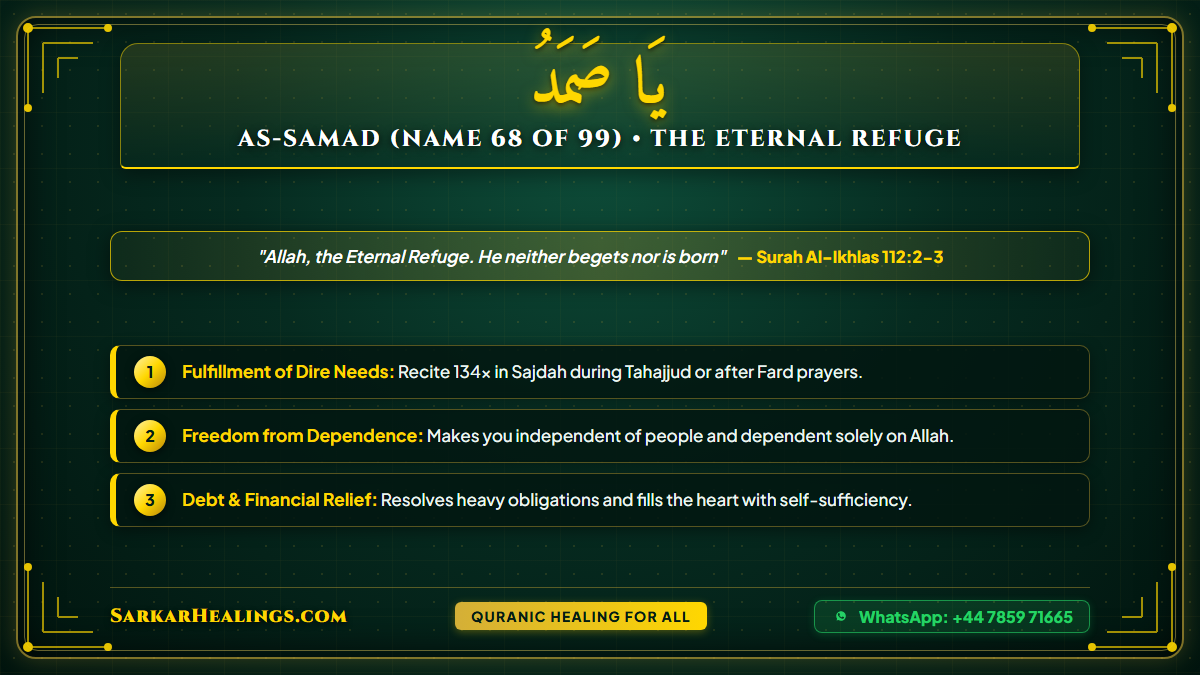
As-Samad Meaning & Ya Samadu Benefits (Name 68 of 99)
Sarkar Healings · 99 Names of Allah · Name 68 of 99
الصَّمَد
As-Samad — The Eternal Refuge, The Self-Sufficient
As-Samad Meaning & Ya Samadu Benefits
The One to Whom All Creation Turns, Who Has No Need of Anything
As-Samad (الصَّمَد) is the 68th Name, from root ص-م-د (solid, eternal, master to whom needs are directed). It appears verbatim once in the Qur’an (112:2). Invoked for fulfilment of needs, removal of anxiety, and realisation of absolute reliance on Allah.
Key Facts at a Glance
| Name in Arabic | الصَّمَد |
|---|---|
| Transliteration | As-Samad (invoked as Ya Samadu) |
| English Meaning | The Eternal Refuge, The Self-Sufficient |
| Position | 68th of the 99 Names (Asma-ul-Husna) |
| Arabic Root | ص-م-د |
| Quran Occurrences | The Name As-Samad occurs verbatim once in the Qur’an: Surah Al-Ikhlas 112:2 (اللَّهُ الصَّمَدُ). The root ص-م-د appears in verbal forms elsewhere (e.g. 14:17 يَصَّدُّونَ — ‘they turn away’), but the Divine Name form is exclusive to 112:2. |
| Invoked For | Fulfilment of needs, relief from anxiety, self-sufficiency, protection, spiritual independence |
| Related Names | Al-Ghani · Al-Qayyum · Ar-Razzaq |
Meaning & the Arabic Root
From the root ص-م-د (s-m-d), carrying meanings of solidity, permanence, and lordship. Lane’s Lexicon records: ‘a thing that is solid, firm, without hollow; a lord/master to whom reference is made for the fulfilment of needs; one who has no need of others.’
The morphological form is fa’īl (intensive active participle), indicating a permanent, essential attribute: The One Who is eternally, intrinsically the Refuge. Unlike Al-Ghanī (Self-Sufficient in essence) or Al-Qayyūm (Self-Subsisting Sustainer), As-Ṣamad specifically captures the relational dynamic: creation’s absolute turning (ṣamada ilayh) to Him for every need, while He remains utterly independent.
Imam al-Zajjaj summarised: ‘The Master (sayyid) whose lordship is complete, to whom the creation turns in their needs, who neither eats nor drinks, and who has no cavity or hollow’ — i.e., no internal dependency or lack.
As-Samad in the Quran
Quran
The Name As-Samad occurs verbatim once in the Qur’an: Surah Al-Ikhlas 112:2 (اللَّهُ الصَّمَدُ). The root ص-م-د appears in verbal forms elsewhere (e.g. 14:17 يَصَّدُّونَ — ‘they turn away’), but the Divine Name form is exclusive to 112:2.
Surah Al-Ikhlas 112:2
Allāhu ṣ-Ṣamad
“Allah, the Eternal Refuge.”
Surah Al-Ikhlas 112:2
The entire surah is a declaration of tawhīd; this verse names the attribute that makes Allah the unique goal of all dependence. The definite article + proper name construction (Allāhu ṣ-Ṣamad) marks it as a Divine Name, not merely a description.
The Hadith Foundation of the 99 Names
Hadith — graded
Abū Hurayrah reported: The Messenger of Allah ﷺ said, “Allah has ninety-nine names, one hundred less one; whoever enumerates (aḥṣāhā) them enters Paradise.” (Ṣaḥīḥ al-Bukhārī 2736; Ṣaḥīḥ Muslim 2677)
The itemised list of the ninety-nine names appears in Jāmiʿ at-Tirmidhī 3507, but its chain is graded ḍaʿīf (weak) by several scholars including al-Albānī; it is cited here for recognition, not as a primary proof for any single Name.
No additional ṣaḥīḥ narration singles out As-Ṣamad with a specific virtue or count; the practice of invoking it derives from the Qur’anic occurrence and the general prophetic encouragement to call upon Allah by His Names (Q 7:180).
Classical Commentary
Classical Scholarship — Sunni / Sufi tradition
Imam al-Ghazālī (al-Maqṣad al-Asnā)
Al-Ghazālī explains that aṣ-Ṣamad is the One Who is perfect in His lordship, nobility, greatness, forbearance, knowledge, and wisdom — the Master (sayyid) in the absolute sense. He has no need of His creation in any respect, while the whole creation is in absolute need of Him. The servant’s share in this Name is to realise his own utter poverty (faqr) and to cut off hope from other-than-Allah, making his heart a refuge for nothing but Allah.
Ibn ʿArabī (Akbarian tradition)
In his writings on the Divine Names, Ibn ʿArabī associates aṣ-Ṣamad with the station of al-faqr al-muṭlaq (absolute poverty) — the servant’s recognition that he possesses no independent existence, sustenance, or power. The Name manifests in the heart that has become ‘solid’ (ṣamīd) against reliance on created means, turning exclusively to the Real.
Benefits of Reciting Ya Samadu
Within the devotional tradition, the following benefits are associated with the sincere and consistent remembrance of As-Samad. Each reflects the meaning of the Name itself.
- Fulfilment of legitimate needs
Because As-Ṣamad is the One to whom all creation directs its needs, the tradition records reciting this Name when presenting one’s necessities to Allah, trusting that the Refuge Himself answers. - Removal of anxiety and fear
The root meaning of solidity and permanence grounds the heart; recitation is believed to replace fear of created things with reliance on the Unshakeable Refuge. - Cultivation of spiritual self-sufficiency (faqr)
Regular invocation nurtures the inner state of faqr — not material poverty, but the realised independence from needing anyone besides Allah. - Protection from harm and oppression
As the ultimate Master and Refuge, As-Ṣamad is invoked for divine shielding; the tradition associates it with safety in travel, illness, and difficulty. - Strengthening of tawakkul (trust)
The Name’s semantics — the One turned to for every need — directly trains the heart to delegate all affairs to Allah, the essence of tawakkul. - Healing of heart and body (alongside medical care)
Recited as a complementary spiritual support for physical and psychological ailments, reflecting the comprehensive refuge the Name denotes. - Realisation of Surah Al-Ikhlas in the heart
Since the Name appears in the ‘Surah of Tawhīd’, its invocation is a means to internalise the surah’s declaration that Allah alone is the Eternal Refuge.
Traditional Wazifa Practices (with Sources)
Devotional Tradition — South Asian wazifa literature
The following practices belong to the devotional tradition of the South Asian wazifa manuals (e.g. Ism-e-Aʿẓam by ʿĀlam Faqrī) and Sufi silsila curricula. They are not prescribed in the Qur’an or authentic Sunnah with fixed counts or used as a means (sabab) outcomes. Heavy or fixed-duration practices (chillas, counts above ~500) are traditionally undertaken with a qualified teacher’s guidance. Recite for healing alongside medical seek healing forment, never as a replacement. No spiritual or worldly result is used as a means (sabab); all matters rest with Allah.
- Qur'anic foundation: Surah Al-Ikhlas
Recite Surah Al-Ikhlas (Qul Huwa Allāhu Aḥad…) three times after each farḍ prayer, or eleven times morning and evening. The surah itself contains the Name and is authenticated as ‘equivalent to a third of the Qur’an’ (Ṣaḥīḥ al-Bukhārī 5013). This is the primary prophetic practice connected to As-Ṣamad. - Daily wird: Yā Ṣamadu × 100
After Fajr and Maghrib, recite يَا صَمَدُ one hundred times with presence of heart, presenting one’s needs to Allah. A common variation adds يَا غَنِيُّ يَا مُغْنِي (Yā Ghaniyyu Yā Mughnī) ten times before and after. - For a specific need (ḥājah): Yā Ṣamadu × 111
After ʿIshā’ or in the last third of the night, perform two rakʿat ṣalāt al-ḥājah, then recite يَا صَمَدُ 111 times, followed by personal duʿā’. The number 111 is a traditional South Asian convention (3 × 37), not a prophetic specification. - Forty-day chilla (with teacher's permission)
Recite يَا صَمَدُ 1,000 times daily for 2 times daily for forty consecutive days, maintaining wuḍūʾ, fixed time, and a quiet place. This intensive practice is found in Sufi silsila manuals and requires a Shaykh’s oversight to safeguard physical and spiritual well-being.
Etiquette (Adab) of Reciting Ya Samadu
- Begin with istighfar — seeking forgiveness before presenting the request.
- Praise Allah and send salawat upon the Prophet ﷺ before and after the dhikr.
- Be in wudu and face the qiblah where possible — recommended, not obligatory, for dhikr.
- Ask with certainty — the Prophet ﷺ instructed asking Allah with conviction of response (Jami’ at-Tirmidhi 3479).
- Keep lawful earnings and intentions.
- Consistency over quantity — the most beloved deeds are the most constant, even if small (Sahih al-Bukhari 6464).
- Face the qibla if possible; begin with ṣalawāt on the Prophet ﷺ; keep the tongue moist with the Name while the heart rests in the meaning ‘He is my only Refuge.’
Frequently Asked Questions
- What does As-Samad mean?
- The Eternal Refuge / The Self-Sufficient Master. From root ص-م-د: solid, permanent, the lord to whom all creation turns for every need while He needs nothing.
- Where does As-Samad appear in the Qur'an?
- Verbatim once: Surah Al-Ikhlas 112:2 — اللَّهُ الصَّمَدُ (Allah, the Eternal Refuge). The root appears in verbal forms elsewhere, but the Divine Name form is unique to this verse.
- How is As-Samad different from Al-Ghani and Al-Qayyum?
- Al-Ghanī = Self-Sufficient in essence (no needs). Al-Qayyūm = Self-Subsisting Sustainer of all existence. As-Ṣamad = the specific relational attribute: the Solid, Eternal Master whom creation *turns to* for every need.
- How many times should I recite Ya Samadu?
- No fixed count is prophetic. Common traditional counts: 100x daily (wird), 111x for a need, 1,000x in a 40-day chilla (with teacher). The Qur’anic practice is reciting Surah Al-Ikhlas, which contains the Name.
- Can anyone recite Ya Samadu, or do I need initiation?
- Any Muslim may recite this Name as dhikr or duʿā’. Fixed high-count regimens (chillas) are traditionally done under a teacher’s guidance for safety and correct adab, but the simple daily wird is open to all.
Obtain a Spiritually Prepared Ya Samadu Taweez
At Sarkar Healings we prepare Taweez and Naqash of As-Samad following the etiquette and recitations described in this guide.
Explore Coded Duas & Taweez
WhatsApp Us
Or email: help@sarkarhealings.com
Continue the series: Al-Ghani · Al-Qayyum · Ar-Razzaq · All 99 Names of Allah
This is a traditional practice, not a substitute for medical treatment, legal advice, or professional care. Scholars differ on some of these practices; where they differ, that difference is noted. Benefit and outcome are from Allah alone. If you are facing a medical, psychological, or financial emergency, seek qualified professional help first.
Coded Duas based on As-Samad

Need Personal Guidance on This?
Get a confidential, free consultation with our spiritual advisor — usually replied within hours.
Complete healing path: The Complete Quran Coded Dua — all 114 Surahs & Asma-ul-Husna in one hand-written taweez.
This content and its associated Quranic recitations are offered strictly as a spiritual means (asbab) seeking Allah's guidance, protection, and barakah. Sarkar Healings does not guarantee magical outcomes or instant cures. Spiritual remedies are to be used alongside lawful personal effort and professional medical, legal, or financial advice.