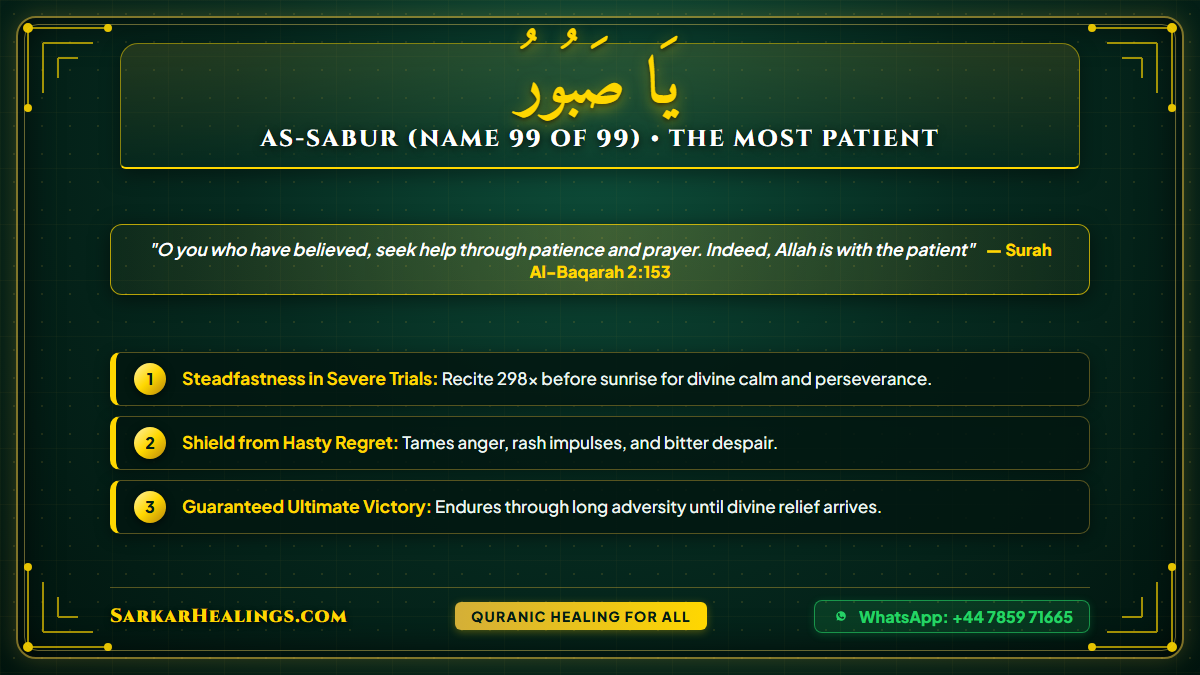
Ya Sabur: Meaning, Benefits & Wazifa for General Spiritual
Ya Sabur: Meaning, Benefits & Wazifa for General Spiritual
Many Muslims recite the Names of Allah while asking for general spiritual. This guide explains the meanings of Ya Sabur, how they are understood in Islamic devotion, and how to make dua with sincerity.
These Names are not magic words and do not guarantee a particular outcome. Make dua, trust Allah, and take practical steps toward your goal.
What Do Ya Sabur Mean?
1. Ya Sabur — يَا صَبُورُ
Meaning: O The Patient.
Ya Sabur is a Name of Allah. Muslims may call upon Allah by this Name when asking for general spiritual.
Quran reference: Surah reference 2:153, 8:46, 16:127 describes Allah as Ya Sabur.
Ya Sabur: What Is the Difference?
| Name | Meaning | What a Person May Ask Allah For |
|---|---|---|
| Ya Sabur يَا صَبُورُ | The Patient | General Spiritual and related needs |
In simple terms, Ya Sabur directs the heart toward Allah as the The Patient; reminds a believer to ask Allah to open a way forward; and reminds a believer that blessings are gifts from Allah. You can call upon Allah using one Name or more than one, while asking for what is good.
Ya Sabur: Common Devotional Meanings
Muslims may recite these Names as part of personal dhikr and dua. The points below describe the intentions people commonly bring to their prayers; they are not guaranteed effects of a particular formula.
- When seeking work: Ask Allah for lawful employment, useful skills, good contacts, and opportunities.
- When running a business: Ask for honest customers, wise decisions, fair dealings, and blessing in lawful earnings.
- When worried about provision: Ask Allah for ease and sustenance, while reviewing your budget and seeking suitable work or advice.
- When a path feels blocked: Ask for clarity, patience, and a good way forward; consider practical alternatives.
- When asking for family blessings: Ask Allah for what is good, and take respectful, responsible steps in family matters.
- When you have received blessings: Express gratitude and use what you have in a responsible and beneficial way.
A Simple Daily Wazifa and Dua Routine
If you want a simple routine, keep it manageable and consistent. This is a suggested personal routine, not a claim that a specific number is prescribed in an authentic hadith.
- Begin with praise of Allah and, if you wish, send blessings upon Prophet Muhammad ﷺ.
- Recite Ya Sabur at a pace that helps you focus.
- Make dua in your own words. Explain your need clearly and ask for what is lawful and good for you.
- Ask Allah to guide you toward the right action, not only toward a specific outcome.
- Take a practical step after your dua, such as applying for a job, contacting a customer, seeking advice, or making a plan.
“O Allah, You are Ya Sabur. Open for me a good and lawful way forward, provide for me from Your bounty, and bless me with what is best for my faith and my life. Guide me to take the right steps. Amin.”
This is a personal supplication in English, not a quoted hadith.
Ya Sabur 100, 1,000 or 1,100 Times: What Should You Know?
People sometimes ask about reciting Ya Sabur 100 or 1,000 times. A specific count should not be presented as a guaranteed way to obtain general spiritual.
There is no verified evidence cited here that makes these exact counts a universal, obligatory Sunnah practice or guarantees a special result. Some devotional traditions use set counts as a personal discipline. If you follow a count taught by a trusted religious teacher, understand its status and do not confuse a customary practice with a Qur’anic verse or an authenticated Prophetic instruction.
You may begin with a small amount of dhikr that you can sustain attentively. Do not feel that you must complete a large count, spend money, or stop taking practical steps to have your dua heard.
Supporting Actions When Asking for General Spiritual
- Seek lawful income: Make honest effort and avoid dishonest dealings.
- Keep up your obligations: Maintain prayer and other responsibilities to the best of your ability.
- Practise gratitude: Notice and appreciate the blessings already present in your life.
- Give charity if you are able: Give within your means; do not borrow or put essential expenses at risk to donate.
- Make a practical plan: For job, business, or debt concerns, seek reliable advice and take realistic steps.
- Ask for support when needed: Spiritual practice can sit alongside professional, financial, medical, or legal support where appropriate.
Looking for the Complete Quran Coded Dua for Your Needs?
Your intention matters. What are you looking for?
Choose the area you would like to discuss. We can explain our Complete Quran Coded Dua approach and the available options in a free, no-obligation consultation.
Free consultation. No obligation to purchase. No particular result is promised.
Frequently Asked Questions
What is the meaning of Ya Sabur?
Ya Sabur mean The Patient. Muslims may call upon Allah by these Names while asking for general spiritual.
How many times should I recite Ya Sabur?
There is no fixed count in the Sunnah for this specific purpose. Consistency and attentiveness matter more than volume. Some devotional traditions use set counts as personal discipline; follow a trusted teacher if applicable.
Can Ya Sabur help with general spiritual?
As a spiritual means (sabab), calling upon Allah by these Names while asking for general spiritual is a valid practice — alongside practical steps. No worldly outcome is guaranteed.
Is this practice authenticated?
The Names of Allah are established in the Quran and Sunnah. Specific wazifa counts may be scholarly observations (Mujarrabat) — follow a trusted teacher and distinguish from universal Sunnah.
Do you offer personalized guidance?
Yes, we offer free WhatsApp consultation with Sheikh Sayed Shah Qadri (Qadiri–Chishti lineage) to discuss your situation and recommend the most appropriate coded dua or ruqyah program.
What is the Complete Quran Coded Dua?
A hand-prepared taweez inscribed with specific Quranic verses and abjad encoding for your stated intention, prepared under ritual purity (wudu) on Fridays, sealed in a waterproof silver-plated capsule.
Related Guides
- Ya Razzaq Ya Fattah Ya Wahhab: Complete Guide
- Surah Waqiah Benefits for Wealth & Rizq
- Complete Quran Coded Dua for All Needs
Final Thoughts
Calling upon Allah by His Beautiful Names is a profound act of worship that connects the heart to the Divine. Combine sincere recitation with practical effort, and trust that Allah — {“, “.join(names)} — knows what is best for you. Begin today with a simple, consistent routine.
Ready for personalized guidance? CHAT WITH US ON WHATSAPP
Coded Duas based on As-Sabur



Need Personal Guidance on This?
Get a confidential, free consultation with our spiritual advisor — usually replied within hours.
Complete healing path: The Complete Quran Coded Dua — all 114 Surahs & Asma-ul-Husna in one hand-written taweez.
This content and its associated Quranic recitations are offered strictly as a spiritual means (asbab) seeking Allah's guidance, protection, and barakah. Sarkar Healings does not guarantee magical outcomes or instant cures. Spiritual remedies are to be used alongside lawful personal effort and professional medical, legal, or financial advice.