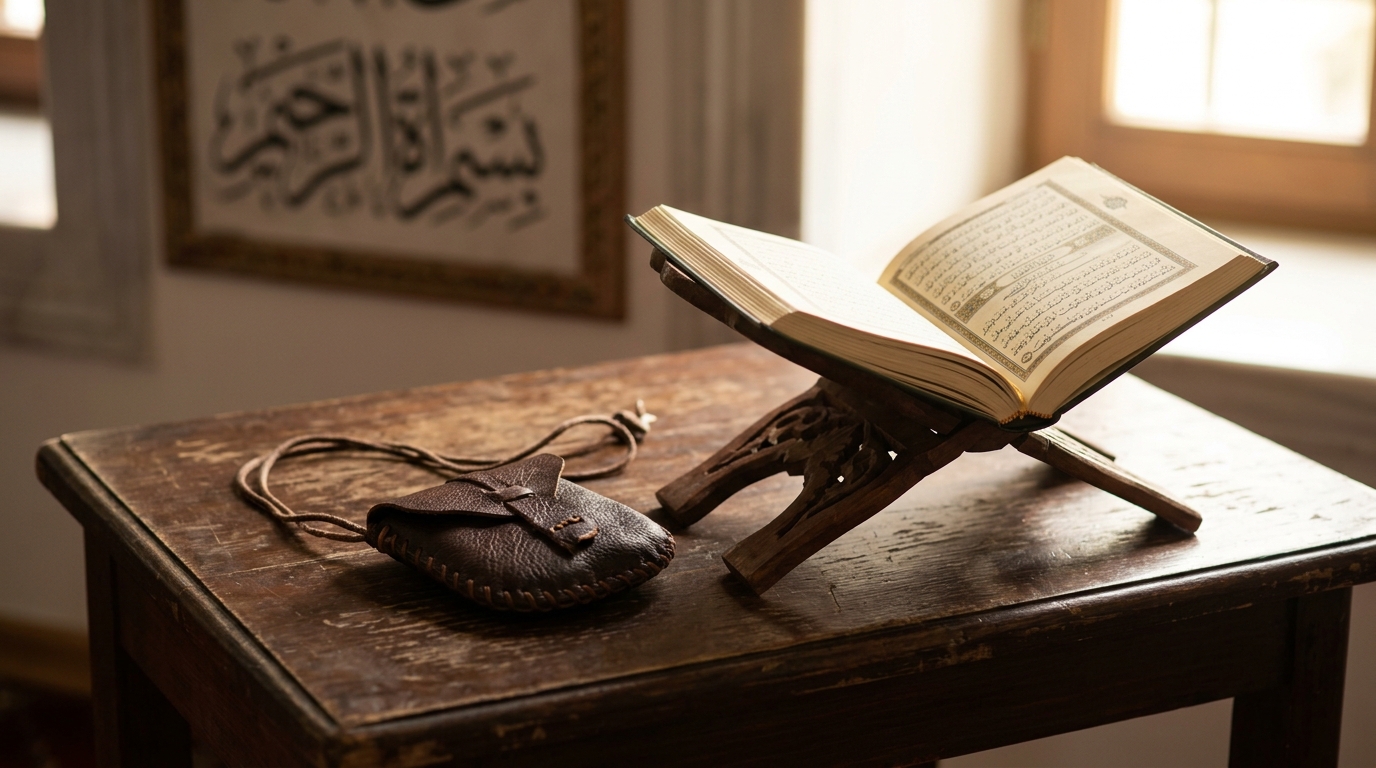
What Is a Taweez in Islam? Definition, Types & Ruling
What Is a Taweez? (Definition)
Taweez (Arabic ta’widh, from a-w-dh “to seek refuge”) literally means that by which one seeks protection. In practice it is a piece of paper or cloth inscribed with Quranic verses, Divine Names, or authentic duas, folded and carried — the object.
Ruqyah is the act — recitation of Quran and prophetic supplications over a person, water, or oil seeking healing from Allah. The Prophet ﷺ said: “There is no harm in ruqyah so long as it involves no shirk” (Sahih Muslim).
The relationship is simple: ruqyah is the recitation; taweez is one way of carrying its words. Understanding this prevents the most common mistake — judging the paper while forgetting the source of its text.
Historical Background: The Prophet ﷺ and the Companions
Ruqyah existed before Islam — pre-Islamic Arabs used it, often mixed with unknown words and invocation of jinn. Islam kept the form and cleansed the content.
The Prophet ﷺ himself practiced and approved Quranic ruqyah:
- He recited al-Fatiha over a stung companion — the man rose as if freed from chains (Bukhari)
- He taught al-Mu’awwidhatayn (Surah al-Falaq and an-Nas) as refuge from sihr and envy
- He approved ruqyah of Auf ibn Malik when shown it contained no shirk (Muslim)
On written amulets, the generation differed — and this is where honest scholarship begins:
- Some Companions permitted Quranic inscriptions for those who could not recite (e.g., children)
- Others discouraged any hanging object as a door to reliance on other than Allah
- Both views are documented by scholars (Ibn Taymiyyah, Ibn Qayyim, Imam Nawawi) without forcing one
The Core Distinction: Permissible vs. Shirk-Based
✅ Permissible (with conditions) — Quranic & Prophetic Taweez
Contains only Quranic verses, Divine Names, or authentic duas in clear Arabic. No symbols, no jinn names, no unknown words. The wearer believes the effect is from Allah alone — the paper is a means (sabab), not a power.
❌ Impermissible / Shirk — Shirk-Based Amulets
Contains invocations to jinn, stars, unknown symbols, numerology grids, or words whose meaning is hidden. The Prophet ﷺ warned: “Whoever hangs an amulet has committed shirk” — scholars apply this to amulets containing shirk (Musnad Ahmad; context in classical texts).
Three Conditions for a Halal Taweez
Scholars distilled the Sunnah into three tests — if any fails, leave it (Ibn Hajar, al-Nawawi):
- No shirk in wording — only Quran, authentic dua, or clear Arabic prayer. No jinn names, no talismanic squares, no “sealed” scripts.
- Clear language — the meaning must be known. Unknown words or coded symbols are rejected even if the seller claims “it is Quranic.”
- Trust in Allah alone — the taweez is a reminder and a means; the Healer is Allah. Whoever believes the paper itself heals has left the path.
Read these three before you wear, buy, or commission any taweez — they are the filter every authentic healer uses first.
Common Misconceptions — Briefly Clarified
| Misconception | Reality |
|---|---|
| *”All taweez is shirk”* | Not what the sources say. The shirk warning targets shirk-containing amulets. Scholars differed on Quranic taweez — and difference of opinion among Companions is mercy, not contradiction. |
| *”Taweez guarantees success”* | No amulet guarantees anything. Rizq, protection, and healing are by Allah’s permission alone (Quran 2:102). The taweez is reliance made visible, not a contract for outcomes. |
| *”Ruqyah is magic”* | Opposite. Magic (sihr) is harm through forbidden means; ruqyah is its cure through Quran and dua. Scholars call ruqyah the anti-sihr taught by the Prophet ﷺ himself. |
FAQs
Q: Is wearing a taweez considered shirk?
Only if it contains shirk — invocations to other than Allah, unknown symbols, or belief that the object itself has power. A Quranic taweez with clear Arabic, worn while trusting Allah alone, is treated by many scholars as permissible with the three conditions above; others still discouraged it as a precaution. We present both views honestly.
Q: Can ruqyah be self-administered?
Yes — and the Sunnah encourages it. The Prophet ﷺ taught the mu’awwidhatayn for self-protection and recited over himself when ill. Self-ruqyah steps (wudu, niyyah, al-Fatiha, Ayat al-Kursi, al-Falaq/an-Nas) are detailed in our Self-Ruqyah Step-by-Step Guide.
Q: Are there specific times for wearing or making a taweez?
No fixed “auspicious hour” in Sunnah. Purity (wudu), sincerity, and trust in Allah are the conditions — not planetary hours or numerology. Any seller prescribing a star-timed ritual is outside the permissible method.
Q: Can women wear a taweez during menstruation?
Yes, if kept in a pouch (not direct skin contact) and removed before bathroom. The Quranic text deserves respect; state of ritual purity affects the person, not the taweez’s permissibility. Consult your scholar for personal ruling.
Q: What should I verify before buying a taweez?
✅ Content disclosed (exact verses/Names)
✅ Practitioner credentials (known scholar/hafiz)
✅ Handwritten in wudu, not printed
✅ No outcome guarantees
✅ Free Istikhara offered
✅ Follow-up support included
The Heart of It: Tawheed First
Every chapter of this topic returns to one reality: the Healer is Allah. Quran, ruqyah, and — where scholars permit — a Quranic taweez are asbab (means). Means are used with adab and abandoned in reliance the moment they become rivals to trust. Strengthen Tawheed first; the means then take their proper, humble place.
Healing note: Spiritual guidance complements, never replaces, medical or mental-health care. If you are unwell or in crisis, seek professional help first.
What You Can Do Today (Free)
- Learn the three conditions — use them as a checklist for any taweez
- Start self-ruqyah — al-Fatiha, Ayat al-Kursi, 3 Quls morning and evening
- Ask before you buy — use the verification checklist above
- Book a consultation if unsure — we’ll review your situation and recommend the appropriate means (or self-ruqyah) without pressure
References Used
- Quran 2:102 (sihr and its cure)
- Quran 7:180 (Asma ul Husna)
- Sahih Muslim (ruqyah permissible without shirk)
- Bukhari (al-Fatiha as ruqyah)
- Musnad Ahmad (warning on amulets with shirk)
- Sunan Abi Dawud 3893 (Abdullah ibn Amr teaching children)
- Jami’ at-Tirmidhi 3528
- Tafsir al-Qurtubi 10/318
- Classical positions: Ibn Taymiyyah, Ibn Qayyim, Imam Nawawi
Internal Link Suggestions
- How to Perform Ruqyah on Yourself
- Is Wearing a Taweez Allowed in Islam?
- Quranic Verses Used in Ruqyah Healing
- Protection from Enemies & Evil Eye
- Our Services — Distance Ruqyah & Coded Dua
Need Personal Guidance on This?
Get a confidential, free consultation with our spiritual advisor — usually replied within hours.
Complete healing path: The Complete Quran Coded Dua — all 114 Surahs & Asma-ul-Husna in one hand-written taweez.
This content and its associated Quranic recitations are offered strictly as a spiritual means (asbab) seeking Allah's guidance, protection, and barakah. Sarkar Healings does not guarantee magical outcomes or instant cures. Spiritual remedies are to be used alongside lawful personal effort and professional medical, legal, or financial advice.