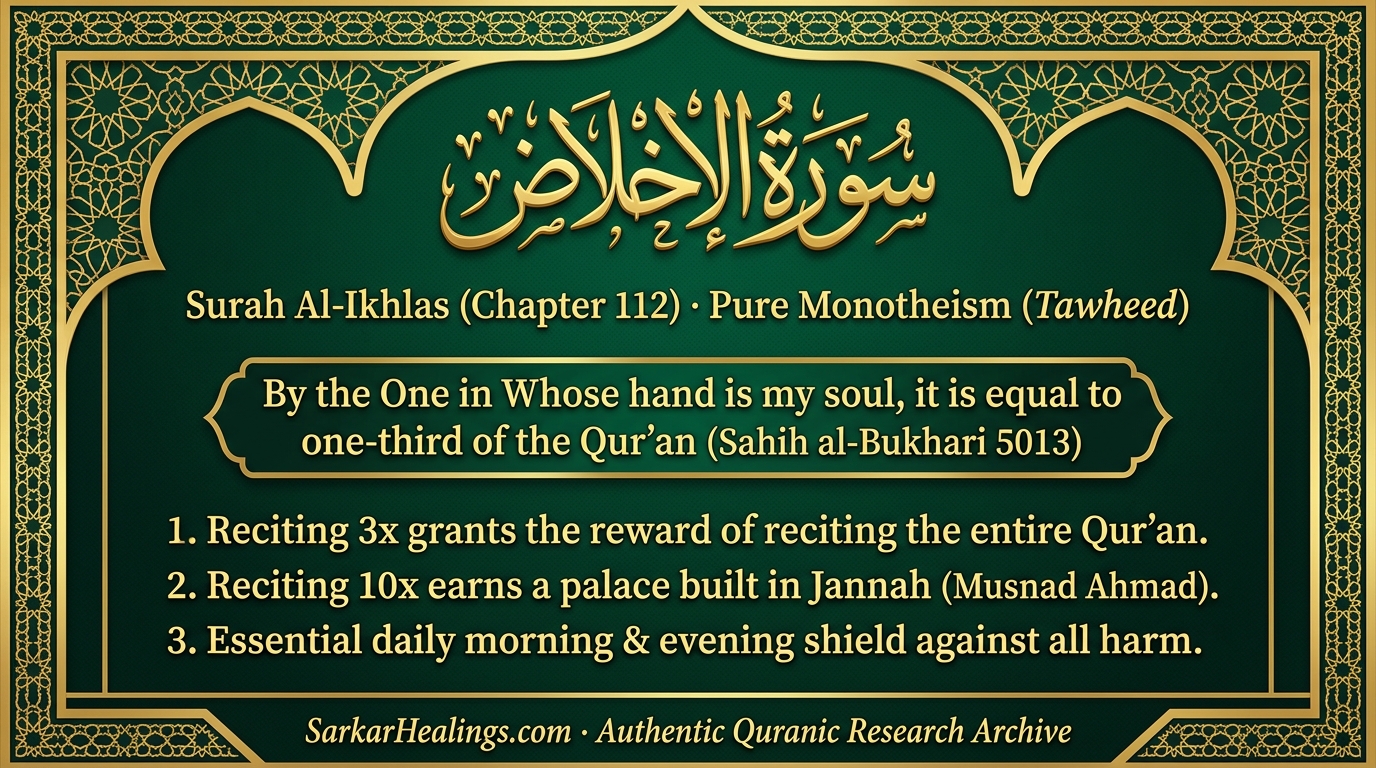
Surah Al-Ikhlas Benefits: Meaning, Virtues & Protection
بِسْمِ ٱللَّٰهِ ٱلرَّحْمَٰنِ ٱلرَّحِيمِ
Surah Al‑Ikhlâs — The Essence of Pure Monotheism
In brief: Surah Al‑Ikhlâs captures the core of Islamic belief in one, indivisible Allah. Its short, powerful verses are a refuge for the heart, a source of blessings, and a practical tool for healing, protection, and spiritual growth when recited with sincerity.
In pain → Healing · Feeling unsafe → Protection · Want to understand it → Station & Meaning
Say: He is Allah, [who is] One. Allah, the Eternal Refuge. He neither begets nor is born, Nor is there to Him any equivalent.
Quran 112:1‑4
What Surah Al‑Ikhlâs Is About
Surah Al‑Ikhlâs, often titled “The Purification” or “Sincerity,” is a Makkan revelation that succinctly declares the absolute oneness of Allah. The term Ikhlâs means purity or sincerity, indicating that the surah purifies the believer’s concept of divinity from any association, offspring, or likeness. Classical scholars describe it as one‑third of the Qur’an because its message encapsulates the central tenet of Tawhid, which underpins the entire faith.
The four verses negate any notion of partnership, progeny, or resemblance to the Divine, affirming Allah as As‑Samad — the Eternal, Self‑Sufficient Refuge upon whom all creation depends. By internalizing this declaration, the believer aligns heart, tongue, and action with pure monotheism, laying the foundation for every act of worship and ethical conduct.
The Benefits of Surah Al‑Ikhlâs — Every Claim Sourced
🌿 Healing
- Reciting Surah Al‑Ikhlâs protects from the evil eye and alleviates childhood ailments, stomach issues, high or low blood pressure, and other physical diseases when done nightly from an early age.
- Numerous benefits are cited as a cure for many ailments; the surah should be recited when travelling or facing a tyrant ruler to seek relief.
- Reciting it once brings blessings to the reciter; twice extends those blessings to children; three times extends them to the entire family, fostering wellbeing in the household.
- When recited 100 times before sleep, Allah forgives sins committed over the past forty years, offering spiritual cleansing that can ease the burden of guilt and stress.
🛡️ Protection
🕌 Station & Meaning
🎁 Reward & Spiritual Gain
How and When to Use — Prescription
Before any use: seek refuge (isti’adhah), begin with Bismillah, recite with tarteel (measured pace), close with Ameen.
| When | How to Use | What It Does |
|---|---|---|
| Daily prayers (Fajr, Dhuhr, Asr, Maghrib, Isha) | Recite Surah Al‑Ikhlâs once after Surah Al‑Fatihah in each rak’ah. | Fulfills the Sunnah of completing the prayer; omission renders the prayer as if not performed. |
| Before sleep | Recite the surah 100 times (or any multiple) with reflection on its meaning. | Seeks forgiveness of sins for the past forty years and invites blessings. |
| When travelling or facing hardship | Recite the surah three times, blowing gently into the palms and wiping over the body. | Invokes protection from the evil eye, tyrants, and travel‑related harm. |
| During Ramadan | Recite Surah Al‑Ikhlâs alongside Surah An‑Nâs in the Witr of Salatul‑Layl. | Earns the reward of Hajj and ‘Umrah and strengthens nightly safeguard. |
| For family blessings | Recite once for personal blessing, twice for children’s blessing, thrice for family blessing. | Draws barakah onto the household and nurtures spiritual wellbeing. |
How to Get Maximum Benefit
- Intention (niyyah): Begin each recitation with a clear, sincere intention to seek Allah’s pleasure, forgiveness, or protection.
- Consistency: Make the surah a regular part of your daily adhkar—morning, evening, and after prayers—to let its meanings settle in the heart.
- Certainty (yaqeen): Trust in the promise of Allah’s mercy as conveyed in the narrations; doubt weakens the spiritual effect.
- Pairing with complementary adhkar: Combine Surah Al‑Ikhlâs with the Ma‘udhatayn (Al‑Falaq, An‑Nâs) and Ayat al‑Kursi for a comprehensive shield.
Listen to Sheikh’s Recitation — Surah Al-Ikhlas
Recited by Sheikh Sayed — listen with khushu, read along, then recite yourself. For personal recitation guidance, message on WhatsApp.
Frequently Asked Questions
What does “Al‑Ikhlâs” mean?
The word Ikhlâs translates to sincerity, purity, or purification. In this context it signifies purifying one’s belief in Allah from any form of shirk (association) or misunderstanding about His nature.
Can I recite Surah Al‑Ikhlâs for someone else’s healing?
Yes. The narrations mention blessings extending to children and family when the reciter repeats the surah multiple times. Reciting with the intention of seeking healing for a loved one is permissible, though the primary benefit remains tied to the reciter’s sincerity.
Is there a specific time of day that is best for recitation?
While the surah can be recited at any time, many traditions recommend reciting it after each obligatory prayer, before sleep, and during the Witr of Salatul‑Layl in Ramadan for added reward.
Do I need to understand Arabic to benefit?
Understanding the meaning enhances reflection and sincerity, but the act of recitation itself carries blessings as indicated in the sources. Learning the translation and contemplating its message deepens the spiritual impact.
Where Al‑Ikhlâs Fits in Your Journey
Surah Al‑Ikhlâs is a cornerstone that can be revisited at every stage of a believer’s path. For those beginning to learn the Qur’an, it offers a clear, concise foundation of Tawhid. For the seeker facing trials, its protective qualities provide spiritual armor. For the advanced student, its profound meanings invite continual contemplation of Allah’s uniqueness, reinforcing the heart’s reliance on the Divine alone.
Cross-Links
- Protection & Safety Hub
- Guidance & Istikhara Hub
- Forgiveness & Repentance Hub
- Continue with Surah Al-Masad
- Continue with Surah Al-Falaq
- All 114 Surahs
Get the Surah Ikhlas Taweez — Quranic Monotheism Protect
WhatsApp Sheikh Sayed — Personal Guidance
Coded Duas based on Surah Al-Ikhlas

Need Personal Guidance on This?
Get a confidential, free consultation with our spiritual advisor — usually replied within hours.
Complete healing path: The Complete Quran Coded Dua — all 114 Surahs & Asma-ul-Husna in one hand-written taweez.
This content and its associated Quranic recitations are offered strictly as a spiritual means (asbab) seeking Allah's guidance, protection, and barakah. Sarkar Healings does not guarantee magical outcomes or instant cures. Spiritual remedies are to be used alongside lawful personal effort and professional medical, legal, or financial advice.