Surah Al-Inshiqaq Benefits for Ease & Relief
بِسْمِ اللَّهِ الرَّحْمَٰنِ الرَّحِيمِ
Surah Al-Inshiqaq — The Sundering
In brief: If you seek reassurance that your deeds will be weighed fairly, yearn for safety in pregnancy or travel, or wish to feel the closeness of the Prophets on the Day of Judgment, Surah Al‑Inshiqaq offers a concise, powerful reminder of Allah’s ultimate justice and mercy.
In pain → Healing · Feeling unsafe → Protection · Want to understand it → Station & Meaning
What Surah Al-Inshiqaq Is About
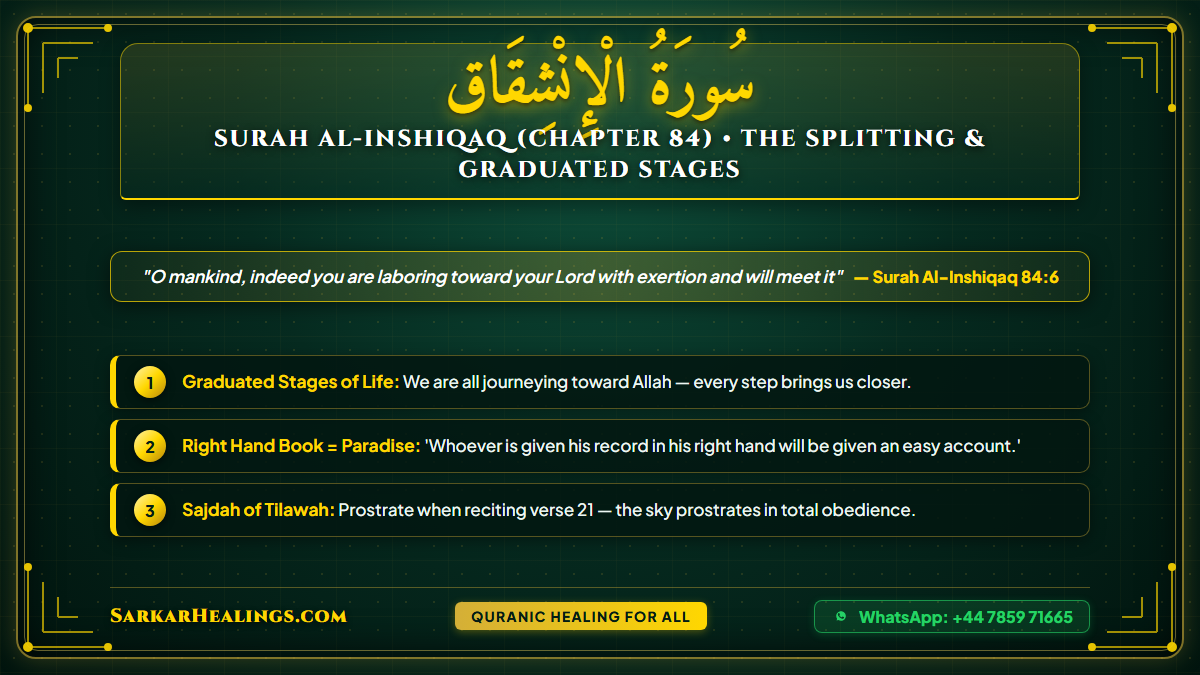
Al‑Inshiqaq, “The Sundering,” depicts the dramatic moment when the heavens are torn open, the earth is flattened, and every soul is presented with its record. The surah moves from cosmic upheaval to the intimate scene of a person receiving their deed‑book either in the right hand (blessing) or behind the back (loss).
Its central theme is the inevitable return to Allah: all stages of life—creation, striving, accountability—lead to the final reckoning where the truth of each deed is laid bare. The surah reassures the believer that sincerity brings the record in the right hand, while heedlessness leads to regret.
The Benefits of Surah Al-Inshiqaq — Every Claim Sourced
🌿 Healing & Ease in Difficult Times
- Reciting the surah shields the believer from having his book of deeds presented from behind on the Day of Reckoning.
- Recitation brings inner calm when facing illness or emotional distress, reminding the heart that ultimate justice rests with Allah.
- Listening to its verses before sleep eases anxiety, as the surah’s vivid imagery of divine order replaces fear with trust.
The one who recites will not get his book of deeds from his back on Reckoning Day.
🛡️ Protection for Pregnancy, Animals & Home
- Writing the surah on paper and wearing it as a taweez by a pregnant woman facilitates easy delivery; after childbirth the taweez must be removed immediately.
- Tying the written surah around the necks of camels or horses keeps them safe from harm during travel or work.
- Hanging the surah as a taweez on a house wall guards the dwelling from wild animals and unexpected calamities.
If written and worn by a pregnant woman, delivery becomes easy. Important: after delivery, keep away from her.
🌟 Station & Closeness to the Messengers
- Regular recitation places the reciter near the Prophets and Messengers on the Day of Judgment, a honor granted by Allah’s mercy.
- The reward equals ten times the gathering of those present at Jumu’ah and the plains of ‘Arafah.
- Reciting the surah while lying in bed grants protection throughout the night, safeguarding the sleeper from unseen harms.
- Placing a paper taweez containing the surah around an infant’s neck assists in smooth weaning and gentle transition to solid foods.
🎁 Additional Rewards & General Blessings
- Keeping the surah as a taweez for cattle ensures they remain free from disease, injury, or natural disasters.
- When affixed to a home’s entrance, it acts as a spiritual barrier against intruders and harmful influences.
- Recitation after the obligatory prayers brings a sense of completion, sealing the worship with Allah’s promise of fairness.
How and When to Use — Prescription
Before any use: seek refuge (isti’adhah), begin with Bismillah, recite with tarteel (measured pace), close with Ameen.
| When | How to Use | What It Does |
|---|---|---|
| Daily obligatory prayers (after Fajr, Dhuhr, Asr, Maghrib, Isha) | Recite Surah Al‑Inshiqaq once, slowly, with reflection. | Seals the prayer with a reminder of accountability and earns the surah’s general blessings. |
| Pregnant woman seeking ease in labor | Write the surah on clean paper, fold, and wear as a taweez around the neck; remove immediately after birth. | Facilitates smooth delivery, as narrated in the source material. |
| Traveler or rider with animals | Tie the written surah around the necks of camels or horses before departure. | Keeps the animals safe from accidents and illness during the journey. |
| Householder desiring home protection | Hang a paper copy of the surah on the main wall or entrance. | Guards the dwelling from wild animals, intruders, and unexpected misfortunes. |
| Nighttime safeguard | Recite the surah three times before sleeping, preferably lying on the right side. | Provides spiritual protection throughout the night, warding off harmful whispers and fears. |
How to Get Maximum Benefit
- Intention (niyyah) – Recite solely for Allah’s pleasure, seeking His mercy and protection.
- Consistency – Make the surah part of your daily or nightly routine; regularity amplifies its effect.
- Certainty (yaqeen) – Trust that Allah’s promise is true; doubt weakens the spiritual impact.
- Pairing – Combine recitation with dhikr (e.g., SubhanAllah, Alhamdulillah) and charitable acts to increase barakah.
Listen to Sheikh’s Recitation — Surah Al-Inshiqaq
Recited by Sheikh Sayed — listen with khushu, read along, then recite yourself. For personal recitation guidance, message on WhatsApp.
Frequently Asked Questions
What is the main theme of Surah Al‑Inshiqaq?
The surah describes the cosmic upheaval of the Day of Judgment—sky splitting, earth flattening—and the personal moment when each soul receives its record, emphasizing accountability and Allah’s ultimate justice.
How should I recite the surah for healing or protection?
Begin with isti’adhah and Bismillah, recite slowly with tarteel, focusing on the meaning. For specific needs (pregnancy, animal safety, home protection) follow the prescribed methods in the “How and When to Use” table.
Is this narration authentic?
The narrations cited come from Fawaid-e-Quran by Sayyid Mustafa Musawi, a later compilation rather than a primary hadith collection. They are not found in the major six‑book hadith corpora, so their chain of transmission is limited. While they convey inspirational guidance, scholars advise treating them as beneficial reflections rather than established legal proofs.
Can I use the surah as a taweez for my child?
Yes—writing the surah on paper and placing it around an infant’s neck is mentioned as a means to assist easy weaning. Ensure the paper is clean, the intention is pure, and remove it once the purpose is fulfilled.
Where Al-Inshiqaq Fits in Your Journey
If you are moving through stages of striving, seeking clarity about your deeds, or desiring tangible safety in pregnancy, travel, or home life, let Surah Al‑Inshiqaq be the bridge that connects your present effort to the reassuring vision of a fair reckoning and divine companionship on the Day of Judgment.
Cross-Links
- Death & Hereafter Hub
- Forgiveness & Repentance Hub
- Guidance & Istikhara Hub
- Continue with Surah Al-Mutaffifin
- Continue with Surah Al-Buruj
- All 114 Surahs
Get the Complete Quran Coded Dua Taweez
WhatsApp Sheikh Sayed — Personal Guidance