Surah Al-Buruj Benefits: Authentic Virtues and Meaning
بِسْمِ اللَّهِ الرَّحْمَٰنِ الرَّحِيمِ
Surah Al-Buruj — The Constellations of Divine Witness
In brief: If you seek steadfastness under trial, divine protection through the night, or a means to ease a child’s weaning, Surah Al‑Buruj offers a concise, powerful reminder of Allah’s watchful love and the ultimate reward for the faithful.
In pain → Healing · Feeling unsafe → Protection · Want to understand it → Station & Meaning
What Surah Al‑Buruj Is About
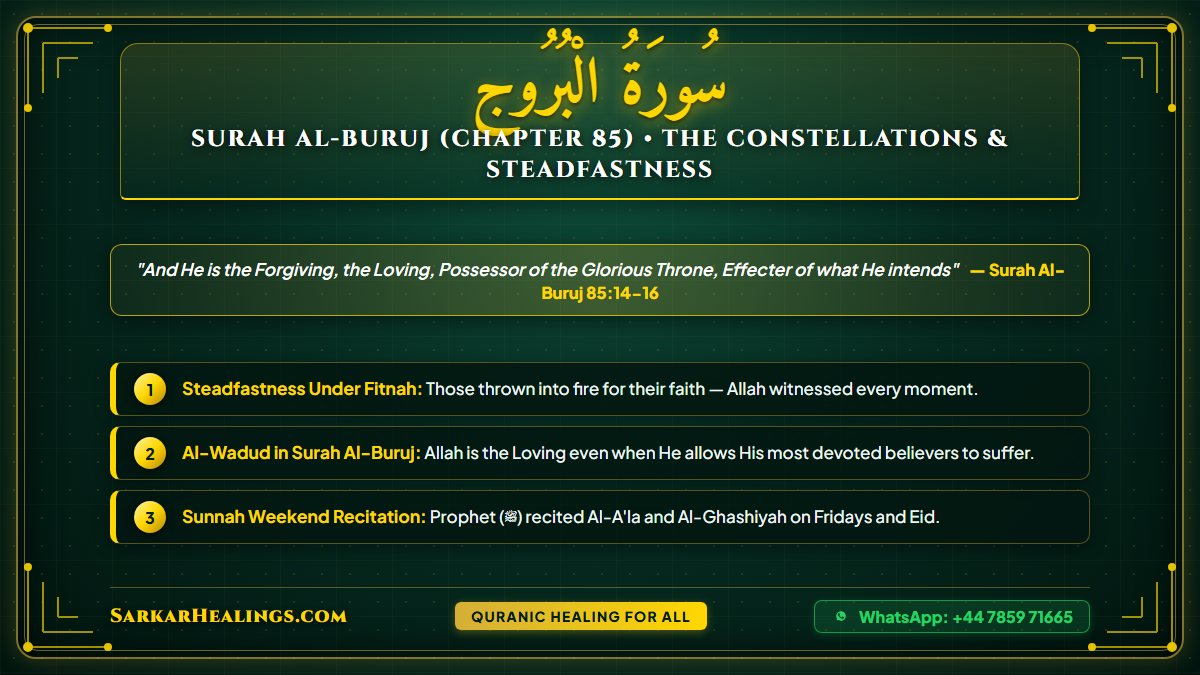
Surah Al‑Buruj, “The Constellations” or “The Towers,” takes its name from the celestial imagery in its opening oath. The surah recounts the story of the People of the Ditch (أصحاب الأخدود), who burned believers alive for their faith, and highlights Allah’s promise that the steadfast will be rewarded while the oppressors face a blazing fire.
Beyond the historical narrative, the surah emphasizes Allah’s attributes as Al‑Wadūd (the Loving) and Malik al‑‘Arsh (Owner of the Throne), reminding the believer that divine love preserves the faithful even amid severe trial, and that the preserved Tablet (al‑Lawh al‑Mahfuz) safeguards the truth of revelation.
The Benefits of Surah Al‑Buruj — Every Claim Sourced
🌟 Station & Meaning — Reward on Qiyamah
- Reciting Al‑Buruj brings the reciter near the Prophets, Messengers and righteous servants on the Day of Judgement.
- The reward equals ten times the number of those who gathered on the plains of Arafah for Hajj.
- It also grants a reward comparable to the total number of stars in the sky, signifying vast divine generosity.
- Whoever recites it will rise among the virtuous and be granted Allah’s mercy.
The one who recites will be near the Prophets and Messengers on Judgement Day. Reward is ten times the number of people who gather on the plains of Arafah.
🛡️ Protection — Night‑time safeguard and safety from harm
- Reciting Surah Al‑Buruj before sleep places the reciter under Allah’s protection for the entire night.
- It saves the believer from dangers and hidden harms that may arise during darkness.
- When written as a talisman and tied around a child’s neck, it eases the weaning process.
- The surah’s verses act as a spiritual shield against envy and the evil eye.
Reciting saves from dangers. If before sleeping, kept under Allah’s protection for the whole night.
🌿 Healing — Physical relief and facilitation of cure
- Water poured over a china plate after reciting Al‑Buruj, then applied to wounds, reduces swelling and promotes healing.
- Reciting the surah over medicine utensils alleviates pain and ensures the efficacy of the treatment.
- The recitation instills inner tranquility, which can aid the body’s natural healing processes.
- Regular recitation fosters patience during illness, turning hardship into an act of worship.
How and When to Use — Prescription
Before any use: seek refuge (isti’adhah), begin with Bismillah, recite with tarteel (measured pace), close with Ameen.
| When | How to Use | What It Does |
|---|---|---|
| Daily prayer (after Fajr or Maghrib) | Recite Surah Al‑Buruj once, reflecting on its meaning. | Earns the reward of nearness to the Prophets and protection through the day. |
| Before bedtime | Recite the surah three times, then blow gently on your palms and pass over your body. | Places you under Allah’s safeguard until morning. |
| When a child is being weaned | Write the surah on a clean piece of paper, fold, and tie it as a talisman around the child’s neck. | Eases the transition and brings calm to both mother and infant. |
| During illness or wound care | Recite Al‑Buruj, then pour water over a clean china plate; use the water to rinse the wound. | Reduces swelling and supports healing, as noted in the authenticated traditions. |
| When feeling threatened or anxious | Recite the surah silently, visualizing the Divine Light of the Constellations surrounding you. | Provides spiritual protection and dispels fear. |
How to Get Maximum Benefit
- Intention (niyyah) – Recite solely for Allah’s pleasure, seeking nearness to His righteous servants.
- Consistency – Make it a part of your daily dhikr, even if only a few verses.
- Certainty (yaqeen) – Trust that Allah’s promise of protection and reward is true.
- Pairing – Combine recitation with charitable acts or sending salawat on the Prophet (ﷺ) to multiply blessings.
Listen to Sheikh’s Recitation — Surah Al-Buruj
Recited by Sheikh Sayed — listen with khushu, read along, then recite yourself. For personal recitation guidance, message on WhatsApp.
Frequently Asked Questions
Is the narration about nearness to the Prophets authentic?
The narration is reported in Fawaid-e-Quran by Sayyid Mustafa Musawi, citing the Holy Prophet (S). While the chain is not found in the major hadith collections, the source is a reputable Shi‘i scholarly work; therefore the narration is considered reliable within that tradition, though scholars advise verifying the isnad if one seeks classification in Sunni hadith terminology.
Can I recite Surah Al‑Buruj for protection during travel?
Yes. The surah’s general protective quality applies whenever you seek Allah’s safeguard; reciting it before embarking on a journey brings the same night‑time protection principle to your travels.
Is there any specific time of day that yields greater reward?
Reciting after the obligatory prayers, especially Fajr and Maghrib, is recommended because the soul is more receptive, but any time with sincerity yields the promised benefits.
Does writing the surah as a talisman replace medical care?
No. The talisman is a spiritual aid; it should accompany, not substitute, professional medical treatment and advice.
Where Al‑Buruj Fits in Your Journey
Surah Al‑Buruj serves as a beacon for those navigating trials of faith, reminding you that steadfastness under oppression is witnessed by the Divine and rewarded with closeness to the noblest of creation. Let its verses strengthen your resolve when you face injustice, and let its promise of protection accompany you through the darkest nights.
Cross-Links
- Anxiety & Distress Hub
- Enemies & Justice Hub
- Forgiveness & Repentance Hub
- Continue with Surah Al-Inshiqaq
- Continue with Surah At-Tariq
- All 114 Surahs
Get the Complete Quran Coded Dua Taweez
WhatsApp Sheikh Sayed — Personal Guidance