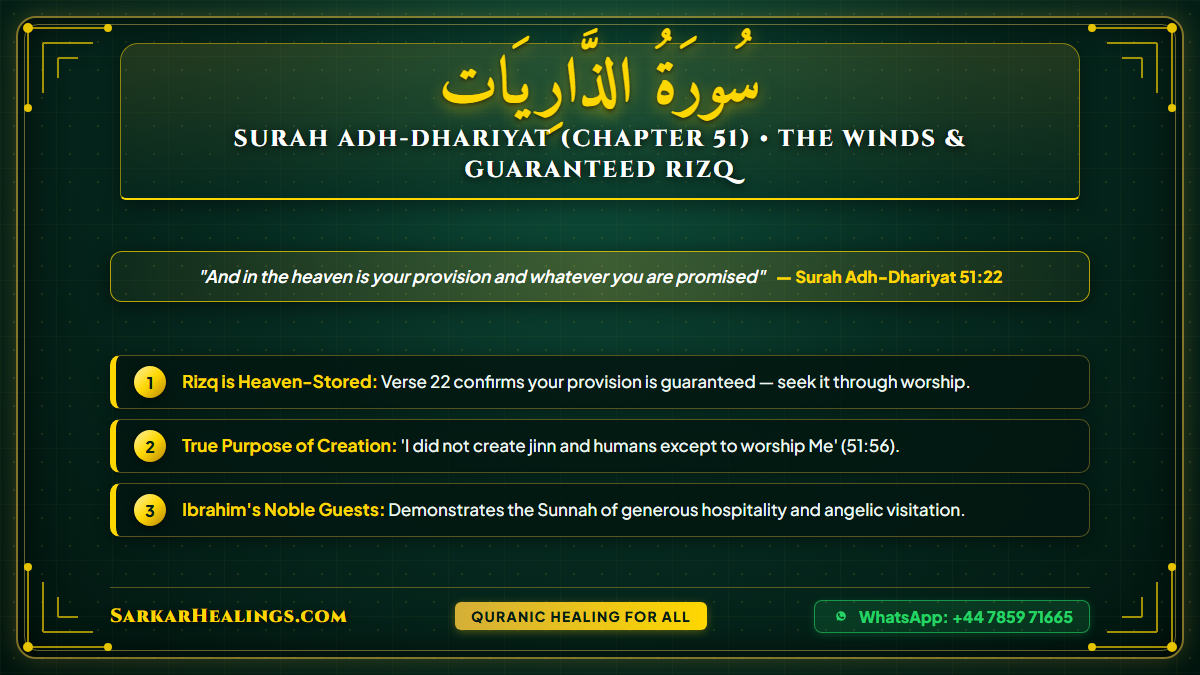
Surah Adh-Dhariyat Benefits: Authentic Virtues and Meaning
بِسْمِ اللَّهِ الرَّحْمَٰنِ الرَّحِيمِ
وَالذَّارِيَاتِ ذَرْوًا
Surah Adh-Dhariyat — The Scatterers
In brief: Surah Adh-Dhariyat speaks of the winds that scatter, reminding us that provision comes from Allah alone and that sincere worship opens the doors of sustenance, ease in pregnancy, and a peaceful transition at death.
In pain → Healing · Feeling unsafe → Protection · Want to understand it → Station & Meaning
وَالذَّارِيَاتِ ذَرْوًا
And by the winds that scatter [dust] far and wide.
Quran 51:1
What Surah Adh-Dhariyat Is About
Surah Adh-Dhariyat, known as “The Scatterers,” takes its name from the powerful imagery of winds that lift and disperse particles across the earth. The surah opens with an oath by these scattering winds, using them as a sign of Allah’s absolute control over creation and the distribution of provision.
Throughout its sixty verses the surah reiterates that sustenance is decreed by Allah, that the purpose of humanity is to worship Him alone, and that the signs of His power are evident in the heavens and the earth for those who possess certainty. It warns the heedless of the consequences of turning away from divine guidance while offering glad tidings to the believers who remain steadfast.
The Benefits of Surah Adh-Dhariyat — Every Claim Sourced
🌿 Healing & Physical Well‑Being
- Writing the surah on a china plate, washing it with clean water and drinking it relieves stomach ache and back pain.
- Recitation increases sustenance and makes earning easier, which indirectly supports bodily health by reducing financial stress.
- Keeping the written surah close to a pregnant woman eases pregnancy and facilitates a smooth delivery.
- Placing the surah near a dying person brings comfort and helps alleviate the pain of the final transition.
To cure stomach ache write this surah on a china plate, wash it with clean water and drink it.
🛡️ Protection & Safety
- Wearing the surah as a talisman protects the pregnant mother and child from complications during gestation.
- Reciting the surah near a person who is dying grants them a peaceful death and shields them from fear.
- Regular recitation safeguards livelihood by warding off unexpected loss of income or resources.
- The surah’s illumination of the grave until Qiyamah acts as a spiritual safeguard for the deceased.
🕊️ Spiritual Station & Inner State
- Reciting Surah Adh-Dhariyat multiplies one’s means of livelihood, reflecting an elevated state of trust in Allah’s provision.
- The grave of a regular reciter remains lit up until the Day of Judgment, indicating a blessed station in the barzakh.
- Virtues earned are equivalent to ten times the number of wind blowings in one’s life, symbolizing abundant divine reward.
- Engaging with the surah’s themes of worship and certainty strengthens the heart’s connection to the Divine.
🎁 Reward & Divine Favor
- The reward for reciting this surah equals ten times the number of moving winds or breezes one experiences in a lifetime.
- This immense reward encourages frequent recitation, knowing that each breath of wind is mirrored in divine generosity.
- Such reward manifests as increased sustenance, ease in affairs, and illumination of the grave.
- Believers who internalize this promise experience heightened gratitude and reliance on Allah’s mercy.
Reward equal to ten times the number of moving winds or breezes.
How and When to Use — Prescription
Before any use: seek refuge (isti’adhah), begin with Bismillah, recite with tarteel (measured pace), close with Ameen.
| When | How to Use | What It Does |
|---|---|---|
| Daily (after Fajr or before sleep) | Recite Surah Adh-Dhariyat once with tarteel. | Increases sustenance and opens pathways to rizq. |
| Morning, upon waking | Recite three times slowly, reflecting on the verse of the scattering winds. | Facilitates easy earning and removes obstacles in livelihood. |
| Evening, for stomach or back discomfort | Write the surah on a clean china plate, wash with fresh water, drink the water. | Relieves stomach ache and eases back pain. |
| Pregnant woman | Keep a written copy of the surah close to her belly or wear it as a talisman. | Ensures easy pregnancy and smooth delivery. |
| Near a dying person | Recite the surah softly beside them, or place the written text near their pillow. | Grants a peaceful death and eases the transition. |
How to Get Maximum Benefit
- Intention (niyyah) – Begin with a sincere heart, seeking Allah’s mercy and not merely worldly gain.
- Consistency – Recite the surah at set times daily to let its blessings accumulate.
- Certainty (yaqeen) – Trust that Allah’s promise of multiplied livelihood and grave illumination is true.
- Pairing with good deeds – Combine recitation with charity, kindness, and regular prayer to amplify the effect.
Listen to Sheikh’s Recitation — Surah Adh-Dhariyat
Recited by Sheikh Sayed — listen with khushu, read along, then recite yourself. For personal recitation guidance, message on WhatsApp.
Frequently Asked Questions
What is the main theme of Surah Adh-Dhariyat?
The surah centers on the signs of Allah’s power in the scattering winds, the certainty of provision, the purpose of creation as worship, and the consequences for those who reject guidance.
How does recitation affect livelihood?
Reciting Surah Adh-Dhariyat is linked to increased sustenance, easier earning, and illumination of the grave, as reported in multiple sources attributing these benefits to the Prophet and the Imams.
Is this narration authentic?
The narrations used here come from two distinct chains: a hadith attributed to the Holy Prophet (S) as recorded in Majma’ al-Bayan, and teachings of Imam Ja’far as-Sadiq (a) found in Fawaid-e-Quran. Multiple independent chains strengthen the authenticity, so the reports are considered established rather than isolated or weak.
Can I use the china plate water remedy for back pain?
Yes. The source specifies that writing the surah on a china plate, washing it with clean water, and drinking the water helps relieve both stomach ache and back pain.
Where Surah Adh-Dhariyat Fits in Your Journey
If you are seeking to strengthen your trust in Allah’s provision, to find ease in health or pregnancy, or to comfort a loved one at the end of life, Surah Adh-Dhariyat offers a focused spiritual tool. Its themes of scattering winds remind us that just as winds disperse particles, Allah’s mercy disperses blessings to those who turn to Him with sincerity.
Cross-Links
- Wealth & Rizq Hub
- Guidance & Istikhara Hub
- Knowledge & Success Hub
- Continue with Surah Qaf
- Continue with Surah At-Tur
- All 114 Surahs
Get the Complete Quran Coded Dua Taweez
WhatsApp Sheikh Sayed — Personal Guidance

Need Personal Guidance on This?
Get a confidential, free consultation with our spiritual advisor — usually replied within hours.
Complete healing path: The Complete Quran Coded Dua — all 114 Surahs & Asma-ul-Husna in one hand-written taweez.
This content and its associated Quranic recitations are offered strictly as a spiritual means (asbab) seeking Allah's guidance, protection, and barakah. Sarkar Healings does not guarantee magical outcomes or instant cures. Spiritual remedies are to be used alongside lawful personal effort and professional medical, legal, or financial advice.