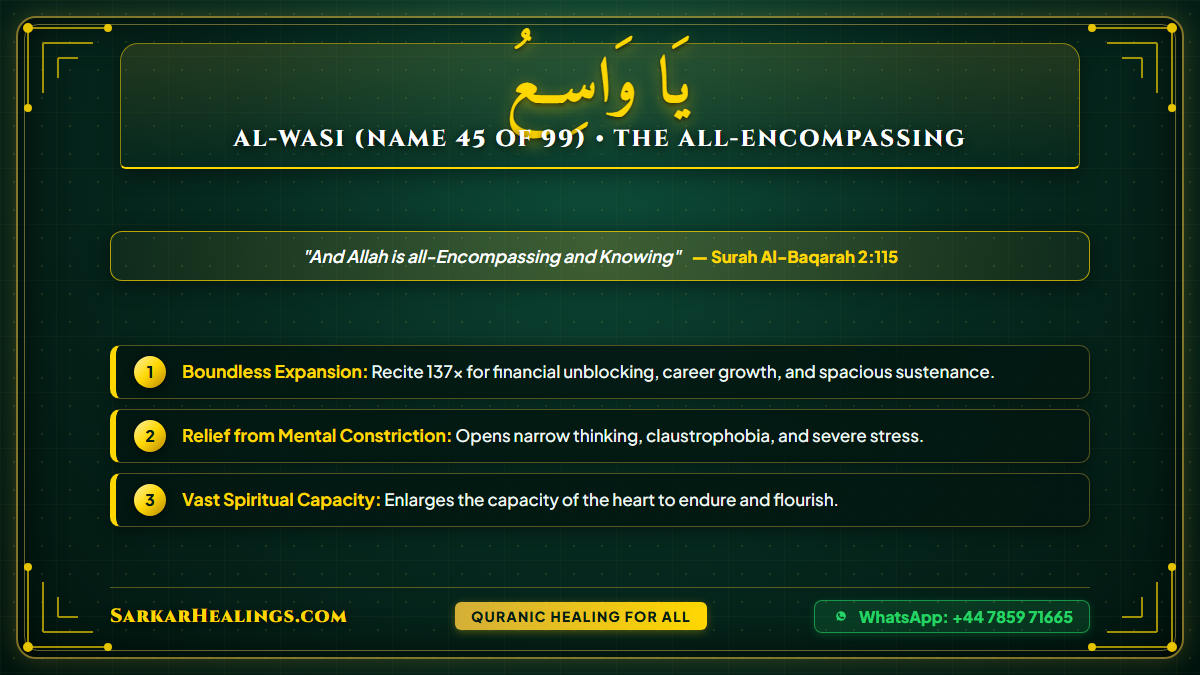
Al-Wasi Meaning & Ya Wasi Benefits (Name 45 of 99)
Sarkar Healings · 99 Names of Allah · Name 45 of 99
الْوَاسِع
Al-Wasi — The All-Encompassing, The Vast
Al-Wasi Meaning & Ya Wasi Benefits
The All-Encompassing, The Boundless in Knowledge, Mercy, and Provision
Al-Wasiʿ (The All-Encompassing) is the 45th Name of Allah, from the root w-s-ʿ denoting vastness, breadth, and capacity without limit. The exact form Al-Wasiʿ does not appear verbatim in the Quran; the indefinite adjective wasiʿun describes Allah in verses such as 2:247 and 4:130. It is invoked for expansiveness in rizq, knowledge, heart-opening, and relief from constriction.
Key Facts at a Glance
| Name in Arabic | الْوَاسِع |
|---|---|
| Transliteration | Al-Wasi (invoked as Ya Wasi) |
| English Meaning | The All-Encompassing, The Vast |
| Position | 45th of the 99 Names (Asma-ul-Husna) |
| Arabic Root | و-س-ع |
| Quran Occurrences | The Name Al-Wasiʿ (الْوَاسِع) with the definite article does not occur verbatim as a standalone Divine Name in the Quran. The root w-s-ʿ appears frequently as the indefinite adjective wasiʿun (وَاسِعٌ) predicated of Allah, notably in 2:247 (وَٱللَّهُ وَٰسِعٌ عَلِيمٌ), 4:130 (وَكَانَ ٱللَّهُ وَٰسِعًا حَكِيمًا), 5:54, 24:32, and 57:29, affirming His boundless knowledge, mercy, and provision. |
| Invoked For | Expansive provision, breadth of knowledge, opening of the heart, relief from financial or emotional constriction |
| Related Names | Al-Muhit · Ar-Razzaq · Al-ʿAlim |
Meaning & the Arabic Root
The root w-s-ʿ (و-س-ع) carries the core sense of wideness, spaciousness, and capacity that cannot be confined. Morphologically, wasiʿ is the active participle (ism al-fāʿil) on the pattern fāʿil, denoting One Who possesses vastness as an essential, perpetual attribute. When the definite article is prefixed — Al-Wasiʿ — it becomes a proper Name signifying that vastness belongs to Allah alone in its absolute, unrestricted sense.
Al-Wasiʿ is distinguished from Al-Muhit (The All-Encompassing) by nuance: muhit (from h-w-t) evokes surrounding or encircling something from every direction; wasiʿ evokes an inner capacity so great that nothing falls outside it — knowledge, mercy, provision, forgiveness, and the very throne of heaven and earth (cf. 2:255, 7:156). It is also distinct from Al-Karim (The Generous), which highlights nobility of giving, whereas Al-Wasiʿ highlights the boundlessness of what is given.
Classical lexicons (e.g. Lisān al-ʿArab, Tāj al-ʿArūs) gloss wasiʿa as ‘to be wide, ample, sufficient’, and note the Quranic phrase wasiʿa kulla shayʾin ʿilman (encompassed all things in knowledge, 40:7) — though there the form is a verb. The Name therefore gathers every dimension of divine infinitude: no need outstrips His treasury, no intellect exhausts His knowledge, no heart exceeds His mercy.
Al-Wasi in the Quran
Quran
The Name Al-Wasiʿ (الْوَاسِع) with the definite article does not occur verbatim as a standalone Divine Name in the Quran. The root w-s-ʿ appears frequently as the indefinite adjective wasiʿun (وَاسِعٌ) predicated of Allah, notably in 2:247 (وَٱللَّهُ وَٰسِعٌ عَلِيمٌ), 4:130 (وَكَانَ ٱللَّهُ وَٰسِعًا حَكِيمًا), 5:54, 24:32, and 57:29, affirming His boundless knowledge, mercy, and provision.
Surah Al-Baqarah 2:247
Wa Allāhu wāsiʿun ʿalīm
“And Allah is All-Encompassing, All-Knowing.”
Surah Al-Baqarah 2:247
Spoken in the context of Tālūt’s appointment; the verse reassures that Allah’s wisdom and provision are not confined by human expectations of status or wealth.
Surah An-Nisa 4:130
Wa kāna Allāhu wāsiʿan ḥakīmā
“And Allah is ever All-Encompassing, All-Wise.”
Surah An-Nisa 4:130
Addresses separation between spouses; affirms that Allah’s provision and wisdom embrace every circumstance, so none need despair of His bounty.
Surah Al-Ma'idah 5:54
Yā ayyuhā alladhīna āmanū man yartadid minkum ʿan dīnihi fasawfa yaʾtī Allāhu bi-qawmin yuḥibbuhum wa yuḥibbūnahu adhillatin ʿalā al-muʾminīn aʿizzatin ʿalā al-kāfirīn yujāhidūna fī sabīli Allāhi wa lā yakhāfūna lawmata lā'im. Dhālika faḍlu Allāhi yuʾtīhi man yashāʾ. Wa Allāhu wāsiʿun ʿalīm.
“O you who believe, whoever of you reverts from his religion — Allah will bring forth a people He loves and who love Him… That is the bounty of Allah; He gives it to whom He wills. And Allah is All-Encompassing, All-Knowing.”
Surah Al-Ma'idah 5:54
The Name appears again coupled with ʿAlīm, underscoring that divine favour (faḍl) flows from an inexhaustible source whose knowledge perfectly matches each recipient.
The Hadith Foundation of the 99 Names
Hadith — graded
Abū Hurayrah reported: The Messenger of Allah ﷺ said, “Allah has ninety-nine names, one hundred less one; whoever enumerates them (aḥṣāhā) enters Paradise.” — Ṣaḥīḥ al-Bukhārī 2736; Ṣaḥīḥ Muslim 2677.
The itemised list of ninety-nine names appears in Jāmiʿ at-Tirmidhī 3507, where Al-Wasiʿ is included as the 45th name. Scholars (including al-Nawawī and Ibn Ḥajar) grade the isnād of this specific list as ḍaʿīf (weak) due to a narrator in the chain, though the principle that Allah has ninety-nine names is authentically established by the two Ṣaḥīḥs.
No authentic, name-specific ḥadīth (e.g. “Whoever says Yā Wāsiʿ such-and-such times…”) is established in the primary collections. Devotional formulas for this Name belong to the later wazīfa tradition, not to the prophetic sunna.
Classical Commentary
Classical Scholarship — Sunni / Sufi tradition
Imam al-Ghazālī on Al-Wāsiʿ (al-Maqṣad al-Asnā)
Al-Ghazālī explains that al-wusʿ in Allah denotes the absence of any limit (ḥadd) or confinement (ḥiṣār) in His attributes. His knowledge is wāsiʿ because it comprehends every particular without omission or sequence; His mercy is wāsiʿ because it reaches every existent — believer and disbeliever — in this world, and the believers specifically in the next (cf. 7:156). His provision is wāsiʿ because no created need can exhaust His treasury (cf. 15:21). The servant’s portion of the discussion urges the seeker to expand his own heart by contemplating this vastness, so that narrowness of hope, fear of poverty, or stinginess toward others are displaced by trust in the Boundless.
In the Akbarian tradition (Ibn ʿArabī and his school), Al-Wāsiʿ is often linked to the Kursī and the ʿArsh as loci where divine vastness is manifested. The Name is said to be the source of the spiritual station of al-inbisāṭ (spiritual expansion), wherein the heart is widened to receive the lights of gnosis. Ibn ʿArabī’s writings on the Divine Names seek healing for Al-Wāsiʿ as the principle that traditional meanss no created reality can ever “fill” Allah or constrain His acts.
Benefits of Reciting Ya Wasi
Within the devotional tradition, the following benefits are associated with the sincere and consistent remembrance of Al-Wasi. Each reflects the meaning of the Name itself.
- Expansiveness in provision (rizq)
Because the Name signifies limitless treasury, the tradition records its invocation when livelihood feels constricted, asking Allah to widen the means. - Opening of the heart (inshirāḥ al-ṣadr)
The root meaning of breadth is applied to the spiritual heart; recitation is associated with relief from anxiety, narrowness, and despair. - Breadth of knowledge and understanding
Paired with ʿAlīm in the Quran, the Name is invoked by students and seekers for grasp of complex sciences and clarity in decision-making. - Removal of stinginess and fear of poverty
Reflecting on Allah’s wusʿ counters the inner constriction that breeds miserliness; the tradition links it to generosity of spirit. - Healing from psychosomatic tightness
Recited alongside medical seek healing forment for conditions experienced as constriction — chest tightness, panic, tension headaches — asking the Vast One to expand. - Forgiveness that knows no bounds
Since His mercy is wāsiʿa (7:156), the Name is called upon when sins feel too many, trusting that divine forgiveness outruns them. - Success in daʿwah and communal work
The vastness of Allah’s capacity encourages the caller to trust that no audience is too large, no heart too hard for the All-Encompassing to reach.
Traditional Wazifa Practices (with Sources)
Devotional Tradition — South Asian wazifa literature
What follows are devotional practices (wazāʾif) transmitted in the South Asian Sufi manual genre (e.g. Ism-e-Aʿẓam compilations by scholars such as ʿĀlam Faqrī) and through living silsila instruction. They are not prophetic sunna, carry no used as a means (sabab) outcomes, and are offered as *means* (asbāb) alongside — never replacing — medical care, lawful effort, and trust in Allah’s decree. Fixed-duration reseek healing fors (chillas) or high repetition counts (above ~500) are traditionally undertaken with a qualified teacher’s guidance.
- Qur'anic duʿāʾ from the verse itself
After each farḍ prayer, recite the Quranic phrase: Wa Allāhu wāsiʿun ʿalīm (2:247) seven times, then ask Allah by this Name for breadth in the specific need (rizq, knowledge, heart-opening). This grounds the practice in revelation. - Daily wird of 100× Yā Wāsiʿ
Recite Yā Wāsiʿ 100 times morning and evening (after Fajr and Maghrib) with presence of heart, visualising the meaning of boundlessness encompassing the need. A common entry-level practice in the manuals. - 313× for acute constriction (khabt al-ṣadr)
In moments of acute anxiety or financial tightness, the tradition suggests 313 repetitions in one sitting (or divided), followed by duʿāʾ. The number 313 recalls Badr and is symbolic, not scripturally mandated. - 40-day chilla of 1,100× daily (with teacher)
A deeper reseek healing for practice: 1,100 × Yā Wāsiʿ after ʿIshāʾ for 40 consecutive days, maintaining wuḍūʾ, facing qibla, and keeping a simple diet. Undertaken only with a shaykh’s permission and monitoring; not for beginners.
Etiquette (Adab) of Reciting Ya Wasi
- Begin with istighfar — seeking forgiveness before presenting the request.
- Praise Allah and send salawat upon the Prophet ﷺ before and after the dhikr.
- Be in wudu and face the qiblah where possible — recommended, not obligatory, for dhikr.
- Ask with certainty — the Prophet ﷺ instructed asking Allah with conviction of response (Jami’ at-Tirmidhi 3479).
- Keep lawful earnings and intentions.
- Consistency over quantity — the most beloved deeds are the most constant, even if small (Sahih al-Bukhari 6464).
- When invoking Al-Wāsiʿ, inwardly affirm that no created means — salary, doctor, connection — is the true source of expansion; they are mere vessels of the Vast One.
Frequently Asked Questions
- Al-Wāsiʿ (الْوَاسِع) means The All-Encompassing, The Vast, The Boundless — the One whose knowledge, mercy, provision, and every attribute have no limit or confinement.
- The exact form Al-Wāsiʿ (with alif-lām) does not appear as a standalone Name. The indefinite adjective <em>wāsiʿun</em> is predicated of Allah in several verses (2:247, 4:130, 5:54, 24:32, 57:29), and the verbal form <em>wasiʿa</em> appears in 7:156 and 40:7.
- Both convey encompassing. Al-Muhīṭ (from ḥ-w-ṭ) emphasises surrounding from all sides externally; Al-Wāsiʿ (from w-s-ʿ) emphasises limitless internal capacity — nothing can exceed or exhaust Him.
- No prophetic count exists. Common traditional wirds are 100× daily, 313× in need, or 1,100× for a 40-day chilla (with a teacher). Choose what is sustainable with presence of heart.
- Any Muslim may recite this Name in duʿāʾ and daily wird. High-count reseek healing fors (chillas) and specific Sufi formulas traditionally require a teacher's permission for spiritual safety and correct adab.
Obtain a Spiritually Prepared Ya Wasi Taweez
At Sarkar Healings we prepare Taweez and Naqash of Al-Wasi following the etiquette and recitations described in this guide.
Explore Coded Duas & Taweez
WhatsApp Us
Or email: help@sarkarhealings.com
Continue the series: Al-Muhit · Ar-Razzaq · Al-ʿAlim · All 99 Names of Allah
This is a traditional practice, not a substitute for medical treatment, legal advice, or professional care. Scholars differ on some of these practices; where they differ, that difference is noted. Benefit and outcome are from Allah alone. If you are facing a medical, psychological, or financial emergency, seek qualified professional help first.
Coded Duas based on Al-Wasi

Need Personal Guidance on This?
Get a confidential, free consultation with our spiritual advisor — usually replied within hours.
Complete healing path: The Complete Quran Coded Dua — all 114 Surahs & Asma-ul-Husna in one hand-written taweez.
This content and its associated Quranic recitations are offered strictly as a spiritual means (asbab) seeking Allah's guidance, protection, and barakah. Sarkar Healings does not guarantee magical outcomes or instant cures. Spiritual remedies are to be used alongside lawful personal effort and professional medical, legal, or financial advice.