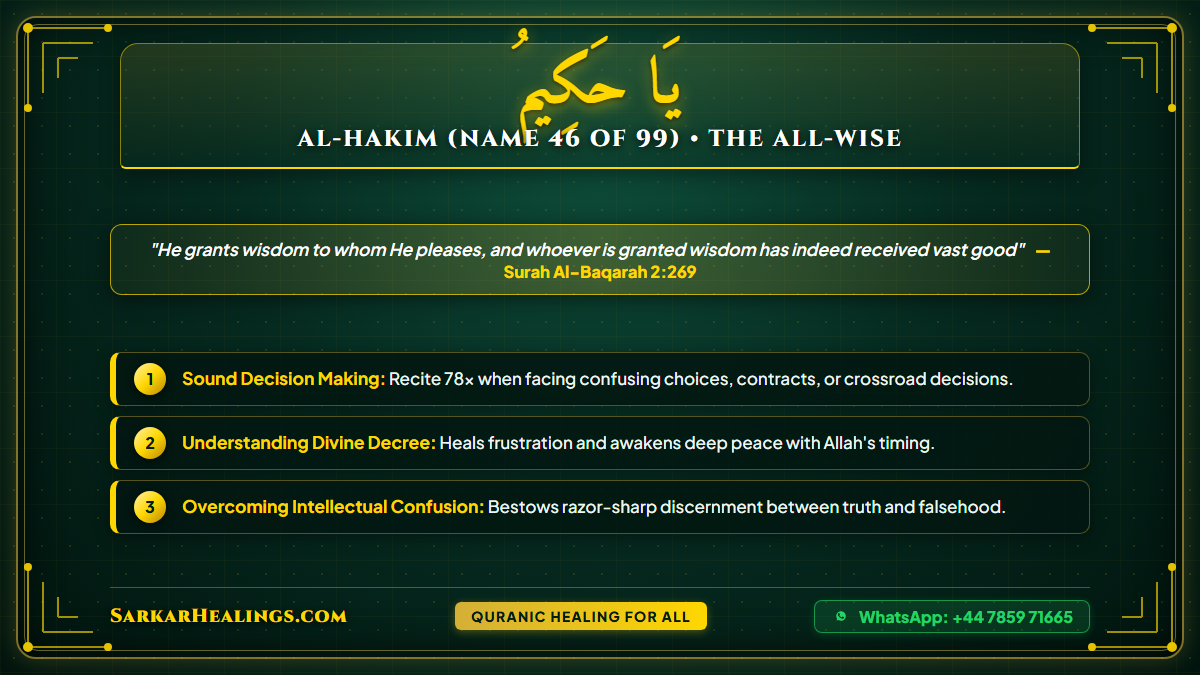
Al-Hakim Meaning & Ya Hakimu Benefits (Name 46 of 99)
Sarkar Healings · 99 Names of Allah · Name 46 of 99
الْحَكِيم
Al-Hakim — The All-Wise
Al-Hakim Meaning & Ya Hakimu Benefits
The All-Wise — He whose every decree, creation, and command flows from perfect wisdom
Al-Hakim (The All-Wise) is the 46th Name of Allah, from the root ح-ك-م (wisdom, judgment, preventing error). It occurs verbatim 93 times in the Qurʾān (e.g. 2:32, 3:62, 4:26). The Name signifies that Allah’s knowledge, will, and action are inseparable: He places every thing in its most fitting station. Believers invoke Yā Hakīm for sound decision-making, resolution of confusion, healing from spiritual and physical ailments, and alignment with divine order.
Key Facts at a Glance
| Name in Arabic | الْحَكِيم |
|---|---|
| Transliteration | Al-Hakim (invoked as Ya Hakimu) |
| English Meaning | The All-Wise |
| Position | 46th of the 99 Names (Asma-ul-Husna) |
| Arabic Root | ح-ك-م |
| Quran Occurrences | Al-Ḥakīm appears verbatim in the Qurʾān 93 times across 21 sūrahs. Key occurrences include Al-Baqarah 2:32, 2:129, 2:209, 2:228, 2:260, 2:269, 2:283; Āl ʿImrān 3:62, 3:118, 3:180; An-Nisāʾ 4:11, 4:17, 4:24, 4:26, 4:28, 4:32, 4:34, 4:56, 4:58, 4:59, 4:65, 4:70, 4:83, 4:105, 4:113, 4:130, 4:158, 4:165, 4:176; and many others. The intensive form (faʿīl) indicates permanence and perfection of the attribute. |
| Invoked For | Wisdom in decisions, clarity in confusion, healing, justice, right judgment, spiritual insight |
| Related Names | Al-ʿAlīm · Al-Ḥakam · Al-Qadīr |
Meaning & the Arabic Root
The root ḥ-k-m (ح-ك-م) carries the core senses of wisdom, sound judgment, decisive ruling, and preventing something from falling into corruption. The word ḥikmah denotes placing a thing in its proper place; a ḥakīm is one who consistently does so.
Morphologically, Al-Ḥakīm is on the pattern faʿīl (intensive active participle), indicating that wisdom is not merely an occasional act of Allah but His permanent, essential quality. Every divine decree (qadar), legislative ruling (sharʿ), and creative act (khalq) proceeds from wisdom — nothing is futile, misplaced, or devoid of purpose.
Distinction from related Names: Al-ʿAlīm (The All-Knowing) describes the breadth of divine knowledge; Al-Ḥakīm describes the manner of its deployment — knowledge perfected by wisdom. Al-Ḥakam (The Judge) emphasises the verdict that separates right from wrong; Al-Ḥakīm emphasises the underlying wisdom that makes every verdict, and every created thing, perfectly suited to its reality.
Al-Hakim in the Quran
Quran
Al-Ḥakīm appears verbatim in the Qurʾān 93 times across 21 sūrahs. Key occurrences include Al-Baqarah 2:32, 2:129, 2:209, 2:228, 2:260, 2:269, 2:283; Āl ʿImrān 3:62, 3:118, 3:180; An-Nisāʾ 4:11, 4:17, 4:24, 4:26, 4:28, 4:32, 4:34, 4:56, 4:58, 4:59, 4:65, 4:70, 4:83, 4:105, 4:113, 4:130, 4:158, 4:165, 4:176; and many others. The intensive form (faʿīl) indicates permanence and perfection of the attribute.
Surah Al-Baqarah 2:32
Qālū subḥānaka lā ʿilma lanā illā mā ʿallamtanā; innaka anta al-ʿAlīmu al-Ḥakīm
“They said, 'Exalted are You; we have no knowledge except what You have taught us. Indeed, it is You who is the Knowing, the Wise.'”
Surah Al-Baqarah 2:32
The angels acknowledge that all true knowledge and its wise application belong solely to Allah. The pairing of Al-ʿAlīm and Al-Ḥakīm shows knowledge and wisdom as inseparable divine attributes.
Surah Al-Isrāʾ 17:85
Wa mā ūtitum min al-ʿilmi illā qaṣīlan; wa kāna faḍlu Llāhi ʿalayka ʿaẓīmā
“And you have not been given of knowledge except a little. And ever is the favour of Allah upon you great.”
Surah Al-Isrāʾ 17:85
Though this verse does not contain Al-Ḥakīm verbatim, it is the immediate context of the preceding verse (17:84) where the Prophet ﷺ is told: ‘Say: The Spirit is of the affair of my Lord…’ — affirming that the wisdom behind creation (ḥikmah) is known fully only to Al-Ḥakīm.
Surah Yūnus 10:1 (also 31:2, 13:1, 27:1, 28:2, 36:2)
Tilka āyātu al-kitābi al-Ḥakīm
“These are the verses of the Wise Book.”
Surah Yūnus 10:1 (also 31:2, 13:1, 27:1, 28:2, 36:2)
The Qurʾān itself is described as al-Ḥakīm — a revelation characterised by wisdom, with every verse placed precisely, addressing human needs with perfect suitability. This is the wisdom of Al-Ḥakīm made manifest in speech.
The Hadith Foundation of the 99 Names
Hadith — graded
Abū Hurayrah reported: The Messenger of Allah ﷺ said, “Allah has ninety-nine names, one hundred less one; whoever enumerates them enters Paradise.” Ṣaḥīḥ al-Bukhārī 2736; Ṣaḥīḥ Muslim 2677
The above ḥadīth al-aḥādīth (umbrella hadith) establishes the ninety-nine names as a framework; Al-Ḥakīm is among them. A version recorded in Jāmiʿ al-Tirmidhī (3507) itemises the names explicitly including Al-Ḥakīm, though scholars such as al-Albānī grade the itemised list itself as ḍaʿīf (weak) while accepting the principle of the ninety-nine names from the Ṣaḥīḥayn.
Regarding wisdom specifically, the Prophet ﷺ said: “Whoever is given wisdom (ḥikmah) has been given abundant good” (Ṣaḥīḥ al-Bukhārī, Ṣaḥīḥ Muslim — referencing Qurʾān 2:269). This connects the human receipt of wisdom to its divine Source, Al-Ḥakīm.
Classical Commentary
Classical Scholarship — Sunni / Sufi tradition
Imam al-Ghazālī on Al-Ḥakīm (al-Maqṣad al-Asnā)
Al-Ghazālī explains that ḥikmah in the divine sense means “placing things in their proper stations” (wadʿ al-ashyāʾ mawāḍiʿahā). Al-Ḥakīm is He whose knowledge encompasses the true natures of all things, whose will chooses the most fitting existence for each, and whose power brings it into being without flaw. There is no ʿabath (futility), no ṣudf (randomness), and no ẓulm (misplacement) in His creation or command. The world’s apparent imperfections are imperfections only relative to our limited perception; from the vantage of Al-Ḥakīm, every event occupies its exact coordinate in the total order of goodness.
The Akbarian tradition (Ibn ʿArabī and his school) elaborates that Al-Ḥakīm is the Name through which the aʿyān thābita (immutable archetypes) are distinguished and ordered. Each thing’s ḥikmah is its specific mode of manifesting the Real; the cosmos is the ḥikmah of Al-Ḥakīm made visible. To know a thing’s ḥikmah is to know its face turned toward the Divine.
Benefits of Reciting Ya Hakimu
Within the devotional tradition, the following benefits are associated with the sincere and consistent remembrance of Al-Hakim. Each reflects the meaning of the Name itself.
- Sound decision-making (istikhārah clarity)
Because Al-Ḥakīm places every matter in its correct station, invoking Him (especially after ṣalāt al-istikhārah) is traditionally sought for clarity when choices seem equally weighted. - Removal of confusion and waswās
The root meaning of preventing corruption extends to the heart; recitation of Yā Ḥakīm is associated with stilling obsessive doubts and aligning the mind with divine order. - Healing from chronic or baffling ailments
In the South Asian wazifa tradition, Al-Ḥakīm is invoked for illnesses where the cause is hidden or seek healing forment fails, trusting that the Wise Healer knows the precise remedy — always alongside medical care. - Justice in disputes and legal matters
As the source of all true judgment, the Name is recited by those seeking fair outcomes in courts, family mediation, or business conflicts, asking that truth be distinguished from falsehood. - Spiritual insight (baṣīrah) and understanding of the Qurʾān
Since the Qurʾān is kitābun ḥakīm, calling upon its Author as Al-Ḥakīm before study or tadabbur is believed to open the heart to the wisdom embedded in the verses. - Correcting misplaced attachments
Wisdom is putting love, fear, and reliance in their rightful object (Allah alone); the Name is invoked to reorder disordered priorities and seek healing for the heart’s misplacements. - Patience in the face of seemingly adverse decree
Trusting Al-Ḥakīm means affirming that what appears harmful contains a hidden wisdom; recitation nurtures riḍā (contentment) with the divine measure.
Traditional Wazifa Practices (with Sources)
Devotional Tradition — South Asian wazifa literature
The following practices are drawn from the South Asian Urdu wazifa manual tradition (e.g. Ism-e-Aʿẓam compilations) and Sufi silsila custom. They are devotional acts, not prescriptive injunctions from the Qurʾān or Sunnah. No specific count or duration is authenticated from the Prophet ﷺ. Heavy or fixed-duration practices (chillas, counts above ~500) are traditionally undertaken with a qualified teacher’s guidance. Recitation is for healing and spiritual support alongside, never instead of, medical or professional seek healing forment. Outcomes are from Allah alone; the tradition records benefits, but no traditional meanss are made.
- Qurʾānic Dua Practice — After Ṣalāt al-Istikhārah
Pray two rakʿahs of istikhārah, then recite the masnūn duʿā. Conclude with: Yā Ḥakīm, yā ʿAlīm, aḥkim lī amrī wa ʿallimnī khayrah (O Wise, O Knowing, make my affair wise and teach me the best) — 7 times. This ties the Name directly to its Qurʾānic pairing in 2:32. - Daily Wird for Clarity (Traditional Count)
Recite Yā Ḥakīm 100 times after Ṣalāt al-Fajr and 100 times after Ṣalāt al-ʿIshāʾ, with ṣalawāt before and after. Consistent for 40 days. The tradition records this for dispelling confusion and gaining insight into difficult matters. - Healing-Focused Recitation (with Medical seek healing forment)
Recite Yā Ḥakīm 313 times (or 100 times if 313 is difficult) over water, blow gently, and drink/use for washing the affected area. Done once daily. The count 313 recalls the companions of Badr; the practice is recorded in wazifa manuals for chronic or undiagnosed conditions, always alongside doctor’s care. - Pre-Study/Tadabbur Invocation
Before opening the Qurʾān or a book of sacred knowledge, recite Yā Ḥakīm 11 times with the intention: ‘O Wise One, open the wisdom of Your speech to my heart.’ A light, non-fixed practice suited for students and seekers.
Etiquette (Adab) of Reciting Ya Hakimu
- Begin with istighfar — seeking forgiveness before presenting the request.
- Praise Allah and send salawat upon the Prophet ﷺ before and after the dhikr.
- Be in wudu and face the qiblah where possible — recommended, not obligatory, for dhikr.
- Ask with certainty — the Prophet ﷺ instructed asking Allah with conviction of response (Jami’ at-Tirmidhi 3479).
- Keep lawful earnings and intentions.
- Consistency over quantity — the most beloved deeds are the most constant, even if small (Sahih al-Bukhari 6464).
- When invoking Al-Ḥakīm, cultivate the inner adab of taslīm (surrender): do not merely ask for your preferred outcome, but ask that Allah choose the outcome that is truly wisest — even if it differs from your wish.
Frequently Asked Questions
- What does Al-Hakim mean?
- Al-Ḥakīm (The All-Wise) means the One whose knowledge, will, and action are perfectly aligned so that every created thing, every divine decree, and every legislative ruling is placed in its most fitting station — nothing is futile, random, or misplaced.
- Is Al-Hakim mentioned in the Quran?
- Yes, verbatim, 93 times across 21 sūrahs. Examples include Al-Baqarah 2:32, 2:129, 2:269; Āl ʿImrān 3:62; An-Nisāʾ 4:26, 4:58, 4:165; and Yūnus 10:1 (tilka āyātu al-kitābi al-Ḥakīm).
- What is the difference between Al-Hakim and Al-Alim?
- Al-ʿAlīm denotes the perfection and comprehensiveness of divine knowledge; Al-Ḥakīm denotes the perfection of acting upon that knowledge — wisdom is knowledge deployed so that everything reaches its proper place. They appear paired in 2:32, 2:269, 4:26, 4:165, etc.
- How many times to recite Ya Hakim?
- There is no authentically prescribed count from the Sunnah. The South Asian wazifa tradition mentions 100× daily, 313× for healing, 1000× in a chilla (40-day reseek healing for), or simply 11× before study. Choose a manageable, consistent amount; heavy counts are traditionally done with a teacher’s guidance.
- Who can recite Ya Hakim?
- Any Muslim — man, woman, child, scholar, or layperson — may invoke Allah by this Name. No initiation, lineage, or special permission is required. The only conditions are sincerity (ikhlāṣ), presence of heart, and observing the outward manners of duʿā (wuḍūʾ, facing qibla, ṣalawāt).
Obtain a Spiritually Prepared Ya Hakimu Taweez
At Sarkar Healings we prepare Taweez and Naqash of Al-Hakim following the etiquette and recitations described in this guide.
Explore Coded Duas & Taweez
WhatsApp Us
Or email: help@sarkarhealings.com
Continue the series: Al-ʿAlīm · Al-Ḥakam · Al-Qadīr · All 99 Names of Allah
This is a traditional practice, not a substitute for medical treatment, legal advice, or professional care. Scholars differ on some of these practices; where they differ, that difference is noted. Benefit and outcome are from Allah alone. If you are facing a medical, psychological, or financial emergency, seek qualified professional help first.
Coded Duas based on Al-Hakim

Need Personal Guidance on This?
Get a confidential, free consultation with our spiritual advisor — usually replied within hours.
Complete healing path: The Complete Quran Coded Dua — all 114 Surahs & Asma-ul-Husna in one hand-written taweez.
This content and its associated Quranic recitations are offered strictly as a spiritual means (asbab) seeking Allah's guidance, protection, and barakah. Sarkar Healings does not guarantee magical outcomes or instant cures. Spiritual remedies are to be used alongside lawful personal effort and professional medical, legal, or financial advice.