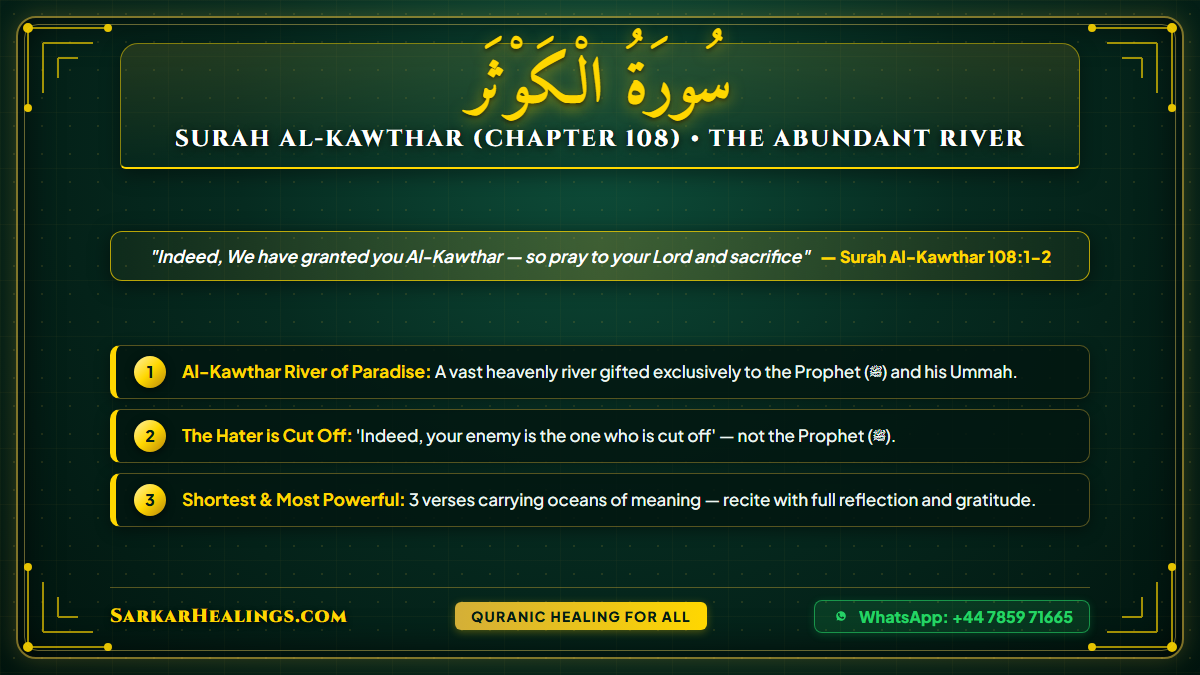
Surah Al-Kawthar Benefits: Authentic Virtues and Meaning
Sarkar Healings · Quranic Wisdom
بِسْمِ اللهِ الرَّحْمنِ الرَّحِيمِ
In the Name of Allah, the Beneficent, the Merciful
Surah Kausar Benefits & Virtues of Chapter 108
Also known as Surah Al-Kawthar — “The Abundance”
How the shortest Surah in the Quran brings divine healing, rizq (sustenance), and protection against every adversary
In pain or distress → Healing
Feeling unsafe → Protection
Want to understand it → Station & meaning
Want the practice → How to recite it

Surah Kausar as a Source of Healing
Muslims across the world embrace the profound reality that the Quran is a primary source of physical, emotional, and spiritual healing. Within this vast ocean of divine wisdom lies Surah Al-Kawthar (Chapter 108) — the shortest Surah in the Holy Quran, comprising only three verses yet carrying immeasurable weight.
Despite its brevity, Surah Kausar benefits are widely spoken of. Allah revealed this chapter to provide immense comfort to the Prophet Muhammad ﷺ during a period of intense grief, and believers have long turned to it for the same comfort. The Quran’s healing properties flow directly from its spiritual and moral teachings, offering guidance through hardship. To understand how this fits into the broader tradition, read our full guide on authentic Islamic spiritual healing.
- Meaning: The Abundance / A River in Paradise
- Chapter Number: 108
- Number of Verses: 3
- Revelation: Generally Meccan; some scholars note it may have been revealed twice — in Mecca and again in Medina.
Arabic Text, Transliteration & Meaning
إِنَّا أَعْطَيْنَاكَ الْكَوْثَرَ
Inna a’tainakal-kawthar
فَصَلِّ لِرَبِّكَ وَانْحَرْ
Fasalli li rabbika wanhar
إِنَّ شَانِئَكَ هُوَ الْأَبْتَرُ
Inna shani-aka huwal-abtar
In the Name of Allah, the Beneficent, the Merciful
“Indeed, We have granted you, O Muhammad, al-Kawthar (abundant goodness / a river in Paradise). So pray to your Lord and sacrifice to Him alone. Indeed, your enemy is the one who is cut off.”
Quran 108:1–3
Historical Context & Occasion of Revelation
To fully appreciate Surah Kausar benefits, one must understand the circumstances surrounding its revelation. Al-‘As ibn Wa’il, one of the arrogant chiefs of the Meccan pagans, met the Holy Prophet ﷺ coming out of the Sacred Mosque and spoke with him for a while. A group of Quraish men sitting inside watched from a distance.
When Al-‘As ibn Wa’il entered the Mosque, they asked: “To whom were you speaking?”
“With this abtar one.”
He used this derogatory word to taunt the Prophet ﷺ. The Prophet’s two sons — Qasim and Abdullah — born of Lady Khadijah (RA), had both died in infancy, leaving no surviving male heir. In ancient Arab culture, a man without a son was called abtar — literally “the one whose tail is cut off” — implying his lineage, legacy, and memory would perish with him.
The Divine Response
The pagans imagined that the mission of Islam would vanish upon the Prophet’s death. To console him ﷺ and answer his enemies, Allah revealed this Surah — announcing the greatest and most enduring abundance: the River of Kawthar in Paradise and the enduring legacy of Islamic faith. The enemies of the Prophet who mocked him are themselves forgotten by history, while Islam, the Quran, and the legacy of the Prophet ﷺ have endured for over fourteen centuries.
This occasion-of-revelation account is widely repeated across tafsir literature.Source: pending citation
The Benefits of Surah Kausar — Every Claim Graded
Throughout Islamic devotional history, saints and spiritual practitioners have documented specific virtues (Wazaif) associated with this blessed chapter. We’ve grouped them below by what people most often come to this page seeking, and marked the evidence status of each — most circulate widely in Sufi and devotional literature but are not yet matched to a graded hadith collection, so we present them as tradition, not as guaranteed outcomes.
🌿 Healing & Inner Peace
- Drinking from the Fountain of Kawthar Grade: pending
A tradition attributed to the Holy Prophet ﷺ states that whoever recites it in their prayers will be given to drink from the fountain of Kawthar, with reward recompensed as generously as the sacrifices offered on the Day of the Feast. This narration is in wide devotional circulation; its collection and hadith number have not yet been confirmed here. - Steadiness against fear and anxiety
Many turn to regular recitation as a sabab (means) they hope brings steadiness against distress and a deepened reliance on Allah (tawakkul) — since it was revealed to console the Prophet ﷺ in grief. The outcome and its timing rest with Allah alone. - A dawn practice for the heart Grade: pending
Some devotional sources describe reciting it a small number of times at daybreak as a practice associated with easing anxiety and settling the heart before the day begins.
🛡️ Protection
- Seeing the Prophet ﷺ in a dream Grade: pending
Devotional literature holds that whoever recites this Surah one hundred times on Friday night with sincerity may, by the will of Allah, be blessed with seeing the Holy Prophet ﷺ in a dream. - A shield against envy and the evil eye
Just as this Surah answered and outlasted the Prophet’s enemies, some practitioners recite it as protection from jealousy, the evil eye (Nazar), and malicious intent. The final verse — inna shani-aka huwal-abtar — is read as a declaration against adversaries. For more on using Quranic verses this way, see our complete guide to Taweez in Islam. - Forgiveness for the reciter and their family Grade: pending — needs sourcing before publish
Devotional sources link consistent recitation to hoped-for forgiveness for the reciter and their parents and children. Some versions of this tradition add a claim of martyrdom-equivalent standing upon death; because that is a significant claim to make on someone’s behalf, we are not including it here until it is traced to a named, gradable source.
🌟 Station & Meaning
- Companionship of the Prophet ﷺ in Paradise Grade: pending
A narration attributed to Imam Ja’far as-Sadiq (a.s.), reported with a single chain in Fawaid-e-Quran, holds that whoever recites this Surah consistently in daily prayers will be near the Holy Prophet ﷺ beneath the Tree of Tuba in Paradise. Note: this is a Shia-attributed source with a solitary chain — confirm it fits alongside this site’s Sunni Sufi framing, and treat it as a promising tradition awaiting further confirmation rather than an established one. - A share of the Quran’s reward Grade: pending
Some devotional literature describes reciting this Surah as carrying a reward comparable to a portion of the entire Quran’s reward. This is a popular estimate in circulation, not a figure we can currently attribute to a specific graded source.
🎁 Reward
- Reward likened to countless sacrifices Grade: pending
The reward described above is popularly elaborated as comparable to many times the number of animals sacrificed on Eid-ul-Adha globally — an embellishment not yet traced to a specific source. - Wazifa for Wealth & Rizq Grade: pending
Reciting Surah Kausar a fixed number of times daily is a well-known devotional practice some observe as a sabab for opening doors of sustenance — not a guarantee of any specific result. Explore our Surah Kausar Taweez for wealth and abundance for a prepared spiritual aid.
How & When to Recite It
Before any use: seek refuge (isti’adhah), begin with Bismillah, recite with tarteel (a measured, unhurried pace), and close with Ameen.
| When | How to Use | Traditionally Associated With |
|---|---|---|
| Daily prayer recitation | Recite Surah Al-Kawthar within an obligatory or optional salat | The fountain of Kawthar & nearness to the Prophet ﷺ under Tuba (see gradings above) |
| Before sleep | Recite Al-Kawthar, then Surah Al-Ikhlas | A sense of protection and settledness through the night |
| Friday night | Recite 100 times after Maghrib | Hoped-for dream of the Holy Prophet ﷺ |
| Daybreak | Recite a small number of times at dawn | Easing anxiety, settling the heart |
| Ongoing wazifa | Recite with the intention of forgiveness and sustenance for yourself and your family | Hoped-for forgiveness and open doors of rizq |
Getting the Most From Your Recitation
- Intention (niyyah): Recite for Allah’s pleasure first, before any specific outcome.
- Consistency: Make it a regular part of your salah or daily adhkar rather than a one-off.
- Presence of heart: Recite with sincerity and attention — many practitioners describe this as central to the practice’s benefit.
- Pairing: Some combine it with Surah Al-Ikhlas before sleep, or with Surah Al-Fatiha in salah.
Other Miracles Mentioned in the Quran
Surah Kausar benefits form part of a much larger framework of divine miracles embedded throughout the Holy Quran. In Surah Yunus (10:57) Grade: Quran, Allah ﷻ declares that what descends from the Quran is a healing and a mercy for believers — understood by classical exegesis as healing for spiritual ailments of the heart such as doubt, hypocrisy, and despair.
In Surah Al-Isra (17:82) Grade: Quran, the Quran is described as healing and mercy specifically for those who believe. And in Surah Aal-Imran (3:7) Grade: Quran, Allah explains the Quran’s layered depth: verses clear and precise alongside allegorical ones, whose full interpretation belongs to Allah and those firmly grounded in knowledge.
This indicates hidden meanings accessible only through sincere faith and deep scholarship — including the science of Ruqyah and spiritual healing. Those who follow the Quran’s teachings often describe profound positive transformation, improved wellbeing, and a deepened connection to Allah ﷻ.
Listen to the Recitation
Recited by Sheikh Sayed — listen with khushu, read along with the transliteration above, then recite yourself. For personal recitation guidance, message on WhatsApp.
Frequently Asked Questions
Is wearing or carrying a Coded Dua (Taweez) of Surah Kausar shirk?
No, provided it contains only Quranic text and Allah’s Names, and the wearer understands it as a sabab (means) rather than a source of benefit in itself. All benefit is from Allah alone. Scholars differ on the underlying question of taweez generally — see our full guide on taweez in Islam for that discussion.
What does Surah Al-Kawthar (Chapter 108) mean?
Al-Kawthar means abundance, and is also understood as the name of a river granted to the Prophet Muhammad ﷺ in Paradise. It is the shortest surah in the Quran, with three verses.
Are the rewards described for reciting Surah Kausar authenticated hadith?
Several of the specific rewards described in Sufi and devotional literature for Surah Kausar are widely repeated but not yet confirmed against a graded hadith collection, and some circulate as solitary-chain narrations. We label each such claim on this page with its evidence status rather than presenting it as authenticated, and update the grading as sources are verified.
Does reciting Surah Kausar a specific number of times guarantee wealth or a particular outcome?
No outcome is guaranteed by any recitation count. Specific repetition counts and timings mentioned in devotional literature are, at most, a sabab (means) some practitioners use — never a promise of a particular result. All outcomes are by Allah’s will alone.
Can I recite Surah Kausar for my children’s wellbeing?
Many parents include it in their own daily adhkar with their children in mind, and some devotional literature links its recitation to a hoped-for blessing on one’s family. This is a matter of personal spiritual practice and intention (niyyah), not a documented guarantee, and it sits alongside — not in place of — a child’s normal care and upbringing.
Can Surah Kausar or a related Coded Dua replace medical or mental health treatment?
No. Recitation and taweez are a spiritual means (sabab) that may accompany, but never replace, qualified medical or psychological care. Anyone with chest pain, persistent physical symptoms, or a mental health concern should consult a qualified professional.
Harness the Power of Surah Kausar
At Sarkar Healings, we prepare specialised spiritual items utilising the divine verses of the Quran to help you overcome life’s obstacles — whether that is financial hardship, illness, or spiritual blockages.
Those who desire a spiritually prepared Taweez or Naqash of Surah Kausar for wealth, business success, or protection should reach out directly.
Order Surah Kausar Taweez
WhatsApp Us
Or email: sarkarhealing@gmail.com
Explore more Quranic Taweez & coded duas:
Also recommended: Why Every Muslim Should Read the Quran Regularly