Surah Al-Qiyamah Benefits: Authentic Virtues and Meaning
بِسْمِ اللَّهِ الرَّحْمَٰنِ الرَّحِيمِ
وَلَا تُحْيِي الْمَوْتَىٰ وَلَا تَسْمَعُ الصُّمَّ الدُّعَاءَ إِذَا وَلَّوْا مُدْبِرِينَ
Surah Al‑Qiyamah — The Day of Resurrection
In pain → Healing · Feeling unsafe → Protection · Want to understand it → Station & Meaning
وُجُوهٌ يَوْمَئِذٍ نَّاضِرَةٌ * إِلَىٰ رَبِّهَا نَاظِرَةٌ
Some faces that Day will be radiant, looking to their Lord.
Surah Al‑Qiyamah 75:22‑23
What Surah Al‑Qiyamah Is About
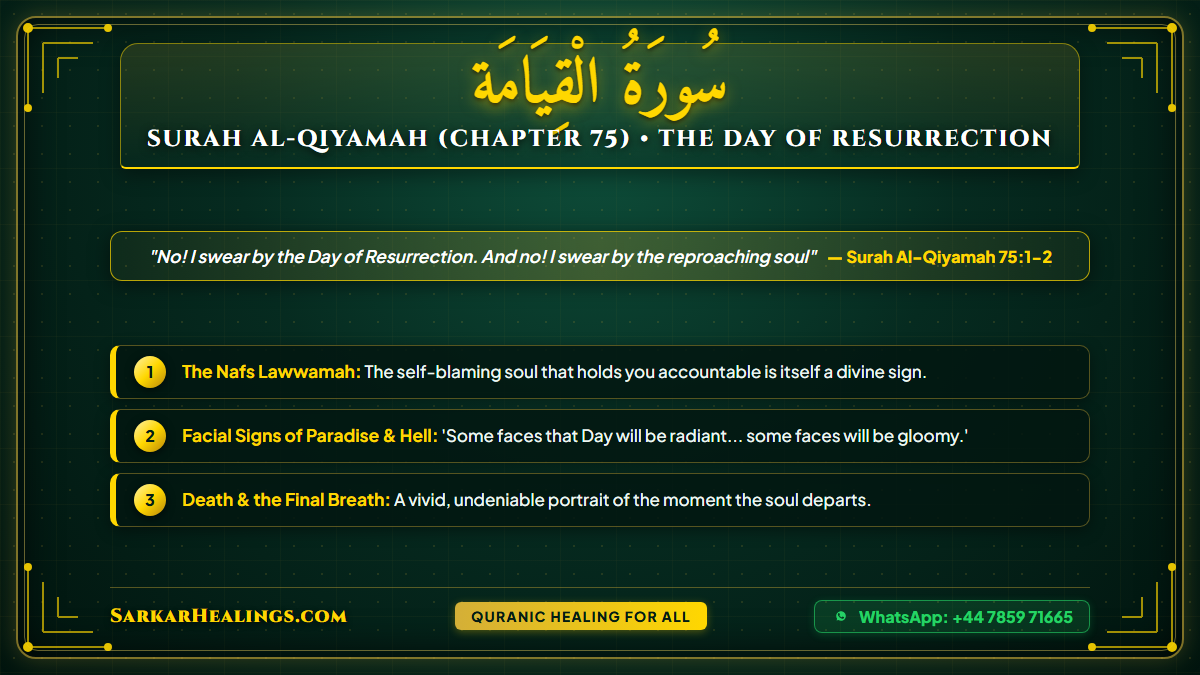
Al‑Qiyamah, “The Resurrection,” vividly describes the awe‑inspiring events of the Day when every soul will be raised, questioned, and recompensed. The surah opens with a solemn oath by the Day of Resurrection, underscoring its certainty.
It then turns to the self‑reproaching soul (an‑nafs al‑lawwāmah) that acknowledges its shortcomings, and affirms Allah’s power to recreate even the minutest particle. The climax paints the faces of the believers as radiant, gazing upon their Lord — a promise of honour and closeness for those who sincerely believe in the Day of Judgement.
The Benefits of Surah Al‑Qiyamah — Every Claim Sourced
🌿 Healing & Well‑Being
- The person who recites will be counted among those who believed in Judgement Day and his face will be shining when raised from his grave.
- Frequent reciters will be raised with handsome and attractive faces on Judgement Day.
- Recitation increases sustenance (rizq), protects life and possessions, makes one liked by people, chaste (ʿafīf), humble (mutawāḍiʿ) and sincere (mukhlis).
- Drinking water in which the surah is written keeps the heart safe from ailments.
The person who recites will be counted from among those who believed in Judgement Day and his face will be shining when raised from his grave.
🛡️ Protection & Victory
- Thursday morning recitation grants proximity to the Prophet (S) in Jannah, 100 houries, and 4,000 slaves.
- Recitation brings victory in war.
- China‑plate water infused with the surah strengthens body and mind while curing heart ailments.
- Regular recitation places the believer under divine protection; no man‑in‑authority would harm him.
🌟 Station & Meaning (Reward)
- Whoever recites Al‑Qiyamah regularly and acts upon it will rise from the grave fresh, smiling, looking good and join the company of the Holy Prophet.
- He will pass the Mizan (scale) and Sirat (bridge) with ease because the Holy Prophet and Jibrīl bear witness that he was an upright believer in the Day of Judgement.
- He will have more than enough means of livelihood and remain under divine protection.
- No person in authority will be able to harm him.
How and When to Use — Prescription
Before any use: seek refuge (isti’adhah), begin with Bismillah, recite with tarteel (measured pace), close with Ameen.
| When | How to Use | What It Does |
|---|---|---|
| Daily prayer (after Fajr or Maghrib) | Recite Surah Al‑Qiyamah once, slowly, with reflection. | Establishes a constant reminder of the Day of Resurrection and nurtures sincerity. |
| Thursday morning | Recite the surah after sunrise, preferably with ablution. | Draws proximity to the Prophet (S) in Jannah, grants spiritual rewards and protection. |
| Preparing drinking water | Write the surah on a clean plate, immerse in water, then drink. | Keeps the heart safe from ailments and strengthens bodily health. |
| Before a challenging endeavor (e.g., work, travel, or conflict) | Recite three times with firm intention. | Invokes divine assistance, increases sustenance, and safeguards life and possessions. |
| When feeling unsafe or oppressed | Recite continuously for a few minutes, visualising the radiant faces of the believers. | Provides inner calm, reinforces trust in Allah’s justice, and wards off harm from authorities. |
How to Get Maximum Benefit
- Intention (niyyah) – Recite solely for Allah’s pleasure, seeking the realities of the Hereafter.
- Consistency – Make it a regular part of your daily or weekly worship.
- Certainty (yaqeen) – Trust that the promises are true manifestations of Allah’s mercy.
- Pairing with good deeds – Couple recitation with acts of charity, honesty, and kindness.
Listen to Sheikh’s Recitation — Surah Al-Qiyamah
Recited by Sheikh Sayed — listen with khushu, read along, then recite yourself. For personal recitation guidance, message on WhatsApp.
Frequently Asked Questions
What is the main theme of Surah Al‑Qiyamah?
The surah centres on the Day of Resurrection: the certainty of rising, the self‑reproaching soul, Allah’s power to recreate, and the radiant faces of believers who look to their Lord.
How often should I recite Surah Al‑Qiyamah for benefit?
Reciting it at least once daily — preferably after Fajr or Maghrib — yields steady spiritual uplift; additional recitations on Thursday mornings are highlighted in the sources for extra reward.
Is the narration about the shining face authentic?
The narration appears in Fawaid‑e‑Quran by Sayyid Mustafa Musawi, attributed to the Holy Prophet (S). It is transmitted through a single chain in this source; therefore, while the wording is respected, its authenticity should be verified through broader hadith literature.
Can I use the water‑infusion method for health?
Yes. The sources state that drinking water in which Surah Al‑Qiyamah has been written keeps the heart safe from ailments and strengthens body and mind. Use clean water and a clean vessel, and always begin with Bismillah.
Where Al‑Qiyamah Fits in Your Journey
If you are seeking to strengthen your conviction in the Hereafter, to beautify your inner state, and to invite divine protection into your affairs, let Surah Al‑Qiyamah be a regular companion. Its vivid depiction of the Day of Judgement awakens the heart, while its promised rewards encourage sincere effort in both worship and character.
Cross-Links
- Death & Hereafter Hub
- Forgiveness & Repentance Hub
- Guidance & Istikhara Hub
- Continue with Surah Al-Muddaththir
- Continue with Surah Al-Insan
- All 114 Surahs
Get the Complete Quran Coded Dua Taweez
WhatsApp Sheikh Sayed — Personal Guidance