Surah As‑Sajdah (The Prostration) – Benefits, Virtues & Spiritual Practice
Surah As‑Sajdah (Qur’an 32) is a Makki chapter of 30 verses that calls the heart to prostration, reminds us of the certainty of resurrection, and praises those who leave their beds at night to worship. Its authentic virtues are tied to the Prophet’s nightly and Friday‑Fajr recitation, while many popular “numeric formulas” rest on weak narrations. Below you will find a graded evidence table, classical Sufi insights, practical guidance on when to recite, and links to related hubs.
What the Surah Is About
As‑Sajdah opens with the declaration that the Qur’an is a revelation from the Lord of the worlds (32:1‑2). It then describes the creation of the heavens and earth in six days, the fashioning of man from clay, and the breathing of the divine spirit into him (32:7‑9). The surah contrasts the fate of the disbelievers with the reward of the believers who “forsake their beds to call upon their Lord in fear and hope” (تَتَجَافَىٰ جُنُوبُهُمْ عَنِ الْمَضَاجِعِ يَدْعُونَ رَبَّهُمْ خَوْفًا وَطَمَعًا, 32:16). The final verses depict the Day of Judgement, the regret of the deniers, and the ultimate triumph of the truthful.
Authentic Virtues (Graded A)
- Nightly recitation before sleep. The Prophet ﷺ would not go to sleep until he had recited Surah As‑Sajdah and Surah Al‑Mulk. Grade A – reported by al‑Tirmidhī (Hadith 3404) [VERIFY].
- Friday Fajr recitation. The Prophet ﷺ used to recite Surah As‑Sajdah and Surah Al‑Insān in the Fajr prayer on Fridays. Grade A – reported by al‑Bukhārī (Hadith 891) and Muslim (Hadith 880) [VERIFY].
- Qur’anic praise of night worshippers. Verse 32:16 explicitly commends those who rise from their beds to pray. Grade B – direct Qur’anic text, universally agreed upon by scholars.
Graded Benefits Table
| Claim / Practice | Grade | Evidence & Notes |
|---|---|---|
| Reciting As‑Sajdah (with Al‑Mulk) before sleeping | A | Prophetic practice reported by al‑Tirmidhī 3404 [VERIFY]. The hadith is classified sahih by al‑Albānī. |
| Reciting As‑Sajdah (with Al‑Insān) in Friday Fajr | A | Reported in al‑Bukhārī 891 and Muslim 880 [VERIFY]. Both collections are sahih. |
| General reward for reciting any Qur’anic surah | B | Qur’an 35:29‑30; consensus of scholars that every letter recited earns ten rewards. |
| Verse 32:16 as a spiritual model for qiyām al‑layl | B | Direct Qur’anic description; cited by classical exegetes (e.g., al‑Ṭabarī, Ibn Kathīr) as encouragement for night prayer. |
| Reciting As‑Sajdah 70 times (or any fixed number) for cure, protection, or fulfilment of needs | C | Popular in some devotional booklets but the supporting narrations are weak (daʿīf) or fabricated; no sahih chain exists. |
| Reciting As‑Sajdah 41 times after Fajr for “opening of the heart” | C | Attributed to later Sufi manuals without authentic isnād; treat as a weak claim. |
| Making a habit of nightly recitation as a personal spiritual routine | D | Derived from the authentic hadith (Grade A) but the specific “routine” is a later devotional practice, not a prophetic prescription. |
Sufi / Classical Insights
- Al‑Qushayrī (d. 465/1072), Lataʾif al‑Ishārāt. He explains that the prostration (sajdah) mentioned in the surah’s opening verse symbolises the soul’s total submission. The night‑worshippers of 32:16 are described as “those whose hearts are illuminated by the light of the unseen,” and their rising from bed is an outward sign of an inward awakening.
- Ibn ʿAjība (d. 1224/1809), Al‑Baḥr al‑Madīd. In his tafsīr of 32:16 he writes that “forsaking the bed” is not merely physical; it is the abandonment of comfort for the sake of divine intimacy. He links the verse to the stations of mujāhada (spiritual struggle) and murāqaba (watchfulness).
- Al‑Ghazālī (d. 505/1111), Iḥyāʾ ʿUlūm al‑Dīn, Book of Qiyām al‑Layl. He cites the Prophet’s nightly recitation of As‑Sajdah and Al‑Mulk as a model for the believer who wishes to “seal the day with the Qur’an.” Al‑Ghazālī stresses that the benefit lies in the presence of heart (ḥuḍūr al‑qalb) during recitation, not in a mechanical count.
How & When to Recite
- Before sleep (nightly). Follow the Prophetic habit: after ʿIshāʾ, recite Surah As‑Sajdah followed by Surah Al‑Mulk. No fixed number of repetitions is required; one complete reading of each surah suffices.
- Friday Fajr. If you attend the congregational Fajr on Friday, recite As‑Sajdah and Al‑Insān in the first rakʿah (or both rakʿahs) as the Prophet ﷺ did.
- During Tahajjud / Qiyām al‑Layl. The surah’s themes of resurrection and night worship make it especially fitting for voluntary night prayer. Recite with reflection on verses 32:7‑9 (creation) and 32:16 (the believers’ vigil).
- As a contemplative reading. Sit quietly, read the Arabic (or a reliable translation) once, pause at each verse, and ask Allah for insight into the reality of the Hereafter.
Reminder: The spiritual benefit comes from sincerity (ikhlāṣ), presence of heart, and acting upon the guidance—not from a mechanical count.
Related Hubs
Frequently Asked Questions
Is there a specific number of times I must recite As‑Sajdah for healing?
No authentic narration prescribes a fixed count for healing. The “70‑times” or “41‑times” formulas are based on weak (daʿīf) reports (Grade C). The authentic practice is a single recitation before sleep or in Friday Fajr (Grade A). Seek medical treatment for any illness; recitation is a spiritual complement, not a substitute.
Can I recite As‑Sajdah for a deceased relative?
Reciting Qur’an and gifting the reward (iḥsān) to the dead is a well‑established scholarly opinion (Grade B). You may include As‑Sajdah in such a reading, but there is no special hadith singling it out for the deceased.
What is the reward for reciting As‑Sajdah on Friday?
<
Obtain the Spiritually Prepared Surah As
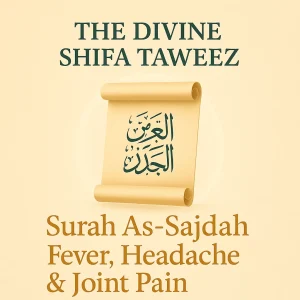
At Sarkar Healings we prepare this taweez and coded dua following the Qur’an and Sunnah described in this guide, with the correct intention and adab.
Or email: help@sarkarhealings.com
Coded Duas based on Surah As-Sajdah
This content and its associated Quranic recitations are offered strictly as a spiritual means (asbab) seeking Allah's guidance, protection, and barakah. Sarkar Healings does not guarantee magical outcomes or instant cures. Spiritual remedies are to be used alongside lawful personal effort and professional medical, legal, or financial advice.