Surah Hud Benefits: Authentic Virtues, Rewards &…
بِسْمِ اللَّهِ الرَّحْمَٰنِ الرَّحِيمِ
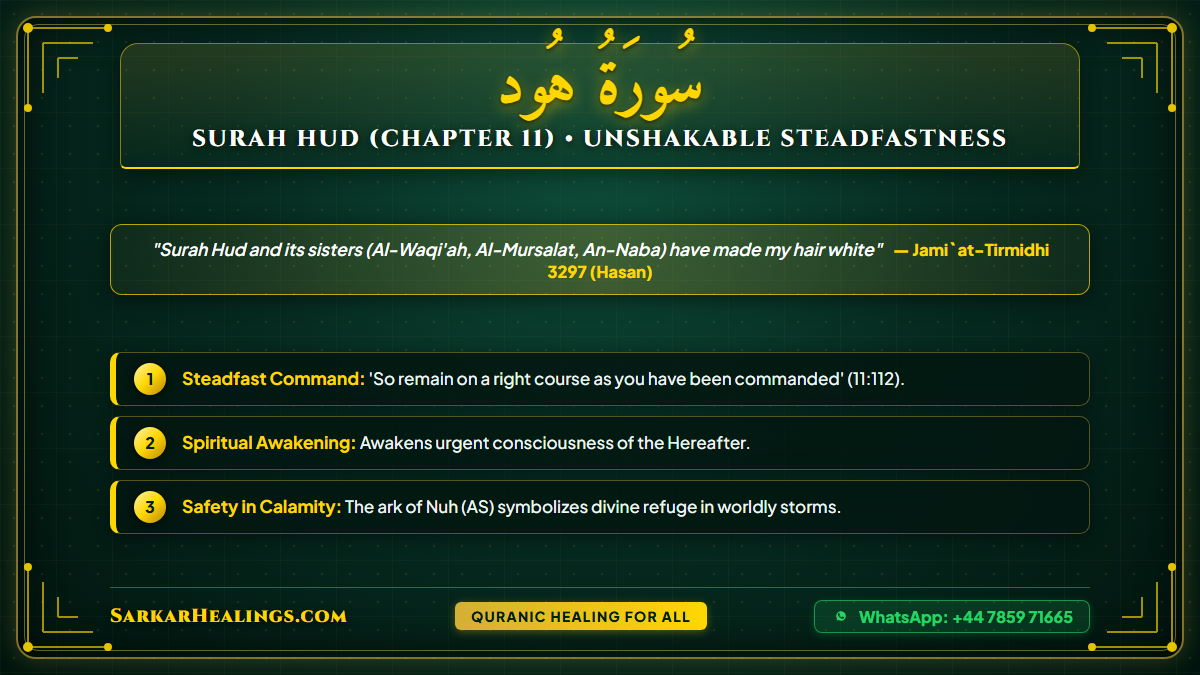
Surah Hud — The Steadfast
In brief: If you seek inner steadfastness amid trials, desire a reckoning that feels light, or wish to carry a tangible sign of courage, Surah Hud offers a Qur’anic anchor rooted in the stories of the prophets who stood firm against oppression.
In pain → Healing · Feeling unsafe → Protection · Want to understand it → Station & Meaning
What Surah Hud Is About
Surah Hud takes its name from the prophet Hud, whose narrative occupies a central portion of the chapter. Classical exegetes often refer to it as “Surah al‑Anbiyā’ al‑Mutaʿāqibah” (the Surah of the Successive Prophets) because it recounts the missions of Noah, Hud, Salih, Abraham, Lot, Shuʿayb and Moses, highlighting a recurring pattern: divine guidance, human arrogance, and inevitable consequence.
The recurring command “فَاسْتَقِمْ” (remain steadfast) threads through the surah, tying the prophetic stories to the believer’s personal struggle. Themes of divine accountability, the gravity of the Day of Reckoning, and the promise of ease for those who persist in truth give the chapter its distinctive spiritual tone.
The Benefits of Surah Hud — Every Claim Sourced
🌿 Healing — Forgiveness and Light Reckoning
- Reciting Surah Hud every Friday leads to the forgiveness of sins and the recording of one’s deeds alongside the Prophets.
- Such Friday recitation also eases the accounting on the Day of Judgement, making the reckoning smooth.
- Allah raises the reciter in the company of the prophets on the Day of Judgement, ensuring no sin is recorded in his register.
- The smooth reckoning brings inner peace, alleviating anxiety about future accountability.
Whoever recites every Friday, his accounts will be taken with that of the Prophets and all sins forgiven.
🛡️ Protection — Courage, Victory and Awe
- Writing Surah Hud on sheepskin and keeping it with you instills immense courage and boldness in the face of adversity.
- Such a talisman makes one unbeatable in combat; opponents are filled with fear upon seeing the bearer.
- Carrying the written surah grants victory in confrontations and inspires awe in onlookers.
- The psychological effect of bearing a divine text strengthens resolve, reducing susceptibility to intimidation.
Writing on sheepskin and keeping makes one courageous and bold, nobody can defeat in combat, whoever sees him will be filled with fear.
🏅 Station & Meaning — Rank, Recompense and Prophetic Company
- Reciting Surah Hud grants a reward equal to the number of people who testified or belied the prophets of Allah.
- The reciter attains a rank comparable to that of martyrs, earning their favour and blessings.
- Accounting is made easy; the reckoning becomes light and straightforward for the faithful reciter.
- Allah’s recompense includes the favours granted to martyrs, reinforcing the spiritual stature of the reciter.
🎁 Additional Reward — Divine Companionship and Ease
- Friday recitation of Surah Hud brings the believer into the company of the prophets on the Day of Judgement.
- The reciter experiences a smooth sailing during the final reckoning, free from entanglement.
- Allah’s mercy extends to erase sins, offering a clean slate for those who uphold the Friday practice.
- Such ease in accounting nurtures gratitude and contentment in daily life.
How and When to Use — Prescription
Before any use: seek refuge (isti’adhah), begin with Bismillah, recite with tarteel (measured pace), close with Ameen.
| When | How to Use | What It Does |
|---|---|---|
| Daily prayers (any time) | Recite Surah Hud after the obligatory salah, preferably in the first rak‘ah of Nawafil. | Keeps the heart anchored in steadfastness and reminds of prophetic perseverance. |
| Every Friday | Recite the entire surah once, preferably after Jumu‘ah prayer or during the early morning. | Forgives sins, aligns accounts with the Prophets, and eases the Day of Judgement reckoning. |
| Before a challenging encounter | Write Surah Hud on a piece of clean sheepskin (or parchment) and carry it in a pocket or wear as a talisman. | Instills courage, deters opponents, and brings awe to onlookers. |
| When seeking spiritual rank | Recite Surah Hud with the intention of attaining martyr‑like reward and prophetic companionship. | Earns reward equivalent to the number of people who affirmed or denied the prophets, and grants ease in accounting. |
| During moments of anxiety about accountability | Recite verses 110‑112 (the steadfastness passage) with reflection and dua. | Brings inner calm, reinforcing that Allah sees all deeds and will judge with mercy. |
How to Get Maximum Benefit
- Intention (niyyah) – Begin each recitation with a clear purpose: seeking forgiveness, courage, or closeness to the prophets.
- Consistency – Practice the Friday recitation regularly; the promised ease accumulates over time.
- Certainty (yaqeen) – Trust that Allah’s promises are true; doubt weakens the spiritual effect.
- Pairing – Combine recitation with charitable acts or dhikr after the surah to seal the blessings.
Listen to Sheikh’s Recitation — Surah Hud
Recited by Sheikh Sayed — listen with khushu, read along, then recite yourself. For personal recitation guidance, message on WhatsApp.
Frequently Asked Questions
What is the main theme of Surah Hud?
The main theme is steadfastness (istiqamah) in the face of opposition, illustrated through the stories of the prophets who remained firm despite rejection and tyranny.
How does Surah Hud help with fear or insecurity?
Writing the surah on sheepskin and carrying it is narrated to instill courage and boldness, making the bearer fearless in combat and inspiring awe in observers.
Is the narration about Friday recitation authentic?
The narration appears in Fawaid-e-Quran, attributed to Imam Muhammad Baqir (a), and is echoed in the authenticated traditions and Benefits of All 114 Surahs collections. While multiple sources repeat the promise, the chain of transmission is not found in the major hadith compilations; therefore the narration should be treated as a well‑known spiritual tradition rather than a rigorously authenticated hadith. Seekers may still benefit from the practice as a means of drawing nearer to Allah, keeping in mind that ultimate outcomes lie with His mercy.
Can Surah Hud replace medical or psychological treatment?
No. Surah Hud is a spiritual aid that comforts the heart and strengthens resolve, but it does not substitute for professional medical, psychological, or psychiatric care. Always consult qualified health‑service providers for physical or mental health concerns.
Where Surah Hud Fits in Your Journey
If you are walking a path that tests your resolve—whether confronting personal doubts, facing external opposition, or preparing for the ultimate accountability—Surah Hud offers a Qur’anic compass. Its stories remind you that every prophet endured hardship yet remained firm; its verses promise that Allah sees your effort and will ease your reckoning. Let the surah be a companion during Friday reflections, a talisman before moments of trial, and a source of hope when you seek the company of the righteous on the Day of Judgement.
Cross-Links
- Anxiety & Distress Hub
- Guidance & Istikhara Hub
- Forgiveness & Repentance Hub
- Continue with Surah Yunus
- Continue with Surah Yusuf
- All 114 Surahs
Get the Complete Quran Coded Dua Taweez
WhatsApp Sheikh Sayed — Personal Guidance