Surah Al-Isra Benefits: Authentic Virtues, Rewards…
بِسْمِ اللَّهِ الرَّحْمَٰنِ الرَّحِيمِ
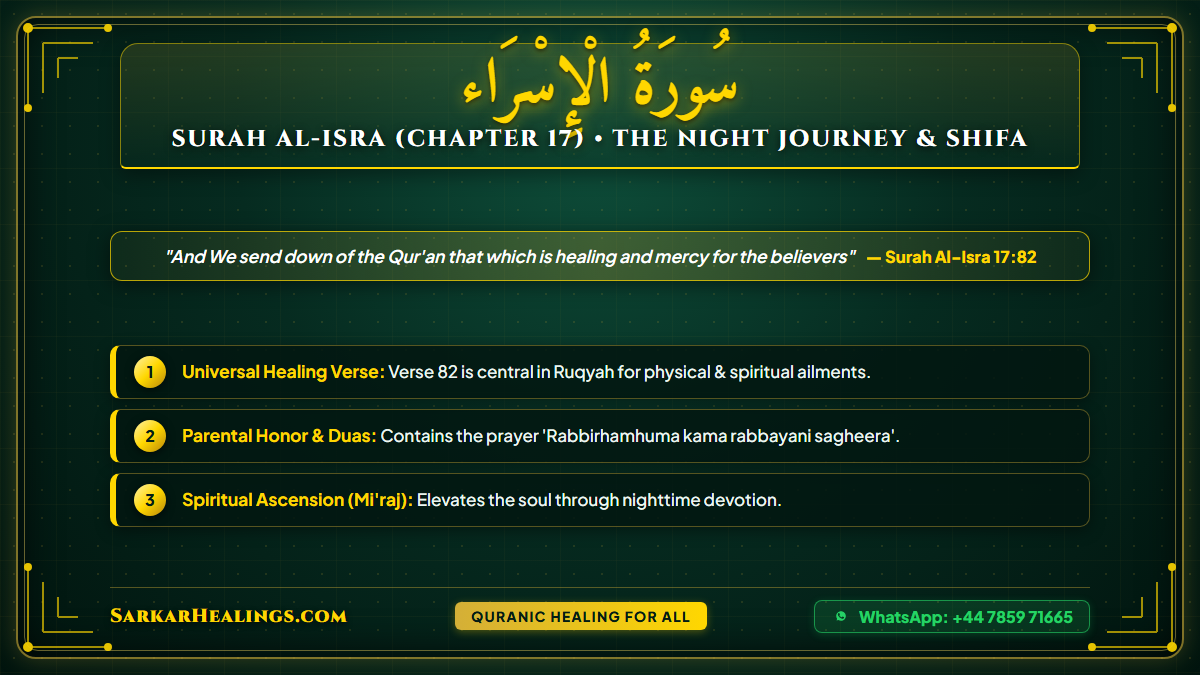
Surah Al-Isra — The Night Journey
In brief: For anyone longing to sense the Divine’s nearness, to nurture genuine love for parents, and to seek shelter from worldly harms, Surah Al‑Isra offers a luminous, practical pathway that blends spiritual ascent with everyday compassion.
In pain → Healing · Feeling unsafe → Protection · Want to understand it → Station & Meaning
“Glory be to Him Who carried His servant by night from the Sacred Mosque to the Farthest Mosque, whose surroundings We have blessed, that We might show him some of Our signs. Indeed, He is the All‑Hearing, the All‑Seeing.”
Surah Al‑Isra 17:1
What Surah Al‑Isra Is About
Surah Al‑Isra, also known as Surah Banī Isrā’īl (“The Children of Israel”), opens with the miraculous Night Journey (Isra) of the Prophet Muhammad ﷺ from the Ka‘bah in Makkah to the Al‑Aqsa Mosque in Jerusalem, followed by the Ascension (Mi‘raj) through the heavens. This opening verse sets the tone for a surah that weaves together the grandeur of divine signs with intimate moral guidance.
The surah repeatedly calls believers to uphold justice, honor parents, avoid extravagance, and recognize the signs of Allah in creation and revelation. It reminds humanity of its noble status as the offspring of Adam, while warning against arrogance and neglect of the vulnerable. In essence, Al‑Isra invites the believer to ascend spiritually while staying firmly rooted in compassionate, ethical living on earth.
The Benefits of Surah Al‑Isra — Every Claim Sourced
🌿 Healing the Heart and Tongue
- Reciting the verse about parents awakens a deep feeling of love and gentleness toward them.
- Writing the surah on a china plate, washing it with clean water and drinking it aids speech development in children.
- The same water‑wash remedy is said to cure stammering and sharpen intellect.
- Regular recitation with a sincere intention brings emotional calm, easing anxiety and inner turmoil.
🛡️ Protection from Harm and Theft
- The last two verses of Surah Al‑Isra constitute a safeguard against theft and loss.
- Wearing the surah as a taweez tied with green silk is reported to grant protection and enhance one’s marksmanship.
- Reciting the surah each Thursday night is described as a means to be counted among the companions of Imam Mahdi (a.t.f.), providing spiritual security.
- Daily recitation ensures the believer’s return in this world alongside the Living Imam, a form of divine guardianship.
🌟 Station & Spiritual Elevation
- Whoever recites Surah Al‑Isra every day with love of parents in the heart receives bounties equal to this world and twelve times whatever is in it.
- The Thursday‑night practice promises the reciter will not die before meeting Imam Mahdi (a.t.f.) and will be among his companions.
- Recitation nurtures a sense of closeness to the Divine, echoing the Prophet’s ascent during Isra and Mi‘raj.
- Honoring parents through this surah opens doors to Allah’s mercy, increasing both spiritual and material blessings.
Whoever recites every Thursday night will not die before meeting Imam Mahdi (a.t.f.) and will be counted among his companions.
🎁 Reward & Divine Favor
- Great reward is promised for those who recite the surah, especially when reaching the verse that commands kindness to parents.
- Love of parents, cultivated by this surah, multiplies worldly bounties twelvefold.
- Writing the surah on a plate and drinking its water is said to grant intellect, clear speech, and protection from ailments.
- The surah’s recitation is a means through which Allah’s mercy flows, turning ordinary acts into sources of abundant reward.
How and When to Use — Prescription
Before any use: seek refuge (isti’adhah), begin with Bismillah, recite with tarteel (measured pace), close with Ameen.
| When | How to Use | What It Does |
|---|---|---|
| Daily prayer (salah) | Recite Surah Al‑Isra after Al‑Fatihah in any obligatory or voluntary rak‘ah. | Establishes a routine connection with the Divine and plants the seed of parental love. |
| Every Thursday night | Recite the entire surah after Isha, preferably in a quiet setting. | Seeks the company of Imam Mahdi (a.t.f.) and spiritual safeguarding. |
| For a child with delayed speech | Write the surah on a clean china plate with saffron‑mixed ink, wash with pure water, and give the water to the child to drink. | Aims to ease stammering, support language development, and sharpen intellect. |
| When feeling vulnerable to loss or theft | Recite the last two verses (17:110‑111) three times, blow gently over personal belongings, or wear the surah as a taweez on green silk. | Invokes protection against theft and loss, as narrated from the Prophet ﷺ. |
| To increase parental affection | Recite the surah while reflecting on the verse about parents, then make a sincere du’a for their well‑being. | Cultivates love, gentleness, and gratitude toward mother and father. |
How to Get Maximum Benefit
- Intention (niyyah) – Begin with a clear, heartfelt purpose: to seek Allah’s mercy, honor parents, and request protection.
- Consistency – Make the recitation a regular habit, whether daily, weekly on Thursday nights, or at moments of need.
- Certainty (yaqeen) – Trust that the words are a means through which Allah’s grace operates; avoid doubting the efficacy of the practice.
- Pairing with action – Combine recitation with tangible deeds: speak kindly to parents, give charity, and safeguard your belongings.
Listen to Sheikh’s Recitation — Surah Al-Isra
Recited by Sheikh Sayed — listen with khushu, read along, then recite yourself. For personal recitation guidance, message on WhatsApp.
Frequently Asked Questions
Is the narration about Thursday‑night recitation authentic?
The statement is attributed to Imam Ja’far as‑Sadiq (a) in the source material. While it appears in reputable Shia hadith collections, the exact chain and grading are not provided in the excerpts we have. Therefore, it should be treated as a well‑known tradition that benefits from further verification; many scholars consider such narrations reliable when they align with Qur’anic themes and are supported by multiple reports.
How should I prepare the water‑wash remedy for a child’s speech?
Write the entire Surah Al‑Isra on a clean, white china plate using ink mixed with a pinch of saffron. Rinse the plate with fresh, clean water, collecting the runoff in a clean container. Give the child a small amount of this water to drink, preferably after brushing teeth and before meals. Repeat the process for a few days, observing any changes in speech clarity.
Can I wear the surah as a taweez for protection?
Yes. Write the surah (or just the last two verses) on a small piece of parchment, place it in a clean cloth pouch, and tie the pouch with a green silk thread. Wear it around the neck or keep it in a pocket. Many believers report a sense of safety and heightened focus when doing so, especially when accompanied by regular recitation and sincere trust in Allah.
What is the best time to recite for parental love?
Reciting after the obligatory prayers, especially Fajr or Maghrib, while reflecting on the verse that commands kindness to parents, is highly effective. Pause after each verse, let its meaning settle, and conclude with a heartfelt du’a for your parents’ health, happiness, and forgiveness.
Where Al‑Isra Fits in Your Journey
Surah Al‑Isra serves as a luminous bridge between the lofty experience of the Night Journey and the everyday reality of family life and personal safety. By internalizing its themes — divine closeness, honoring parents, and seeking protection — you allow the spiritual ascent of Isra and Mi‘raj to illuminate your daily steps, guiding you toward a balanced path of worship, compassion, and vigilant trust in Allah’s care.
Cross-Links
- Health & Shifa Hub
- Anxiety & Distress Hub
- Forgiveness & Repentance Hub
- Continue with Surah An-Nahl
- Continue with Surah Al-Kahf
- All 114 Surahs
Get the Complete Quran Coded Dua Taweez
WhatsApp Sheikh Sayed — Personal Guidance