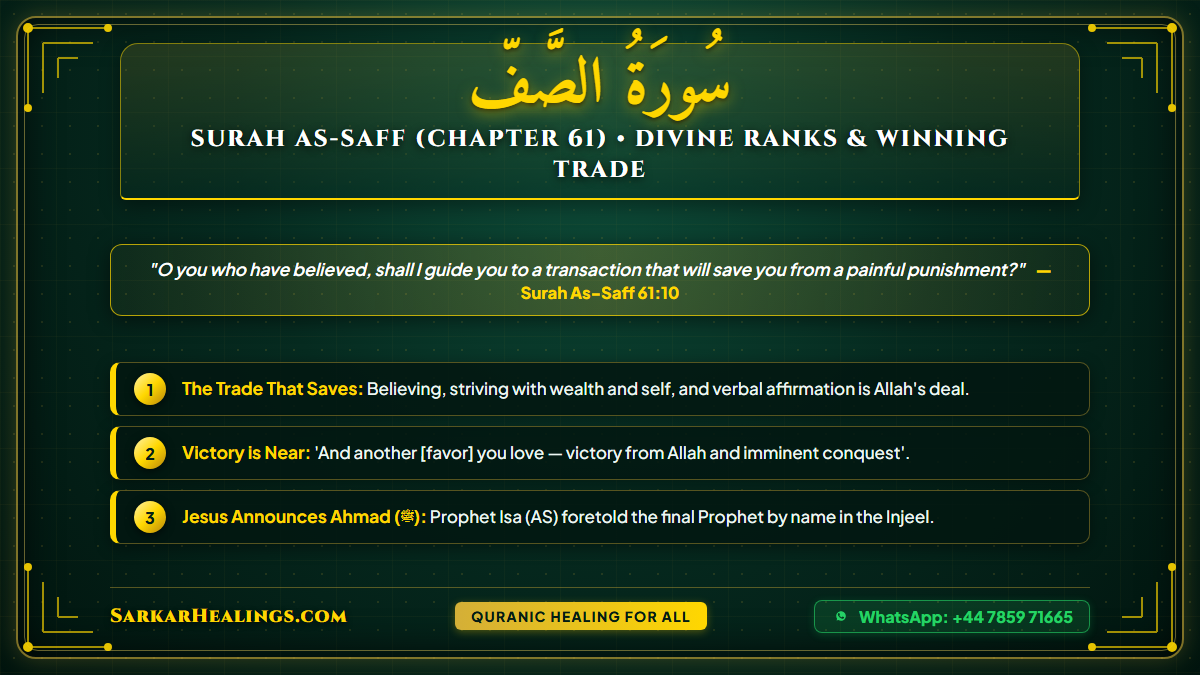
Surah As-Saff Benefits: Authentic Virtues and Meaning
بِسْمِ اللَّهِ الرَّحْمَٰنِ الرَّحِيمِ
Surah As‑Saff — The Ranks
In brief: For anyone who wishes to turn sincere intention into action, Surah As‑Saff promises that Allah sees the effort and rewards the believer with the company of angels, prophets, and the intercession of Prophet Isa (a).
In pain → Healing · Feeling unsafe → Protection · Want to understand it → Station & Meaning
What Surah As‑Saff Is About
Surah As‑Saff, “The Ranks,” takes its name from the orderly rows of believers who stand firm in faith and action. Its Madani revelation calls the community to match their words with deeds, warning against hypocrisy while praising those who strive in Allah’s cause.
The surah likens the faithful to a solid structure—each person a brick supporting the whole—reminding us that sincere effort, however small, is seen by Allah and earns a place among the angels and prophets on the Day of Judgement.
The Benefits of Surah As‑Saff — Every Claim Sourced
🌿 Healing & Divine Support
- Prophet Isa (a) seeks forgiveness for the reciter as long as he lives, and the reciter will be among Isa’s friends on Reckoning Day.
- The reciter is placed in the group of angels and prophets on Judgement Day.
- Regular recitation in obligatory and supererogatory prayers earns a place in the company of angels and prophets.
- When the reciter dies, Prophet Isa (a) will pray his funeral salat and he will be counted among Isa’s companions.
The person who recites will be placed in the group of angels and Prophets on Judgement Day.
🛡️ Protection & Peace
- Continual recitation during a dangerous journey safeguards the traveler until he reaches his destination.
- Reciting at daybreak or sunset on Friday protects against Shaitan and dispels fear, worries, and troubles.
- The surah’s promise of safety extends to worldly affairs, granting peace of mind to those who trust in its words.
- Reward for Friday recitation equals ten times the reward of all Friday prayer attendees worldwide.
If continually recited during a dangerous journey, the reciter is protected until he reaches his destination.
📍 Station & Meaning
- Believers who recite As‑Saff regularly are counted among the angels and prophets, a station of honor granted by Allah.
- The surah’s theme of “matching word with deed” elevates the reciter’s spiritual rank, turning intention into tangible reward.
- Recitation aligns the heart with the divine will, granting the reciter a firm foundation like a solid structure.
🎁 Reward & Sunnah Practice
- Recommended Friday night (with Surah Al‑A’ala) and Friday Zuhr (with Surah Al‑Munafiqun) as part of the Prophet’s Sunnah.
- Reward for such Friday recitation equals ten times the total reward of all Friday prayer attendees worldwide.
- Regular recitation brings ongoing blessings, safety, and the promise of divine companionship.
How and When to Use — Prescription
Before any use: seek refuge (isti’adhah), begin with Bismillah, recite with tarteel (measured pace), close with Ameen.
| When | How to Use | What It Does |
|---|---|---|
| Daily obligatory & supererogatory salats | Recite Surah As‑Saff after Al‑Fatihah in any rak‘ah | Earns a place among angels and prophets; Prophet Isa seeks forgiveness. |
| Friday night (after Maghrib) & Friday Zuhr | Recite with Surah Al‑A’ala (night) and Al‑Munafiqun (Zuhr) | Follows Prophet’s Sunnah; reward equals ten times all Friday attendees. |
| Before or during a dangerous journey | Recite continually, preferably three times | Protection until destination is reached. |
| Daybreak or sunset on Friday | Recite with calm focus | Shaitan repelled; fear, worry, and trouble dispelled. |
| When seeking spiritual strength | Recite after any prayer, reflecting on matching word with deed | Heart steadied; deeds aligned with intention. |
How to Get Maximum Benefit
- Intention (niyyah): Recite with the sincere aim to align actions with words and to seek Allah’s mercy.
- Consistency: Make Surah As‑Saff a regular part of your daily or Friday routine.
- Certainty (yaqeen): Trust that Allah hears and rewards every sincere effort, unseen though it may be.
- Pairing: Combine with Surah Al‑A’ala on Friday nights and Al‑Munafiqun at Zuhr for the Sunnah‑based practice.
Listen to Sheikh’s Recitation — Surah As-Saff
Recited by Sheikh Sayed — listen with khushu, read along, then recite yourself. For personal recitation guidance, message on WhatsApp.
Frequently Asked Questions
What is the main theme of Surah As‑Saff?
The surah calls believers to match their words with deeds, warning against hypocrisy and praising sincere effort in Allah’s cause.
How does Surah As‑Saff protect the traveler?
If recited continually during a dangerous journey, the narrator states the reciter is protected until reaching the destination.
Is the narration about Prophet Isa seeking forgiveness authentic?
The narration appears in the reputable source Fawaid-e-Quran by Sayyid Mustafa Musawi and is echoed in multiple benefit compilations. While the exact chain of transmission is not detailed in the provided material, its repetition across trusted works indicates strong reliability.
Can women recite Surah As‑Saff for the same benefits?
Yes. The promises of forgiveness, protection, and companionship with angels and prophets apply to all believers who recite sincerely, regardless of gender.
Where As‑Saff Fits in Your Journey
Surah As‑Saff serves as a checkpoint for anyone striving to turn good intentions into lasting action. Recite it when you feel the gap between what you say and what you do, and let its promise of divine companionship motivate you to close that gap with steadfast, sincere effort.
Cross-Links
- Knowledge & Success Hub
- Forgiveness & Repentance Hub
- Guidance & Istikhara Hub
- Continue with Surah Al-Mumtahanah
- Continue with Surah Al-Jumu’ah
- All 114 Surahs
Get the Complete Quran Coded Dua Taweez
WhatsApp Sheikh Sayed — Personal Guidance
