Surah Fatir Benefits: Authentic Virtues, Rewards &…
بِسْمِ ٱللَّٰهِ ٱلرَّحْمَٰنِ ٱلرَّحِيمِ
Surah Fatir – The Originator
In brief: A Makki surah that reminds us Allah alone creates and sustains; its recitation brings divine mercy, protection from harm, and a promise of eased entry into Paradise.
In pain → Healing · Feeling unsafe → Protection · Want to understand it → Station & Meaning
If Allah touches you with hardship, none can remove it but Him; and if He intends good for you, none can repel His bounty. He is over all things competent.
Quran 35:42
What Surah Fatir Is About
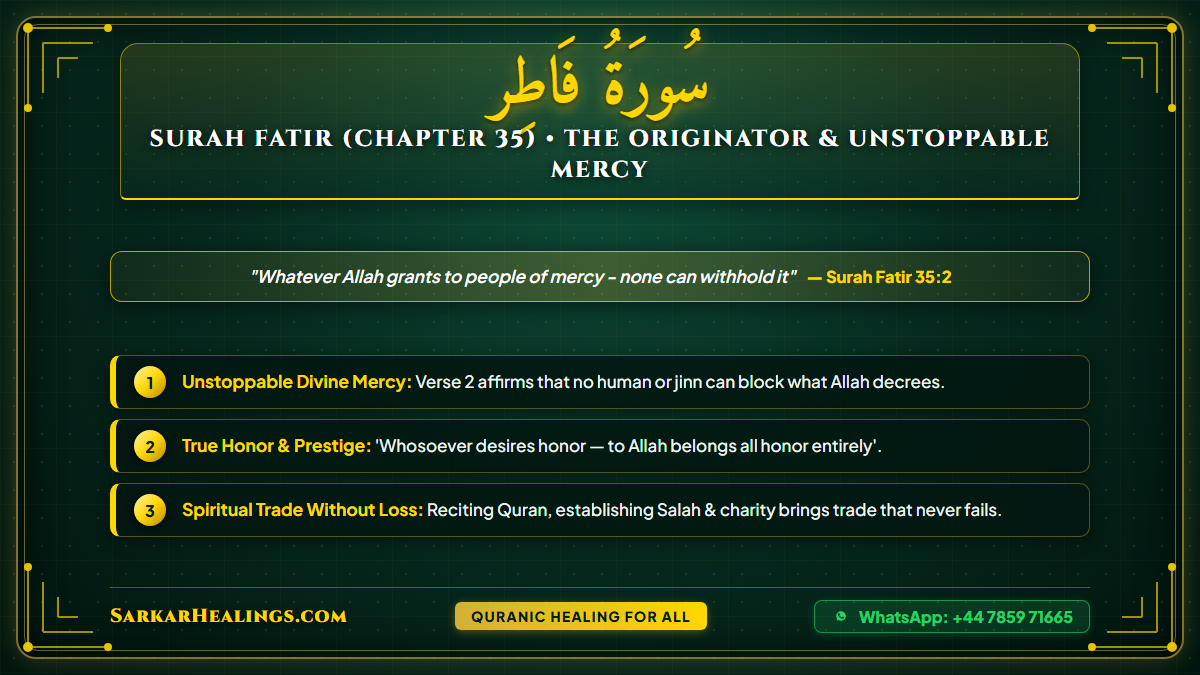
Surah Fatir, “The Originator,” opens with praise to Allah as the Creator of the heavens and the earth, the One who fashions angels with wings in pairs, threes, and fours. It stresses that all power and ability belong to Him alone, and that no soul bears the burden of another.
The surah repeatedly calls humanity to gratitude for countless favours, warns against associating partners with Allah, and affirms that the mercy He opens for His servants cannot be withheld by any force.
The Benefits of Surah Fatir – Every Claim Sourced
🌿 Healing
- Reciting verse 42 while placing a hand on the forehead eases severe migraines.
A person complained to Imam Ja’far as-Sadiq (a) about his daughter’s severe migraines; the Imam placed his hand on her head and recited verse 42 and she was cured.
🛡️ Protection
- Reciting Surah Fatir after sunset invites 1 000 angels to guard the reciter from the mischief of Shaytan and his agents throughout the night.
- Regular recitation creates a spiritual shield against sudden calamities and unseen harms.
🕌 Station & Meaning
- Understanding Fatir deepens tawhid: recognizing Allah as the sole Originator cultivates humility and reliance.
- Reflecting on its verses nurtures gratitude for the innumerable blessings that surround us daily.
🎁 Reward
- Reciting Surah Fatir opens three doors of Jannah for the reciter; another narration mentions eight doors, allowing entry through whichever door one prefers.
Three doors of Jannah will be opened for the person who recites; he will be able to enter through whichever door he pleases. Another narration says eight doors.
How and When to Use – Prescription
Before any use: seek refuge (isti’adhah), begin with Bismillah, recite with tarteel (measured pace), close with Ameen.
| When | How to Use | What It Does |
|---|---|---|
| Daily prayer (after Fajr or Maghrib) | Recite Surah Fatir once, slowly, with reflection. | Invokes Allah’s creative mercy and sets a tone of gratitude for the day. |
| Experiencing a migraine or severe headache | Recite verse 42 (35:42) three times while gently placing the right hand on the forehead. | Eases pain through the prophetic cure reported from Imam Ja’far as-Sadiq (a). |
| Before sleep, seeking night‑time protection | Recite the entire surah once, then utter Ayat al‑Kursi if desired. | Calls upon 1 000 angels to guard against Shaytan’s whispers and nocturnal harms. |
| When feeling spiritually distant or ungrateful | Recite Surah Fatir with contemplation of its opening verses. | Renews awareness of Allah as the Originator and rekindles thankfulness for His countless favours. |
| Seeking ease in entering Paradise | Recite Surah Fatir regularly, hoping for the opening of the Jannah doors. | Aligns the heart with the promise of three (or eight) doors of Paradise opened for the reciter. |
How to Get Maximum Benefit
- Intention (niyyah) – Recite solely for Allah’s pleasure, not for show.
- Consistency – Make it a daily habit, even if only a few verses.
- Certainty (yaqeen) – Trust that Allah’s mercy responds to sincere recitation.
- Pairing – Combine with dhikr (e.g., SubhanAllah, Alhamdulillah) and dua for specific needs.
Listen to Sheikh’s Recitation — Surah Fatir
Recited by Sheikh Sayed — listen with khushu, read along, then recite yourself. For personal recitation guidance, message on WhatsApp.
Frequently Asked Questions
What is the main theme of Surah Fatir?
The surah emphasizes Allah as the sole Originator of creation, calls for gratitude, warns against shirk, and affirms that His mercy cannot be blocked.
How does verse 42 help with migraines?
According to a report from Imam Ja’far as-Sadiq (a), placing a hand on the head and reciting verse 42 cured a severe migraine, indicating a spiritual remedy for pain.
What protection does Surah Fatir offer at night?
Scholarly sources mention that reciting the surah after sunset invites 1 000 angels to shield the reciter from Shaytan’s mischief and nocturnal calamities.
Is the narration about the migraine cure authentic?
The migraine cure is reported in Fawaid-e-Quran with a single chain from Imam Ja’far as-Sadiq (a). While the source is respected in Shia literature, it lacks multiple independent chains, so its authenticity rests on that one source; believers may still find spiritual benefit in the practice.
Where Fatir Fits in Your Journey
If you are working to deepen your awareness of Allah’s creative power and to cultivate a heart full of gratitude, Surah Fatir serves as a luminous companion—its verses remind you that every breath, every blessing, and every moment of relief originates from the One who alone creates and sustains.
Cross-Links
- Wealth & Rizq Hub
- Forgiveness & Repentance Hub
- Guidance & Istikhara Hub
- Continue with Surah Saba
- Continue with Surah Yaseen
- All 114 Surahs
Get the Complete Quran Coded Dua Taweez
WhatsApp Sheikh Sayed – Personal Guidance