Surah Al-Ghashiyah Benefits: Authentic Virtues and Meaning
بِسْمِ اللَّهِ الرَّحْمَٰنِ الرَّحِيمِ
الْغَاشِيَةُ
Surah Al-Ghashiyah — The Overwhelming
In brief: Reciting Surah Al‑Ghashiyah brings Allah’s mercy, eases the accounting of deeds, safeguards from Hell‑fire, soothes a crying child, relieves bodily pain, protects food, and invites the companionship of Imam Husayn (a) in Paradise.
In pain → Healing · Feeling unsafe → Protection · Want to understand it → Station & Meaning
الْغَاشِيَةُ
The Overwhelming (Event).
Quran 88:1
What Surah Al-Ghashiyah Is About
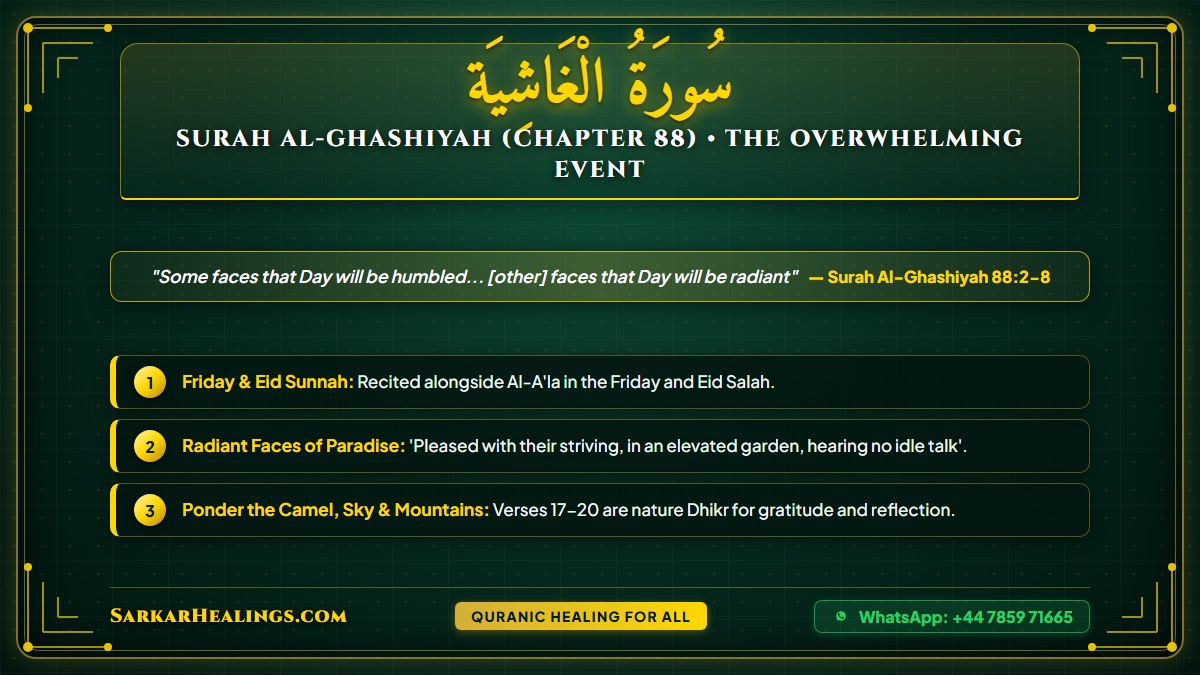
Surah Al‑Ghashiyah, “The Overwhelming,” paints the vivid scene of the Day when reality overwhelms every soul. It contrasts the faces of those in bliss with those in toil, urging reflection on the signs of creation and the inevitable return to Allah.
The chapter’s nickname derives from its opening verse, which describes the overwhelming event that will engulf all creation—a reminder of Allah’s ultimate authority and the certainty of accountability.
The Benefits of Surah Al-Ghashiyah — Every Claim Sourced
🌿 Healing & Comfort
- Reciting over a paining body part removes the pain.
- Reciting over food items eliminates any harmful effects.
- Reciting near a baby stops fright and crying.
Reciting near a baby removes fright and stops crying.
- Reciting for molar‑tooth or dental pain brings relief.
🛡️ Protection & Safety
- Regular recitation in obligatory and supererogatory prayers shields one from the fire of Hell.
- Provides 24‑hour protection when recited with intention.
- Wearing the surah as a back tawiz before intimacy guards the household and blesses with virtuous offspring.
- Reciting for a screaming child (human or animal) ends the habit and brings an ordinary life.
🌟 Station & Reward
- The reciter will not face difficulty in accounting of deeds on Judgement Day; Allah shows mercy and saves him from Jahannam.
- Recitation in prayers earns Allah’s mercy in this world and the hereafter, and grants a smooth sailing through life.
- Reciting secures the companionship of Imam Husayn (a) in Jannah.
- Forgives sins ten times the number of reciters and grants light on the Day of Qiyamah.
How and When to Use — Prescription
Before any use: seek refuge (isti’adhah), begin with Bismillah, recite with tarteel (measured pace), close with Ameen.
| When | How to Use | What It Does |
|---|---|---|
| Daily prayer (obligatory & supererogatory) | Recite Surah Al‑Ghashiyah after Al‑Fatihah in any rak‘ah. | Receives Allah’s mercy, protection from Hell‑fire, smooth sailing in life. |
| Near a crying baby | Recite the surah softly close to the child. | Removes fright and stops crying. |
| On a paining body part | Place hand on the area and recite the surah. | Pain goes away. |
| Before eating | Recite over the food, then consume. | Removes harmful effects, keeps safe from any harm in the food. |
| Before intimacy | Write the surah on a piece of cloth and wear it as a back tawiz. | Blesses with virtuous offspring and safeguards the household. |
How to Get Maximum Benefit
- Intention (niyyah) – Recite solely for Allah’s pleasure and the specific need.
- Consistency – Make it a regular part of your dhikr or prayer routine.
- Certainty (yaqeen) – Trust that Allah’s mercy accompanies the recitation.
- Pairing – Combine with charitable acts or sending blessings on the Prophet (s) and his family for amplified effect.
Listen to Sheikh’s Recitation — Surah Al-Ghashiyah
Recited by Sheikh Sayed — listen with khushu, read along, then recite yourself. For personal recitation guidance, message on WhatsApp.
Frequently Asked Questions
What is the main theme of Surah Al‑Ghashiyah?
It describes the overwhelming Day of Judgement, contrasting the faces of bliss and toil, and invites reflection on creation and the return to Allah.
Can I recite Surah Al‑Ghashiyah for protection during travel?
Yes. Reciting it with the intention of seeking Allah’s safeguard provides spiritual protection; pair it with the prescribed travel dua for best results.
Is the narration about stopping a baby’s cry authentic?
The narration appears in Fawaid‑e‑Quran by Sayyid Mustafa Musawi. It is reported as a single narration without a detailed chain of transmitters in the source. While the work is respected for its compilations, the narration’s authenticity rests on the reliability of that specific source; many scholars treat such reports as beneficial practices rather than established hadith.
How many times should I recite it for pain relief?
There is no fixed number; recite it with focus and tarteel until you feel relief, while also seeking appropriate medical care.
Where Al‑Ghashiyah Fits in Your Journey
Let Surah Al‑Ghashiyah be your companion when you seek relief from physical discomfort, emotional distress, or spiritual unease. Its verses remind you that every overwhelming moment is met by Allah’s encompassing mercy, guiding you back to peace and purpose.
Cross-Links
- Death & Hereafter Hub
- Guidance & Istikhara Hub
- Forgiveness & Repentance Hub
- Continue with Surah Al-A’la
- Continue with Surah Al-Fajr
- All 114 Surahs
Get the Complete Quran Coded Dua Taweez
WhatsApp Sheikh Sayed — Personal Guidance