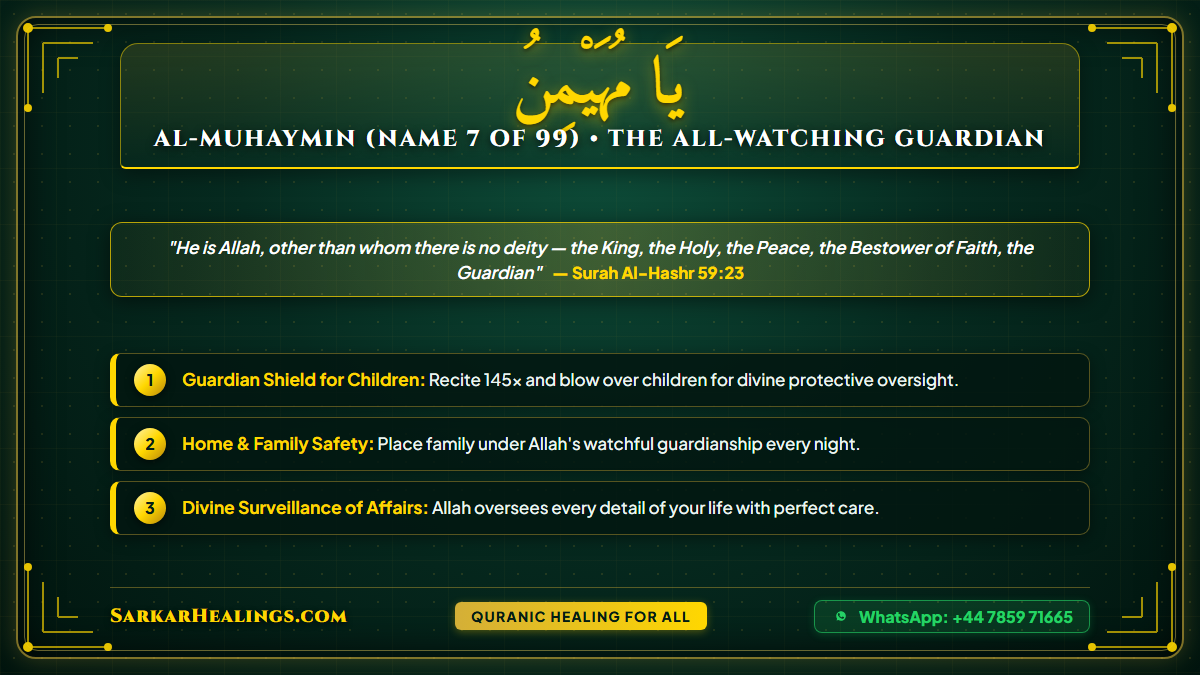
Al-Muhaymin Meaning & Ya Muhaymin Benefits (Name 7 of 99)
Sarkar Healings · 99 Names of Allah · Name 7 of 99
الْمُهَيْمِن
Al-Muhaymin — The Guardian, The Overseer
Al-Muhaymin Meaning & Ya Muhaymin Benefits
The Guardian, The Overseer — Ya Muhaymin
Al-Muhaymin (The Guardian, The Overseer) is the 7th of the 99 Names. From root ه-ي-م-ن (to watch over, protect, oversee), it appears once as a Divine Name in Qur’an 59:23. The Name signifies Allah’s complete witnessing and guardianship over all creation, deeds, and hearts. Invoked for divine protection, safety in travel, oversight of affairs, and inwardly to cultivate awareness of Allah’s ever-present gaze.
Key Facts at a Glance
| Name in Arabic | الْمُهَيْمِن |
|---|---|
| Transliteration | Al-Muhaymin (invoked as Ya Muhaymin) |
| English Meaning | The Guardian, The Overseer |
| Position | 7th of the 99 Names (Asma-ul-Husna) |
| Arabic Root | ه-ي-م-ن |
| Quran Occurrences | The Name Al-Muhaymin (المهيمن) appears once verbatim as a Divine Name in the Qur’an, in Surah al-Hashr 59:23. The active participle muhayminan (مهيمنا) from the same root occurs in 5:48 describing the Qur’an as a guardian over previous scriptures. |
| Invoked For | divine protection, safety in travel, oversight of affairs, guardianship of heart, awareness of Allah's witness |
| Related Names | Al-Hafiz · Al-Mu'min · Al-Qayyum |
Meaning & the Arabic Root
The root ه-ي-م-ن (h-y-m-n) conveys the sense of watching over, guarding, overseeing, and being a trustworthy guardian. The form muhaymin is an intensive active participle (fa’yīl pattern), denoting One who continuously and comprehensively oversees.
As a Divine Name, Al-Muhaymin affirms that Allah ﷻ is the Supreme Overseer who witnesses every deed, intention, and hidden thought of all creation. He is the Guardian whose authority encompasses the heavens and the earth, and nothing escapes His knowledge or control.
Distinction from related Names: Al-Ḥafīẓ (The Preserver) emphasises preservation from loss or harm; Al-Mu’min (The Granter of Security) emphasises the bestowal of safety and faith; Al-Muhaymin uniquely combines the active, authoritative oversight that traditional meanss that preservation and security. It is the Name of the One who not only protects but also governs the very order of protection.
Al-Muhaymin in the Quran
Quran
The Name Al-Muhaymin (المهيمن) appears once verbatim as a Divine Name in the Qur’an, in Surah al-Hashr 59:23. The active participle muhayminan (مهيمنا) from the same root occurs in 5:48 describing the Qur’an as a guardian over previous scriptures.
Surah al-Hashr 59:23
Huwa Allāhu alladhī lā ilāha illā Huwa al-Maliku al-Quddūsu as-Salāmu al-Mu'minu al-Muhayminu al-'Azīzu al-Jabbāru al-Mutakabbiru. Subḥāna Allāhi 'ammā yushrikūn.
“He is Allah, other than whom there is no deity, the Sovereign, the Pure, the Perfection, the Bestower of Faith, the Overseer, the Exalted in Might, the Compeller, the Superior. Exalted is Allah above whatever they associate with Him.”
Surah al-Hashr 59:23
This verse lists Al-Muhaymin among the cluster of Names concluding Surah al-Hashr, placing divine oversight at the heart of Allah’s sovereignty and perfection.
Surah al-Ma'idah 5:48
Wa anzalnā ilayka al-kitāba bil-ḥaqqi muṣaddiqan limā bayna yadayhi mina al-kitābi wa muhayminan 'alayhi.
“And We have revealed to you the Book in truth, confirming what preceded it of the Scripture and as a guardian over it.”
Surah al-Ma'idah 5:48
Here the root appears as muhayminan describing the Qur’an’s role as a guardian and criterion over previous scriptures — a reflection of the Divine attribute of oversight.
The Hadith Foundation of the 99 Names
Hadith — graded
The Prophet ﷺ said: “Allah has ninety-nine names, one hundred less one; whoever enumerates them enters Paradise.” This is recorded in Ṣaḥīḥ al-Bukhārī 2736 and Ṣaḥīḥ Muslim 2677. The itemised list of the ninety-nine names appears in Jāmiʿ al-Tirmidhī 3507, though scholars of hadith grade its chain as weaker (ḍaʿīf) compared to the two Ṣaḥīḥs.
No specific ṣaḥīḥ hadith singling out Al-Muhaymin by name is established in the canonical collections. The Name is honoured through its Qur’anic occurrence and the general virtue of invoking Allah by His Beautiful Names.
Classical Commentary
Classical Scholarship — Sunni / Sufi tradition
Imam al-Ghazālī on Al-Muhaymin
In al-Maqṣad al-Asnā, Imam al-Ghazālī explains that Al-Muhaymin is the One who watches over the actions of His servants, their inner states, and the outcomes He has decreed. He notes that the Name implies both knowledge (complete awareness) and power (the authority to bring about what is witnessed). The servant’s share in this Name is to become a guardian over his own heart and limbs, watching them as Allah watches him, and to be a trustworthy overseer of whatever trusts he holds — family, wealth, secrets, and public duties.
In the Akbarian tradition, Ibn ʿArabī and his school describe Al-Muhaymin as the Name through which the Real witnesses His own manifestations in every moment, the Guardian of the cosmic order who ensures that no atom strays from its appointed course.
Benefits of Reciting Ya Muhaymin
Within the devotional tradition, the following benefits are associated with the sincere and consistent remembrance of Al-Muhaymin. Each reflects the meaning of the Name itself.
- Divine protection in danger
Because Al-Muhaymin is the Overseer who guards all things, the tradition records reciting this Name when seeking Allah’s shield against seen and unseen harm. - Safety during travel
Travellers in the South Asian Sufi manuals are advised to invoke Ya Muhaymin for a journey watched over by the Divine Guardian. - Oversight of personal affairs
Entrusting one’s business, studies, or family matters to Al-Muhaymin is believed to bring barakah through the awareness that the Ultimate Overseer manages outcomes. - Guarding the heart from heedlessness
Reciting the Name with presence cultivates murāqabah (watchfulness), the inward state of knowing Allah sees you — the servant’s reflection of the Name. - Protection of trusts and secrets
Those entrusted with confidential matters or leadership recite Ya Muhaymin to be aided in fulfilling their duty as faithful guardians. - Relief from anxiety over the future
The Name reminds the heart that the One who oversees tomorrow is the same who guards today, easing worry through tawakkul. - Strengthening spiritual vigilance in worship
Regular invocation is associated in the tradition with increased sincerity (ikhlāṣ) because the reciter lives under the gaze of Al-Muhaymin.
Traditional Wazifa Practices (with Sources)
Devotional Tradition — South Asian wazifa literature
The following practices are drawn from the South Asian Urdu wazifa manual genre (e.g. Ism-e-Aʿẓam by ʿĀlam Faqrī) and the living instruction of Sufi silsilas. They are devotional traditions, not prophetic prescriptions. No specific outcome is used as a means (sabab); they are undertaken as means of drawing near to Allah ﷻ alongside sound belief, obligatory worship, and, where relevant, medical or professional care. Fixed-duration practices (chillas) or high daily counts are traditionally undertaken with a qualified teacher’s guidance.
- Qur'anic Dua Practice — after Fajr and Maghrib
Recite Surah al-Ḥashr 59:23 once, then say Yā Muhaymin 100 times, asking Allah to place His guardianship over your day/night, your family, and your affairs. This roots the dhikr in the very verse where the Name appears. - Daily Wazifa for Protection (Traditional Count)
Recite Yā Muhaymin 313 times after ʿIshāʾ (or before sleep) for 40 consecutive days (a chilla), with the intention of general divine protection and oversight of one’s concerns. Maintain wuḍūʿ and face the qibla where possible. - Travel Safety Invocation
Before setting out, pray two rakʿahs of ṣalāt al-ḥājah, then recite Yā Muhaymin, Yā Ḥafīẓ, Yā Muʾmin 11 times each, blowing gently over yourself and luggage. This combines three Names of guardianship from the same verse cluster. - Guardianship of Trusts — Weekly Practice
On Fridays after Jumuʿah, recite Yā Muhaymin 500 times (or 100 if time is short) with the specific intention of being a faithful guardian over whatever trusts (amānāt) Allah has placed in your care — children, employees, secrets, public office.
Etiquette (Adab) of Reciting Ya Muhaymin
- Begin with istighfar — seeking forgiveness before presenting the request.
- Praise Allah and send salawat upon the Prophet ﷺ before and after the dhikr.
- Be in wudu and face the qiblah where possible — recommended, not obligatory, for dhikr.
- Ask with certainty — the Prophet ﷺ instructed asking Allah with conviction of response (Jami’ at-Tirmidhi 3479).
- Keep lawful earnings and intentions.
- Consistency over quantity — the most beloved deeds are the most constant, even if small (Sahih al-Bukhari 6464).
- Recite with a heart aware that nothing escapes His oversight, and couple the dhikr with sincere taqwā in private and public.
Frequently Asked Questions
- What does Al-Muhaymin mean?
- Al-Muhaymin means The Guardian, The Overseer — the One who watches over, protects, and authoritatively governs all creation with complete knowledge and power.
- Where does Al-Muhaymin appear in the Qur'an?
- It appears once as a Divine Name in Surah al-Ḥashr 59:23. The root also appears as muhayminan in 5:48 describing the Qur’an as a guardian over previous scriptures.
- How is Al-Muhaymin different from Al-Hafiz?
- Al-Muhaymin emphasises active, authoritative oversight and governance; Al-Ḥafīẓ emphasises preservation from loss or harm. Al-Muhaymin is the Overseer who ensures the preservation.
- How many times should I recite Ya Muhaymin for protection?
- Traditional manuals mention 100, 313, or 500 times daily, often for 40 days. There is no fixed number from the Sunnah; choose a manageable count with consistency and sincerity.
- Can anyone recite this Name, or is a teacher required?
- Anyone may recite Ya Muhaymin as general dhikr. For fixed high-count practices (chillas, 500+ daily), the tradition recommends a qualified teacher’s guidance for spiritual safety and correct adab.
Obtain a Spiritually Prepared Ya Muhaymin Taweez
At Sarkar Healings we prepare Taweez and Naqash of Al-Muhaymin following the etiquette and recitations described in this guide.
Explore Coded Duas & Taweez
WhatsApp Us
Or email: help@sarkarhealings.com
Continue the series: Al-Hafiz · Al-Mu'min · Al-Qayyum · All 99 Names of Allah
At Sarkar Healings we prepare this taweez and coded dua following the Qur’an and Sunnah described in this guide, with the correct intention and adab.
Or email: help@sarkarhealings.com
This is a traditional practice, not a substitute for medical treatment, legal advice, or professional care. Scholars differ on some of these practices; where they differ, that difference is noted. Benefit and outcome are from Allah alone. If you are facing a medical, psychological, or financial emergency, seek qualified professional help first.

Need Personal Guidance on This?
Get a confidential, free consultation with our spiritual advisor — usually replied within hours.
Complete healing path: The Complete Quran Coded Dua — all 114 Surahs & Asma-ul-Husna in one hand-written taweez.
This content and its associated Quranic recitations are offered strictly as a spiritual means (asbab) seeking Allah's guidance, protection, and barakah. Sarkar Healings does not guarantee magical outcomes or instant cures. Spiritual remedies are to be used alongside lawful personal effort and professional medical, legal, or financial advice.