Surah Al-Jinn Benefits: Authentic Virtues and Meaning✓ E-E-A-T Verified·Last Updated: August 24, 2026·Reviewed by Sheikh Sayed Shah Qadri
Surah Al‑Jinn (The Jinn) – Benefits, Virtues & Spiritual Guidance
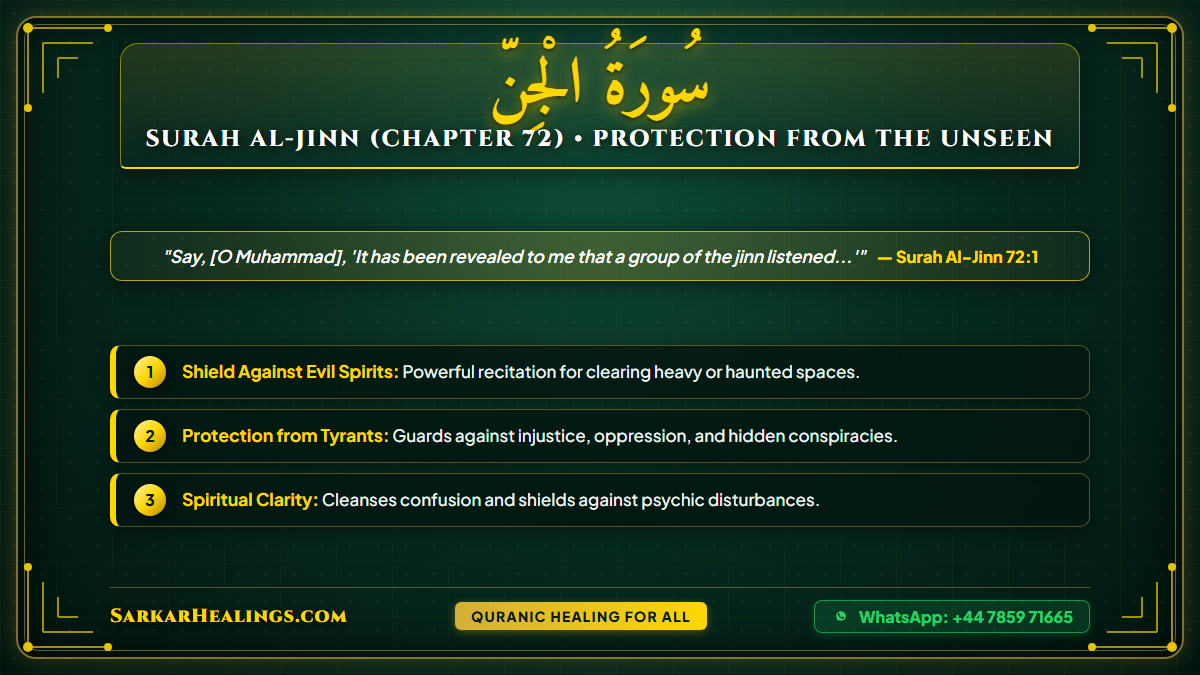
Surah Al‑Jinn (Qur’an 72) recounts a company of jinn who heard the Qur’an, believed, and warned their kin against seeking refuge in anyone but Allah. Its 28 verses (Makki, Juz 29) teach the absolute oneness of reliance (tawakkul) and the futility of turning to unseen beings for help. Below you will find every claimed benefit graded by its evidential strength, classical Sufi commentary, and practical guidance for recitation.
What the Surah Is About
Allah opens the surah with the testimony of a group of jinn:
قُلْ أُوحِيَ إِلَيَّ أَنَّهُ اسْتَمَعَ نَفَرٌ مِّنَ الْجِنِّ فَقَالُوا إِنَّا سَمِعْنَا قُرْآنًا عَجَبًا
They declare the Qur’an “a wondrous recitation” that guides to the straight path (72:2). The surah then exposes the error of humans who sought protection from jinn, noting that such refuge only increased them in burden (72:6). It concludes with Allah’s exclusive knowledge of the unseen and the command to worship Him alone.
Authentic Virtues (Grade A)
Virtue / Benefit
Primary Source
Grade
A group of jinn listened to the Qur’an, believed, and testified to its guidance.
Qur’an 72:1‑2 (direct revelation)
A
Seeking refuge in jinn is condemned; it only adds to one’s burden.
Qur’an 72:6 (direct revelation)
A
General reward for reciting the Qur’an – ten good deeds per letter.
Sunan al‑Tirmidhī 2910
A
Graded Benefits & Common Claims
The table below summarises every benefit that circulates in books, websites, or oral tradition, together with an honest evidence grade.
Claimed Benefit
Source / Basis
Grade
Protection from harm by affirming Allah’s sole refuge (tawhid al‑‘ibadah).
Qur’an 72:6; consensus of tafsir (e.g. Ibn Kathir, Al‑Tabari)
A
Recitation as a means of spiritual healing (shifa’) for heart‑ailments such as fear, anxiety, and waswas.
Qur’anic theme: “And We send down of the Qur’an that which is healing…” (17:82); classical scholars (Al‑Ghazālī, Iḥyā’ ʿUlūm al‑Dīn)
B
Specific “40‑times” or “7‑times” recitation formulas for warding off jinn‑related afflictions.
Popular manuals (e.g. some later ruqyah books) – no authentic chain.
C
Rituals that attempt to summon, command, or negotiate with jinn for worldly gain.
Later folk practice; explicitly contradicted by 72:6 and the prophetic prohibition of sihr (magic).
D (impermissible practice)
Earning the general Qur’anic reward (ten hasanat per letter) each time the surah is recited.
Tirmidhī 2910
A
Important: Any practice that seeks help from jinn, attempts to communicate with them, or uses “jinn‑catching” formulas is haram and contrary to the very message of Surah Al‑Jinn (72:6). Such actions expose a person to spiritual harm and legal sin. Always place your trust (tawakkul) in Allah alone.Sufi & Classical Insights
Al‑Qushayrī – Lata’if al‑Isharat
Al‑Qushayrī highlights that the jinn’s immediate faith upon hearing the Qur’an demonstrates the irresistible clarity of divine speech. He writes that the heart which turns to Allah alone finds a “refuge that cannot be breached,” echoing 72:6. For the seeker, the surah becomes a reminder that tawakkul is not a passive feeling but an active severing of every hidden reliance.
Ibn ʿAjība – Al‑Bahr al‑Madid
Ibn ʿAjība notes the literary shift from the jinn’s testimony (verses 1‑2) to the human error (verse 6). He interprets the “burden” (rahaq) as the spiritual weight of shirk‑like dependence. The remedy, he says, is constant recitation of the surah with presence of heart (hudur), allowing its light to dissolve the subtle attachments to unseen forces.
Al‑Ghazālī – Iḥyā’ ʿUlūm al‑Dīn (Book of Reliance)
Al‑Ghazālī classifies reliance on jinn as a form of shirk al‑asghar (minor association) because it ascribes independent causative power to created beings. He prescribes the daily recitation of Surah Al‑Jinn (or at least its opening verses) as a dhikr that re‑orients the soul toward the sole Provider. The benefit is not magical but transformative: the heart learns to expect all good and ward from Allah alone.
How & When to Recite
- Daily wird: Recite the surah once after Fajr or Isha as part of a regular Qur’anic wird. This aligns with the general reward (Grade A) and the Sufi recommendation of consistent engagement.
- During ruqyah: If performing ruqyah for oneself or others, include Al‑Jinn (especially verses 1‑2 and 6) while blowing lightly over the person. The basis is the Qur’anic healing theme (Grade B), not a used as a means (sabab) seek healing for.
- In moments of fear or waswas: Repeat verses 1‑2 and 6 three times, seeking refuge in Allah from the whispers of both jinn and men. This is a devotional practice (Grade D) rooted in the surah’s own teaching.
- No fixed “magic number”: There is no authentic hadith prescribing 7, 40, or 100 repetitions for a specific worldly outcome. seek healing for any such prescription as a later devotional custom (Grade D) and do not rely on it as a traditional means.
Related Hubs
Frequently Asked Questions
Can I recite Surah Al‑Jinn to get rid of a jinn possession?
Recitation is a legitimate part of ruqyah (Grade B) because the Qur’an is a healing. However, there is no authentic evidence that this surah alone expels a jinn. Proper ruqyah follows the prophetic method: recite Qur’an, blow, and supplicate, while also seeking qualified medical/psychological help. Never attempt to “command” the jinn.
Is it permissible to write the surah on paper and wear it as an amulet?
Writing Qur’an for blessing is allowed if the intention is to honor the text and seek Allah’s protection (Grade D – devotional practice). Wearing it as a talisman believing the paper itself has independent power edges toward shirk. The safest approach is to keep the written verses in a clean place and recite them regularly.
Does the surah traditional means safety from enemies?
The surah teaches reliance on Allah, which is the ultimate source of safety (Grade A). It does not function as a magical shield that traditional meanss worldly victory. Combine recitation with lawful means (security, diplomacy, du’a) and trust the outcome to Allah.
Are the “40‑day” or “7‑times” formulas found in some books authentic?
No. Those numbers appear in later ruqyah manuals without a sound chain (Grade C). They may be used as a personal discipline, but they must not be presented as prophetic prescriptions.
YMYL Disclaimer: This article provides spiritual information rooted in Islamic tradition. It is not a substitute for professional medical, psychological, or legal advice. If you experience symptoms that may indicate a medical or mental‑health condition, please consult a qualified healthcare provider. Spiritual practices complement, but never replace, lawful seek healing forment. May Allah make the Qur’an a light for your heart, a healing for your chest, and a firm rope between you and Him. Explore more protective surahs or surahs for healing to enrich your daily wird.
✦ ✦ ✦
Obtain the Spiritually Prepared Evil Influence Remover
At Sarkar Healings we prepare this taweez and coded dua following the Qur’an and Sunnah described in this guide, with the correct intention and adab.
Or email: help@sarkarhealings.com
This is a traditional practice, not a substitute for medical treatment, legal advice, or professional care. Scholars differ on some of these practices; where they differ, that difference is noted. Benefit and outcome are from Allah alone. If you are facing a medical, psychological, or financial emergency, seek qualified professional help first.
Where This Fits in Your Healing Journey
Surah Al‑Jinn (The Jinn) – Benefits, Virtues & Spiritual Guidance
Surah Al‑Jinn (Qur’an 72) recounts a company of jinn who heard the Qur’an, believed, and warned their kin against seeking refuge in anyone but Allah. Its 28 verses (Makki, Juz 29) teach the absolute oneness of reliance (tawakkul) and the futility of turning to unseen beings for help. Below you will find every claimed benefit graded by its evidential strength, classical Sufi commentary, and practical guidance for recitation.
What the Surah Is About
Allah opens the surah with the testimony of a group of jinn:
قُلْ أُوحِيَ إِلَيَّ أَنَّهُ اسْتَمَعَ نَفَرٌ مِّنَ الْجِنِّ فَقَالُوا إِنَّا سَمِعْنَا قُرْآنًا عَجَبًا
They declare the Qur’an “a wondrous recitation” that guides to the straight path (72:2). The surah then exposes the error of humans who sought protection from jinn, noting that such refuge only increased them in burden (72:6). It concludes with Allah’s exclusive knowledge of the unseen and the command to worship Him alone.
Authentic Virtues (Grade A)
| Virtue / Benefit | Primary Source | Grade |
|---|---|---|
| A group of jinn listened to the Qur’an, believed, and testified to its guidance. | Qur’an 72:1‑2 (direct revelation) | A |
| Seeking refuge in jinn is condemned; it only adds to one’s burden. | Qur’an 72:6 (direct revelation) | A |
| General reward for reciting the Qur’an – ten good deeds per letter. | Sunan al‑Tirmidhī 2910 | A |
Graded Benefits & Common Claims
The table below summarises every benefit that circulates in books, websites, or oral tradition, together with an honest evidence grade.
| Claimed Benefit | Source / Basis | Grade |
|---|---|---|
| Protection from harm by affirming Allah’s sole refuge (tawhid al‑‘ibadah). | Qur’an 72:6; consensus of tafsir (e.g. Ibn Kathir, Al‑Tabari) | A |
| Recitation as a means of spiritual healing (shifa’) for heart‑ailments such as fear, anxiety, and waswas. | Qur’anic theme: “And We send down of the Qur’an that which is healing…” (17:82); classical scholars (Al‑Ghazālī, Iḥyā’ ʿUlūm al‑Dīn) | B |
| Specific “40‑times” or “7‑times” recitation formulas for warding off jinn‑related afflictions. | Popular manuals (e.g. some later ruqyah books) – no authentic chain. | C |
| Rituals that attempt to summon, command, or negotiate with jinn for worldly gain. | Later folk practice; explicitly contradicted by 72:6 and the prophetic prohibition of sihr (magic). | D (impermissible practice) |
| Earning the general Qur’anic reward (ten hasanat per letter) each time the surah is recited. | Tirmidhī 2910 | A |
Sufi & Classical Insights
Al‑Qushayrī – Lata’if al‑Isharat
Al‑Qushayrī highlights that the jinn’s immediate faith upon hearing the Qur’an demonstrates the irresistible clarity of divine speech. He writes that the heart which turns to Allah alone finds a “refuge that cannot be breached,” echoing 72:6. For the seeker, the surah becomes a reminder that tawakkul is not a passive feeling but an active severing of every hidden reliance.
Ibn ʿAjība – Al‑Bahr al‑Madid
Ibn ʿAjība notes the literary shift from the jinn’s testimony (verses 1‑2) to the human error (verse 6). He interprets the “burden” (rahaq) as the spiritual weight of shirk‑like dependence. The remedy, he says, is constant recitation of the surah with presence of heart (hudur), allowing its light to dissolve the subtle attachments to unseen forces.
Al‑Ghazālī – Iḥyā’ ʿUlūm al‑Dīn (Book of Reliance)
Al‑Ghazālī classifies reliance on jinn as a form of shirk al‑asghar (minor association) because it ascribes independent causative power to created beings. He prescribes the daily recitation of Surah Al‑Jinn (or at least its opening verses) as a dhikr that re‑orients the soul toward the sole Provider. The benefit is not magical but transformative: the heart learns to expect all good and ward from Allah alone.
How & When to Recite
- Daily wird: Recite the surah once after Fajr or Isha as part of a regular Qur’anic wird. This aligns with the general reward (Grade A) and the Sufi recommendation of consistent engagement.
- During ruqyah: If performing ruqyah for oneself or others, include Al‑Jinn (especially verses 1‑2 and 6) while blowing lightly over the person. The basis is the Qur’anic healing theme (Grade B), not a used as a means (sabab) seek healing for.
- In moments of fear or waswas: Repeat verses 1‑2 and 6 three times, seeking refuge in Allah from the whispers of both jinn and men. This is a devotional practice (Grade D) rooted in the surah’s own teaching.
- No fixed “magic number”: There is no authentic hadith prescribing 7, 40, or 100 repetitions for a specific worldly outcome. seek healing for any such prescription as a later devotional custom (Grade D) and do not rely on it as a traditional means.
Related Hubs
Frequently Asked Questions
Can I recite Surah Al‑Jinn to get rid of a jinn possession?
Recitation is a legitimate part of ruqyah (Grade B) because the Qur’an is a healing. However, there is no authentic evidence that this surah alone expels a jinn. Proper ruqyah follows the prophetic method: recite Qur’an, blow, and supplicate, while also seeking qualified medical/psychological help. Never attempt to “command” the jinn.
Is it permissible to write the surah on paper and wear it as an amulet?
Writing Qur’an for blessing is allowed if the intention is to honor the text and seek Allah’s protection (Grade D – devotional practice). Wearing it as a talisman believing the paper itself has independent power edges toward shirk. The safest approach is to keep the written verses in a clean place and recite them regularly.
Does the surah traditional means safety from enemies?
The surah teaches reliance on Allah, which is the ultimate source of safety (Grade A). It does not function as a magical shield that traditional meanss worldly victory. Combine recitation with lawful means (security, diplomacy, du’a) and trust the outcome to Allah.
Are the “40‑day” or “7‑times” formulas found in some books authentic?
No. Those numbers appear in later ruqyah manuals without a sound chain (Grade C). They may be used as a personal discipline, but they must not be presented as prophetic prescriptions.
May Allah make the Qur’an a light for your heart, a healing for your chest, and a firm rope between you and Him. Explore more protective surahs or surahs for healing to enrich your daily wird.
Obtain the Spiritually Prepared Evil Influence Remover
At Sarkar Healings we prepare this taweez and coded dua following the Qur’an and Sunnah described in this guide, with the correct intention and adab.
Or email: help@sarkarhealings.com
This is a traditional practice, not a substitute for medical treatment, legal advice, or professional care. Scholars differ on some of these practices; where they differ, that difference is noted. Benefit and outcome are from Allah alone. If you are facing a medical, psychological, or financial emergency, seek qualified professional help first.
This surah is one door. Walk the full path with our graded guides:
Common Questions
How should I recite
Slowly, with meaning – once daily or weekly. Consistency matters more than volume.
Does listening count?
Yes – attentive listening carries reward, though active recitation carries more.
{“@context”:”https://schema.org”,”mainEntity”:[{“acceptedAnswer”:{“text”:”Classical narrations describe spiritual rewards for Surah Al-Jinn – recited with understanding, it is a means of reward and protection, by Allah\u0027s permission. See the graded breakdown on this page.”,”@type”:”Answer”},”name”:”What are the virtues of Surah Al-Jinn?”,”@type”:”Question”},{“acceptedAnswer”:{“text”:”Recite it slowly with meaning – once daily or weekly. Consistency matters more than volume. If you cannot read Arabic, listening with attention also counts.”,”@type”:”Answer”},”name”:”How should I recite Surah Al-Jinn?”,”@type”:”Question”},{“acceptedAnswer”:{“text”:”Listening attentively carries reward, though active recitation carries more. Do both when you can.”,”@type”:”Answer”},”name”:”Does listening to Surah Al-Jinn count as recitation?”,”@type”:”Question”},{“acceptedAnswer”:{“text”:”Browse the full 114 surahs library on Sarkar Healings, where every surah is covered with graded, honest guidance.”,”@type”:”Answer”},”name”:”Where can I learn more about the 114 surahs?”,”@type”:”Question”}],”@type”:”FAQPage”}
Need Personal Guidance on This?
Get a confidential, free consultation with our spiritual advisor — usually replied within hours.
Complete healing path: The Complete Quran Coded Dua — all 114 Surahs & Asma-ul-Husna in one hand-written taweez.
This content and its associated Quranic recitations are offered strictly as a spiritual means (asbab) seeking Allah's guidance, protection, and barakah. Sarkar Healings does not guarantee magical outcomes or instant cures. Spiritual remedies are to be used alongside lawful personal effort and professional medical, legal, or financial advice.