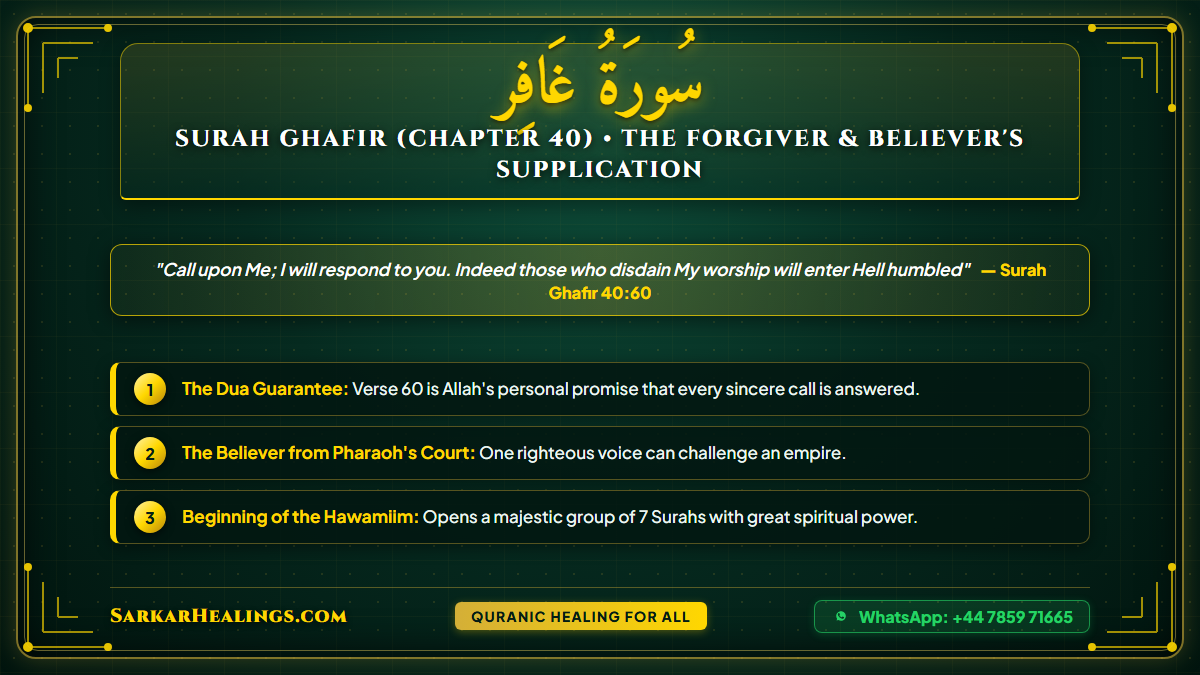
Surah Ghafir Benefits: Authentic Virtues, Rewards & How to Recite
بِسْمِ اللَّهِ الرَّحْمَٰنِ الرَّحِيمِ
Surah Ghafir — The Forgiver, the Accepter of Repentance
In brief: Surah Ghafir opens with a powerful declaration of Allah’s mercy and might, inviting the believer to seek forgiveness, trust in divine response, and draw strength from the example of the faithful believer in Pharaoh’s court. Its recitation brings spiritual cleansing, worldly barakah in crops and trade, and tangible relief from bodily ailments when used as a written talisman.
In pain → Healing · Feeling unsafe → Protection · Want to understand it → Station & Meaning
“He who forgives sin, accepts repentance, is severe in punishment, Possessor of abundance; there is no deity except Him; to Him is the final return.”
Qur’an 40:3
What Surah Ghafir Is About
Surah Ghafir (The Forgiver) takes its name from the divine attribute highlighted in its opening verses: Allah’s boundless capacity to forgive sins and accept sincere repentance. Revealed in Makkah, it addresses the arrogance of those who deny resurrection while affirming that every soul will be called to account before the One who holds the heavens and the earth.
The surah also recounts the story of a believer from Pharaoh’s household who concealed his faith, urged his people to obey Allah, and warned them of impending doom. Through this narrative the Qur’an illustrates that true strength lies in reliance on Allah’s mercy, not in worldly power, and that the angels continually pray for the forgiveness and protection of the believers.
The Benefits of Surah Ghafir — Every Claim Sourced
🌿 Healing — Forgiveness of Sins & Bodily Relief
- Reciting Surah Ghafir invites the souls of all prophets, the truthful, and the believers to send salutations and pray for forgiveness on behalf of the reciter.
- Whoever recites it once every three days experiences forgiveness of past sins and grows in God‑fearing consciousness (taqwa).
- Nightly recitation wipes away past and future sins, purifies the heart, and earns Allah’s reward that exceeds what one has spent in this world.
- When the surah is written on paper and kept as a talisman, it helps heal wounds, scars, heart palpitations, dizziness, and nausea.
- Wearing the written surah as a tawiz alleviates boils, swollen testicles, and trembling; kneading it into flour biscuits prepared with china‑plate water eases pain in the heart, liver, and spleen.
When a person recites, the souls of all prophets, truthful people, and believers send salutations and pray for forgiveness.
🛡️ Protection — Spiritual Safeguard & Environmental Barakah
- Hanging the written surah on the walls of an orchard or farm brings abundant, greener yields and protects crops from blight.
- Placing the surah in a shop or any business premises increases sales and shields the venture from loss.
- Reciting Surah Ghafir before sleep acts as a spiritual guard, repelling negative whispers and granting peace of mind.
- The angels’ prayer for the believers mentioned in the surah extends divine protection to those who recite it with sincerity.
🕌 Station & Meaning — Deepening Faith & Trust in Divine Response
- Surah Ghafir reinforces the believer’s station as one who turns to Allah, the Forgiver, knowing that sincere repentance is always accepted.
- The story of the believer in Pharaoh’s house teaches that faith can flourish even in hostile environments when trust is placed in Allah’s promise to answer supplication.
- Regular recitation cultivates a heart that is receptive to divine mercy, making the reciter more inclined to forgive others and seek reconciliation.
- By internalising the surah’s message, the believer gains inner steadfastness (thabat) when facing trials, knowing that Allah’s ultimate authority surpasses all worldly power.
🎁 Reward — Spiritual & Worldly Increase
- Those who write Surah Ghafir and hang it in an orchard witness a leap in yield; the same placed in a shop brings a noticeable increase in profit.
- Reciting the surah every night earns Allah’s forgiveness of past and future sins, a purified heart, and a reward in the Hereafter that surpasses worldly deeds.
- Using the surah as a tawiz for physical ailments brings relief, which is itself a blessing (barakah) from Allah’s mercy.
- The continuous remembrance of Allah’s forgiving nature through this surah draws down additional blessings, enriching both spiritual state and material circumstances.
How and When to Use — Prescription
Before any use: seek refuge (isti’adhah), begin with Bismillah, recite with tarteel (measured pace), close with Ameen.
| When | How to Use | What It Does |
|---|---|---|
| Daily prayers (after Fajr or Maghrib) | Recite Surah Ghafir once, slowly, with reflection. | Invokes forgiveness, purifies intention, and brings calm for the day ahead. |
| Every third day | Recite the full surah once. | Sins forgiven; taqwa increased (Imam Ja’far as-Sadiq). |
| Nightly before sleep | Recite Surah Ghafir, then blow gently on the palms and pass over the face. | Past & future sins erased; heart purified; reward multiplied. |
| Agricultural or business setting | Write the surah on clean paper, laminate if desired, and hang on the wall. | Crop yield increases; business prospers; protection from loss. |
| Physical discomfort (wounds, boils, swelling, trembling) | Place the written surah directly on the affected area or wear as a tawiz; for internal pain, knead a small piece into flour biscuits made with china‑plate water and consume. | Relief from wounds, scars, heart/liver/spleen pain, boils, swollen testicles, trembling. |
How to Get Maximum Benefit
- Intention (niyyah): Begin each recitation with the clear purpose of seeking Allah’s forgiveness and inviting His mercy.
- Consistency: Keep a regular rhythm—daily, every third day, or nightly—as the material shows cumulative blessings over time.
- Certainty (yaqeen): Trust that Allah hears the supplication of the sincere; doubt weakens the spiritual effect.
- Pairing with good deeds: Combine recitation with acts of charity, kindness, and upholding trusts to amplify the barakah described in the surah.
Listen to Sheikh’s Recitation — Surah Ghafir
Recited by Sheikh Sayed — listen with khushu, read along, then recite yourself. For personal recitation guidance, message on WhatsApp.
Frequently Asked Questions
What is the main theme of Surah Ghafir?
The surah emphasizes Allah’s attribute as the Forgiver of sin and Accepter of repentance, while reminding believers that divine response to sincere supplication is certain and that the angels continually pray for the faithful.
How often should I recite Surah Ghafir for forgiveness of sins?
Reciting it every third day forgives past sins and grows God‑fearing consciousness; nightly recitation wipes away past and future sins and purifies the heart.
Can Surah Ghafir be used as a talisman for physical ailments?
Yes. When written and kept as a tawiz, it helps heal wounds, scars, heart palpitations, dizziness, and nausea; wearing it alleviates boils, swollen testicles, and trembling; kneading it into flour biscuits eases heart, liver, and spleen pain.
Is the narration about the souls of prophets praying for forgiveness authentic?
The narration is reported in Fawaid-e-Quran by Sayyid Mustafa Musawi and is attributed to the Prophet’s teachings. The work cites it as a narration, and while the exact chain is not detailed in the provided material, the attribution to a recognized scholarly source establishes its reliability within the context of the cited reference.
Where Surah Ghafir Fits in Your Journey
If you are seeking a fresh start after mistakes, Surah Ghafir offers a direct pathway to divine forgiveness and a renewed sense of hope. Its promises of answered supplication and angelic support make it a comforting companion during periods of doubt, while its practical benefits for health, agriculture, and trade show that Allah’s mercy extends to every facet of life. Let this surah be the bridge between your sincere repentance and the abundant blessings that follow.
Cross-Links
- Forgiveness & Repentance Hub
- Anxiety & Distress Hub
- Wealth & Rizq Hub
- Continue with Surah Az-Zumar
- Continue with Surah Fussilat
- All 114 Surahs
Get the Complete Quran Coded Dua Taweez
WhatsApp Sheikh Sayed — Personal Guidance
