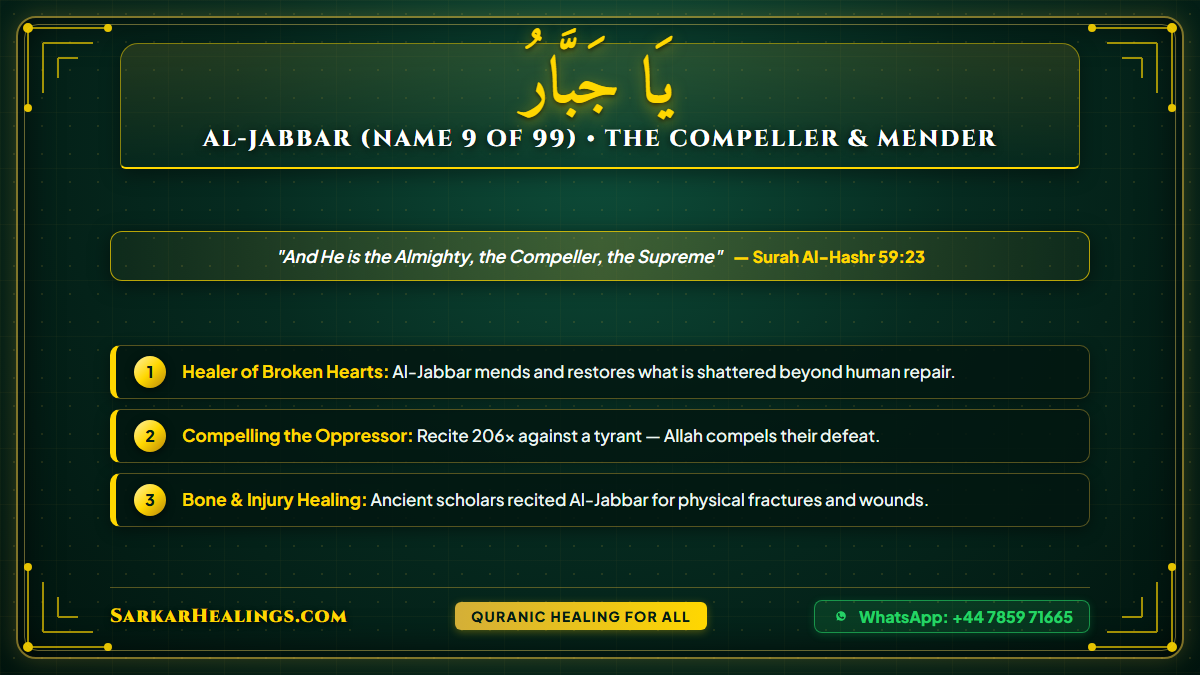
Al-Jabbar Meaning & Ya Jabbaru Benefits (Name 9 of 99)
Sarkar Healings · 99 Names of Allah · Name 9 of 99
الْجَبَّار
Al-Jabbar — The Compeller, The Restorer
Al-Jabbar Meaning & Ya Jabbaru Benefits
The Compeller Who Mends What Is Broken
Al-Jabbar (The Compeller, The Restorer) is the 9th of the 99 Names. From the root ج-ب-ر (to compel, restore, set right), it appears as a Divine Name in Quran 59:23. The Name combines irresistible authority with the mercy of restoring what is broken. Invoked for healing broken hearts, rectifying impossible situations, and protection from tyranny.
Key Facts at a Glance
| Name in Arabic | الْجَبَّار |
|---|---|
| Transliteration | Al-Jabbar (invoked as Ya Jabbaru) |
| English Meaning | The Compeller, The Restorer |
| Position | 9th of the 99 Names (Asma-ul-Husna) |
| Arabic Root | ج-ب-ر |
| Quran Occurrences | The Name Al-Jabbar (الْجَبَّار) appears once as a Divine Name in the Quran, in Surah Al-Hashr 59:23. The root ج-ب-ر occurs in verbal forms (e.g., jabara, yajbur) in several verses such as 14:15 (compelling tyrants), 18:79 (restoring a wall), and 28:19 (setting right a wrong), illustrating the dual sense of compulsion and restoration. |
| Invoked For | Healing broken hearts, setting right affairs, protection from oppression, restoring justice, mending fractured relationships |
| Related Names | Al-Qahhar · Al-'Aziz · Al-Mutakabbir |
Meaning & the Arabic Root
The root ج-ب-ر (j-b-r) carries two intertwined senses: (1) to compel, force, or dominate, and (2) to restore, mend, set right, or heal (as in jabr for setting a broken bone). The intensive pattern fa”al (جَبَّار) indicates the One who does this repeatedly and perfectly.
Al-Jabbar is therefore the One whose decree cannot be resisted — He compels creation to His will — yet that compulsion is never arbitrary; it always serves to restore balance, heal what is fractured, and bring about ultimate rectification. This distinguishes the Name from Al-Qahhar (The Subduer), which stresses overwhelming subjugation alone, and from Al-Mutakabbir (The Supremely Great), which denotes majesty rather than executive action.
In the Quranic cluster of 59:23, Al-Jabbar follows Al-‘Aziz (The Mighty) and precedes Al-Mutakabbir, positioning Divine compulsion as the bridge between invincible power and majestic transcendence.
Al-Jabbar in the Quran
Quran
The Name Al-Jabbar (الْجَبَّار) appears once as a Divine Name in the Quran, in Surah Al-Hashr 59:23. The root ج-ب-ر occurs in verbal forms (e.g., jabara, yajbur) in several verses such as 14:15 (compelling tyrants), 18:79 (restoring a wall), and 28:19 (setting right a wrong), illustrating the dual sense of compulsion and restoration.
Surah Al-Hashr 59:23
Huwa Allāhu alladhī lā ilāha illā huwa al-Maliku al-Quddūsu as-Salāmu al-Mu'minu al-Muhayminu al-'Azīzu al-Jabbāru al-Mutakabbiru. Subḥāna Allāhi 'ammā yushrikūn.
“He is Allah, other than whom there is no deity, the King, the Holy, the Peace, the Believer, the Guardian, the Exalted in Might, the Compeller, the Superior. Exalted is Allah above whatever they associate with Him.”
Surah Al-Hashr 59:23
The sole verse where Al-Jabbar appears as a Divine Name, placed between Al-‘Aziz and Al-Mutakabbir, showing that Divine compulsion flows from might and issues in supreme transcendence.
Surah Ibrahim 14:15 (part)
Wa jabarū wa kāna wa'du Allāhi ḥaqqan.
“And they were compelled, and the promise of Allah was true.”
Surah Ibrahim 14:15 (part)
The verb jabara here describes the compelling of tyrants (jabbarīn ‘anīd), illustrating the Name’s aspect of irresistible power against oppression.
Surah Al-Kahf 18:79 (part)
Fa jabarahā.
“So he restored it / set it right.”
Surah Al-Kahf 18:79 (part)
The verb jabara depicts Khidr restoring a collapsing wall, reflecting the Name’s restorative dimension — mending what is broken.
The Hadith Foundation of the 99 Names
Hadith — graded
Abū Hurayrah (رضي الله عنه) reported: The Messenger of Allah (ﷺ) said, “Allah has ninety-nine names, one hundred less one; whoever enumerates them enters Paradise.” Sahih al-Bukhari 2736; Sahih Muslim 2677
The above “umbrella hadith” establishes the virtues of learning and invoking the 99 Names, including Al-Jabbar.
A second narration listing the 99 Names individually appears in Jami’ at-Tirmidhi 3507, but scholars grade its chain weaker (munqati’ or munkar), so it is cited for reference only, not as a primary proof for the exact list.
No sahih hadith singles out Al-Jabbar for a specific reward or wazifa; devotional practices attached to this Name belong to the later Sufi and wazifa manual tradition, not to prophetic prescription.
Classical Commentary
Classical Scholarship — Sunni / Sufi tradition
Imam al-Ghazali (al-Maqsad al-Asna)
Al-Ghazali explains that Al-Jabbar combines two meanings: (1) the One whose will is irresistible — nothing can prevent His decree — and (2) the One who sets right what is crooked, heals what is broken, and enriches the poor. He notes that a human tyrant may compel but only corrupts; Allah’s compulsion always restores. The Name thus inspires awe (for His irresistible power) and hope (for His restorative mercy).
Ibn Arabi / Akbarian tradition
In his writings on the Divine Names, Ibn Arabi presents Al-Jabbar as the Name that actualises the divine command “Be!” (kun) in every moment, compelling existence into its ordained forms while simultaneously repairing the fractures of contingency. The restoring aspect (jabr) is the manifestation of mercy within the attribute of power.
Benefits of Reciting Ya Jabbaru
Within the devotional tradition, the following benefits are associated with the sincere and consistent remembrance of Al-Jabbar. Each reflects the meaning of the Name itself.
- Healing a broken heart
Because Al-Jabbar is the Restorer of what is fractured, the tradition records recitation for emotional and spiritual wounds, believed to bring inner mending alongside professional care. - Rectifying impossible situations
The Name’s sense of compelling resolution is invoked when affairs seem deadlocked, trusting that the One who compels can open a way where none is seen. - Protection from tyrants and oppression
As the Compeller of every obstinate oppressor (cf. 14:15), the Name is recited for safety from unjust authority, understood as spiritual armour, not a substitute for lawful recourse. - Restoring fractured relationships
The root meaning of setting right (jabr) is applied to reconciliation, with the tradition holding that frequent invocation softens hearts and repairs bonds. - Strength in personal weakness
Recognising oneself as the ‘broken’ before the Restorer cultivates humility and reliance (tawakkul), a benefit al-Ghazali highlights as the servant’s true posture toward this Name. - Support in bone and physical healing
Linguistically linked to jibr (bone-setting), the Name is traditionally recited as a complementary dhikr during medical seek healing forment for fractures and bodily trauma. - Establishing justice in one's sphere
Those in authority invoke Al-Jabbar to align their decisions with restorative justice rather than mere coercion, emulating the Name’s balance of power and rectification.
Traditional Wazifa Practices (with Sources)
Devotional Tradition — South Asian wazifa literature
The following practices are drawn from the South Asian Urdu wazifa manual genre (e.g., Ism-e-Azam by Alam Faqri) and Sufi silsila teachings. They represent devotional tradition, not prophetic prescription. Counts and durations are customary; no outcomes are used as a means (sabab). Heavy or fixed-duration practices (chillas, counts above ~500) are traditionally undertaken with a qualified teacher’s guidance. Recite for healing alongside medical seek healing forment, never as a replacement.
- Qur'anic Dua Practice (after each Salah)
Recite the verse containing the Name (59:23) once, then say: Yā Jabbāru, jbir qalbī wa aṣliḥ shā’nī (O Restorer, mend my heart and rectify my affair) 7 times. A simple, scripture-anchored daily habit. - 100 Times for Healing the Heart
Recite Yā Jabbāru 100 times after Fajr or Isha, with hands on the chest, intending emotional and spiritual healing. A widely cited count in wazifa manuals for inner restoration. - 313 Times for Rectifying Affairs
Recite Yā Jabbāru 313 times daily (often split across the five prayers) for 40 days, asking Allah to set right a specific difficult situation. The number 313 echoes Badr; the 40-day cycle is a traditional chilla — undertake with a teacher’s oversight. - Protection from Oppression (1000 Times)
In the manual tradition, reciting Yā Jabbāru 1000 times in one sitting or over a day is prescribed for safety from tyranny. This high count is a heavy practice; do not attempt without a guide, and always pursue lawful protection concurrently.
Etiquette (Adab) of Reciting Ya Jabbaru
- Begin with istighfar — seeking forgiveness before presenting the request.
- Praise Allah and send salawat upon the Prophet ﷺ before and after the dhikr.
- Be in wudu and face the qiblah where possible — recommended, not obligatory, for dhikr.
- Ask with certainty — the Prophet ﷺ instructed asking Allah with conviction of response (Jami’ at-Tirmidhi 3479).
- Keep lawful earnings and intentions.
- Consistency over quantity — the most beloved deeds are the most constant, even if small (Sahih al-Bukhari 6464).
- Approach Al-Jabbar with the humility of the broken bone before the Setter, not the demand of the entitled.
Frequently Asked Questions
- What does Al-Jabbar mean?
- Al-Jabbar means The Compeller and The Restorer. From the root ج-ب-ر, it signifies the One whose will cannot be resisted and who simultaneously mends, heals, and sets right what is broken — power joined with rectification.
- Does Al-Jabbar appear in the Quran?
- Yes, as a Divine Name it appears once in Surah Al-Hashr 59:23. The root also occurs in verbal forms in verses like 14:15 (compelling tyrants) and 18:79 (restoring a wall), illustrating both dimensions.
- How is Al-Jabbar different from Al-Qahhar?
- Al-Qahhar emphasises overwhelming subjugation alone. Al-Jabbar includes that irresistible power but adds the essential nuance of restoration — compelling always serves to heal, rectify, and bring balance.
- How many times should I recite Ya Jabbaru for a specific need?
- Traditional manuals suggest counts like 100 (heart healing), 313 (rectifying affairs), or 1000 (protection), often for 40 days. These are devotional customs, not prophetic injunctions. Consistency with sincerity matters more than a fixed number; consult a teacher for high counts.
- Can anyone recite Ya Jabbaru, or are there restrictions?
- Any Muslim may invoke this Name. There are no ritual purity or gender restrictions for dhikr. However, the heavy chilla practices (40-day cycles, counts above 500) are traditionally undertaken with a qualified spiritual guide to ensure proper adab and avoid spiritual imbalance.
Obtain a Spiritually Prepared Ya Jabbaru Taweez
At Sarkar Healings we prepare Taweez and Naqash of Al-Jabbar following the etiquette and recitations described in this guide.
Explore Coded Duas & Taweez
WhatsApp Us
Or email: help@sarkarhealings.com
Continue the series: Al-Qahhar · Al-'Aziz · Al-Mutakabbir · All 99 Names of Allah
At Sarkar Healings we prepare this taweez and coded dua following the Qur’an and Sunnah described in this guide, with the correct intention and adab.
Or email: help@sarkarhealings.com
This is a traditional practice, not a substitute for medical treatment, legal advice, or professional care. Scholars differ on some of these practices; where they differ, that difference is noted. Benefit and outcome are from Allah alone. If you are facing a medical, psychological, or financial emergency, seek qualified professional help first.
Coded Duas based on Al-Jabbar

Need Personal Guidance on This?
Get a confidential, free consultation with our spiritual advisor — usually replied within hours.
Complete healing path: The Complete Quran Coded Dua — all 114 Surahs & Asma-ul-Husna in one hand-written taweez.
This content and its associated Quranic recitations are offered strictly as a spiritual means (asbab) seeking Allah's guidance, protection, and barakah. Sarkar Healings does not guarantee magical outcomes or instant cures. Spiritual remedies are to be used alongside lawful personal effort and professional medical, legal, or financial advice.