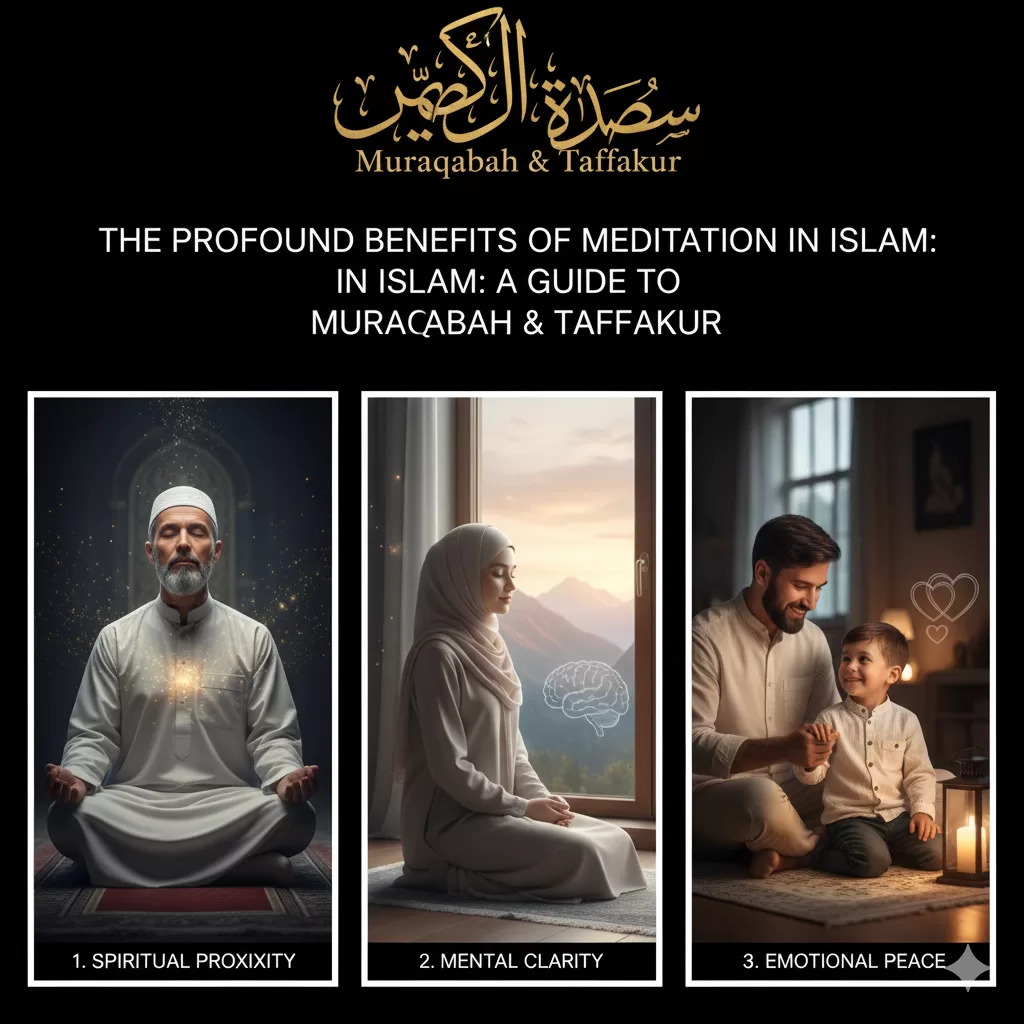
The Profound Benefits of Meditation in Islam: A Guide to Muraqabah & Taffakur
"Meditation is the art of surrendering. It is about being completely still and submitting to the will of Allah in a conscious state of mind."
Meditation is at the core of Islamic spirituality, yet it is often not given the attention and focus it truly deserves in our busy modern lives. Far from being a new-age concept, Islamic meditation (often referred to as Muraqabah or Taffakur) is a deliberate, self-led mental activity practiced by our righteous predecessors. They understood that these techniques were essential to enhancing physical acts of worship, including Salah (prayer), fasting, and Dhikr (remembrance).
Meditation in Islam is the art of surrendering. It involves achieving a state of complete stillness to submit to Allah with full presence of heart and mind. It transforms robotic rituals into profound spiritual experiences.
Understanding Muraqabah: The Spiritual Watch
Muraqabah (watchfulness) is the fulfillment of worshipping Allah according to a proper understanding of His Beautiful Names, particularly those that convey His perfect knowledge and oversight of creation. It is the realization that Allah is watching you at every moment.
Our Beloved Sufi Grand Master, Sheikh ‘Abd al-Qadir al-Jilani (RH), taught that Muraqabah is realized through four key aspects:
- Knowledge of Allah Almighty: Deeply internalizing His attributes and presence.
- Knowledge of the Enemy (Iblis): Recognizing Satan's whispers and traps.
- Knowledge of Your Soul's Capacity (Nafs): Awareness of your own ego's tendency to suggest evil.
- Knowledge of Deeds for Allah's Sake: Acting with pure intention (Ikhlas).
The Practice of Taffakur: Essential Reflection
The practice of Taffakur (deep reflection) is essential today because modern culture encourages constant entertainment and distraction. We rarely have time to just think. As a result, we carry unresolved thoughts, hidden fears, and limiting beliefs that weigh down our spirits.
How to Practice Taffakur:
- Close your eyes and visualize that Allah is watching you.
- Focus on the present moment: It is just you and Him.
- Ponder deeply: Realize that right now, He knows everything going on in your head—your secret worries, your deepest fears, your highest hopes, and your dreams.
"Your mind will always drift—it’s your nafs trying to take over. Gently bring it back to the center. Bring it back to Him."
Your primary focus in this state is on connection with Allah, nothing else. Start small and increase the time in increments every other day as you master the technique. Taking time to reflect on Allah and the Hereafter builds Taqwa (God-consciousness), helps us become more grateful, and significantly eases the daily stress of life.
The Power of Seclusion (Khalwah)
Seclusion is a practice deeply rooted in the Sunnah. The Prophet Muhammad (PBUH) practiced Prophetic Seclusion in the Cave of Hira long before prophet-hood, spending days trying to make sense of the world around him through contemplation.
After prophet-hood, he prescribed I’tikaf in Ramadan—a dedicated retreat for men and women with immense rewards. However, we can practice forms of seclusion throughout the year. Breaking away, even for a few minutes daily, from work, spouse, and children is liberating. It acts as a balm for the soul. Even the wives of the Prophet (PBUH) lived separately, teaching us the importance of having alone time for spiritual growth.
Key Benefits of Meditation in Islam
Integrating meditation into your daily routine offers profound benefits for mental health in Islam and spiritual well-being:
1. Enhances Focus in Worship
Our practice of silent mindfulness in Islam directly improves our Salah concentration (Khushu). Instead of praying distractedly, meditation trains the mind to be present, making prayer a true conversation with the Creator.
2. Deepens the Impact of Dhikr
Dhikr is the most common form of Islamic meditation. However, it is often done robotically. By making Dhikr in a state of meditative awareness, you increase its effectiveness. The act of rolling Dhikr beads helps tactile focus. Wooden beads, sourced from nature, often have a more calming, grounding effect than synthetic plastic ones.
3. Powerful Quranic Meditation
Reading the Qur’an with reflection (Tadabbur) is one of the most rewarding forms of meditation. It is a practical tool for the workday:
- Bad Day Strategy: If you are stressed, break away, make Wudu, and recite the Qur’an.
- Positive Energy: The Qur’an is referred to as a "Remembrance" (Dhikr); reciting it infuses the heart with renewed positive energy and peace.
4. Advanced Spiritual & Mental Benefits
Regular practice leads to higher states of consciousness and well-being:
- Deep Relaxation: Reduces cortisol levels and physical tension.
- Intuition (Firasah): You become more aware and can listen to your "gut feeling" or believer's intuition.
- Inner Peace: Provides a sanctuary of calm in a chaotic world.
- Connection with Higher Self: helps navigate life's challenges with spiritual clarity.
Conclusion: Surrender to Find Peace
Meditation can drastically improve your quality of life, giving you time to completely loosen the knots of stress and realize inner peace in Islam. By taking time to recharge your thinker, you can reach greater heights of productivity and spiritual connection throughout your day.
Ready to Deepen Your Spiritual Practice?
Explore our guides and tools to help you on your journey of self-healing and connection.