Sarkar Healings · Hajj & Dhul Hijjah 2026
بِسْمِ اللهِ الرَّحْمنِ الرَّحِيمِ
Hajj 2026 & the First 10 Days of Dhul Hijjah — Complete Spiritual Guide
Dates, rituals, duas, rewards, Takbeer Tashreeq, Qurbani, and Wazaif for pilgrims and non-pilgrims in Dhul Hijjah 1447 AH
Dhul Hijjah 1447 AH
Hajj 2026
Day of Arafah ~4 June
Eid ul Adha ~5 June
Takbeer Tashreeq
~27 May 2026
1st Dhul Hijjah 1447
Yawm at-Tarwiyah
~3 June 2026
8th Dhul Hijjah
Day of Arafah
~4 June 2026
9th Dhul Hijjah
Eid ul Adha
~5 June 2026
10th Dhul Hijjah
Takbeer Ends
~8 June 2026
Asr — 13th Dhul Hijjah
⚠ All dates are based on astronomical calculations and subject to official moon sighting announcements.
✦ ✦ ✦
Why Dhul Hijjah is the Holiest Month in the Islamic Calendar
Of the twelve months in the Islamic lunar calendar, four are declared sacred (Al-Ashhur al-Hurum) by Allah ﷻ — and Dhul Hijjah stands among the most exalted of them all. It is the month of Hajj, the month of Eid ul Adha, the month of sacrifice, and the home of what the Prophet Muhammad ﷺ described as the greatest days on earth for righteous deeds.
The word Dhul Hijjah (ذو الحجة) literally means “Possessor of the Pilgrimage.” It is the 12th and final month of the Islamic year, and its spiritual significance extends far beyond the pilgrimage itself. The first ten days of Dhul Hijjah are a compressed season of divine mercy, forgiveness, and limitless reward available to every Muslim on earth — whether they stand on the plains of Arafah or in their own homes thousands of miles away.
Understanding this month is itself an act of gratitude. Allah ﷻ gifted these days specifically to this Ummah. Squandering them is a profound loss; embracing them with sincere worship is among the greatest investments a believer can make for this life and the next.
The Four Sacred Months (Al-Ashhur al-Hurum) — Quran 9:36
- Dhul Qa’dah (11th month) — the month before Hajj
- Dhul Hijjah (12th month) — the month of Hajj and Eid ul Adha
- Muharram (1st month) — the Islamic New Year
- Rajab (7th month) — the month of Isra wal Mi’raj
In these sacred months, sins carry greater weight and good deeds earn amplified rewards. The scholars of Islam have historically emphasised extra vigilance in avoiding forbidden acts during these periods and intensifying one’s worship.
✦ ✦ ✦
The Divine Oath in the Quran — Surah Al-Fajr
In Quranic tradition, when Allah ﷻ takes an oath by something, it is an emphatic declaration of that thing’s immense importance. The very opening of Surah Al-Fajr (Chapter 89) features one of the most celebrated oaths in the entire Quran — and it is an oath sworn by the ten nights of Dhul Hijjah.
وَالْفَجْرِ ﴿١﴾ وَلَيَالٍ عَشْرٍ ﴿٢﴾ وَالشَّفْعِ وَالْوَتْرِ ﴿٣﴾ وَاللَّيْلِ إِذَا يَسْرِ ﴿٤﴾
Surah Al-Fajr (89:1–4)
“By the dawn, and by the ten nights, and by the even and the odd, and by the night when it departs.”
“The ten nights are the first ten nights of Dhul Hijjah. ‘The even’ refers to the Day of Sacrifice — the 10th of Dhul Hijjah — and ‘the odd’ refers to the Day of Arafah — the 9th of Dhul Hijjah.”
Tafsir Ibn Kathir, citing Ibn Abbas (RA)
This divine oath is a theological landmark. It is Allah ﷻ Himself drawing attention to these days, elevating them above all others in the earthly calendar. Ibn Abbas (RA), the great Companion and Quranic exegete, confirmed this interpretation, and it has been the dominant scholarly position across all four major schools of Islamic jurisprudence.
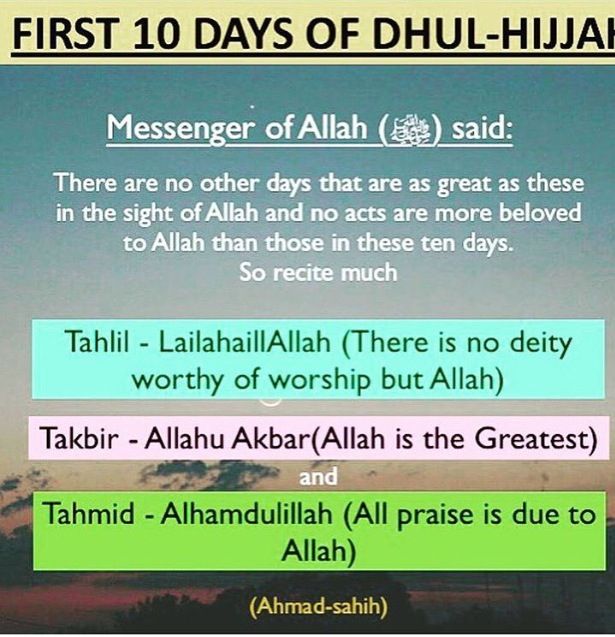
“There are no days that are greater before Allah or in which good deeds are more beloved to Him than these ten days, so recite a great deal of tahleel (La ilaha illallah), takbeer (Allahu Akbar) and tahmeed (Alhamdulillah) during them.”
Ahmad — from Ibn Umar (RA), Sahih
✦ ✦ ✦
The Magnificent Rewards of the First 10 Days of Dhul Hijjah
The ahadith (prophetic traditions) regarding the rewards of these days are among the most staggering in the entire corpus of Islamic scholarship. They are not metaphorical exaggerations — they are factual divine pronouncements about the spiritual economy of this sacred time.
“There are no days in which righteous deeds are more beloved to Allah than these ten days.” The Companions asked: “Not even Jihad for the sake of Allah?” He replied: “Not even Jihad for the sake of Allah, except in the case of a man who goes out, giving himself and his wealth up for the cause of Allah, and comes back with nothing.”
Sahih Bukhari — Hadith 969
1,000×
Each Day’s Reward
Days 1–8 of Dhul Hijjah each carry the reward of 1,000 ordinary days
10,000×
Day of Arafah
The 9th of Dhul Hijjah carries the reward of 10,000 ordinary days
2 yrs
Sins Expiated
Fasting on the Day of Arafah expiates sins of the past AND coming year
∞
Qurbani Reward
For every hair of the sacrificed animal, a good deed is recorded
“Every single day of the first 10 days of Dhul Hijjah is equal to 1,000 days in reward, and the Day of Arafah is equal to 10,000 days in reward.”
Shu’ab al-Iman, Bayhaqi
“Fasting the Day of Arafah expiates the sins of two years: the past one and the coming one.”
Sahih Muslim — Hadith 1162
These hadiths present a unique spiritual opportunity: in just ten days, a believer can accumulate the equivalent of decades of worship. The Day of Arafah alone, when fasted with sincerity, wipes the slate of two full years of sins. No other ten-day period in the Islamic calendar offers this density of divine reward.
✦ ✦ ✦
Hajj 2026 Dates — Full Calendar of Dhul Hijjah 1447 AH
The following dates are based on astronomical calculations for Dhul Hijjah 1447 AH. Official dates may vary by 1–2 days depending on the moon sighting announcement by Saudi Arabia and local Islamic authorities.
| Hijri Date | Gregorian Date (est.) | Significance |
|---|---|---|
| 1st Dhul Hijjah | ~27 May 2026 | Month begins. Stop cutting hair/nails if doing Qurbani. Begin extra worship. |
| 1st–7th | 27 May – 2 June | Days of intensified worship — fasting, dhikr, Quran, charity, night prayer. |
| 8th — Yawm at-Tarwiyah | ~3 June 2026 | Pilgrims travel to Mina. Hajj officially begins. Day of “watering” (historical context). |
| 9th — Yawm Arafah | ~4 June 2026 | Day of Arafah — the most important day. Pilgrims stand at Arafah. Non-pilgrims fast. Sins of 2 years expiated. |
| 10th — Eid ul Adha | ~5 June 2026 | Eid ul Adha. Eid prayer. Qurbani/sacrifice. Pilgrims stone Jamarat, shave heads, perform Tawaf al-Ifada. Fasting forbidden. |
| 11th | ~6 June 2026 | First day of Tashreeq. Pilgrims in Mina. Takbeer Tashreeq after every Fardh prayer. |
| 12th | ~7 June 2026 | Second day of Tashreeq. Pilgrims may depart Mina before sunset (Rukhsat). |
| 13th | ~8 June 2026 | Third and final day of Tashreeq. Takbeer Tashreeq ends after Asr prayer. |
✦ ✦ ✦
Day-by-Day Worship Guide for Dhul Hijjah
For the Muslim who is not performing Hajj, these ten days demand a structured approach to maximise their blessing. The following is a practical day-by-day framework:
Days 1–8: Foundation of Worship
From the very first night of Dhul Hijjah, the believer should shift into a heightened state of consciousness. Begin with sincere tawbah (repentance) on the first night — a clean slate for the sacred days ahead.
- After each Fajr: Recite SubhanAllah, Alhamdulillah, Allahu Akbar 33 times each. Then make sincere dua for 10–15 minutes.
- Morning: Read or listen to at least one juz (chapter) of Quran with reflection.
- Fasting: Fast as many of the first nine days as possible. Even fasting two or three days carries immense reward.
- Dhikr throughout the day: Keep the tongue moist with remembrance of Allah. Scholars particularly recommend: La ilaha illallah, SubhanAllah, Alhamdulillah, Allahu Akbar, Astaghfirullah.
- Charity: Give Sadaqah daily — even a small, consistent amount. Allah loves consistent deeds even if small.
- Night prayer (Tahajjud): Wake before Fajr for at least two rak’at of voluntary prayer and heartfelt supplication.
The 8th — Yawm at-Tarwiyah (Day of Watering)
On this day pilgrims move to Mina and enter their Ihram for Hajj. For non-pilgrims, this is a powerful day to increase worship, give charity, and make dua for the pilgrims on their journey. The name “Tarwiyah” refers historically to the day pilgrims would fill their water vessels for the journey to Arafah.
The 9th — Yawm Arafah (The Greatest Day)
This is the pinnacle of the Islamic spiritual calendar. The Prophet ﷺ said: “Hajj is Arafah.” For those not performing Hajj, fasting this day is the single most rewarding voluntary act available in the entire year. After Asr, engage in maximum dua — the time between Asr and Maghrib on Arafah is among the most powerful windows for accepted supplication.
“There is no day on which Allah frees more people from the Fire than the Day of Arafah. He comes close and then boasts about them to the angels, saying: ‘What do these people want?'”
Sahih Muslim — Hadith 1348
The 10th — Eid ul Adha
The Day of Sacrifice. Perform Ghusl, wear your best clothes, attend the Eid prayer, listen to the khutbah, perform or arrange Qurbani, visit family, give gifts, and share the meat of sacrifice with the poor. Fasting is strictly forbidden on this day.
✦ ✦ ✦
The 5 Pillars of Hajj — Core Rituals Explained
Hajj is the fifth pillar of Islam, obligatory once in a lifetime for every Muslim who is physically and financially able. It is performed from the 8th to the 13th of Dhul Hijjah in and around Makkah al-Mukarramah. For Hajj 2026, these dates fall approximately June 3–8.
- Ihram — The State of Sacred Consecration
The pilgrim enters a state of Ihram before or at the Miqat (designated boundary). Men wear two unstitched white cloths; women wear modest clothing covering all except face and hands. Upon entering Ihram, the pilgrim recites the Talbiyah and observes specific prohibitions: no cutting of hair or nails, no use of perfume, no sexual relations. Ihram symbolises equality before Allah — kings and paupers stand identical in white cloth. - Wuquf at Arafah — Standing on the Plains
This is the heart of Hajj. Pilgrims gather on the plains of Mount Arafah from Dhuhr until sunset on the 9th of Dhul Hijjah. They stand in prayer, dhikr, and supplication — weeping before Allah, seeking forgiveness, and drawing near to the divine. Missing this pillar invalidates the entire Hajj. - Muzdalifah — The Night Under the Stars
After sunset on Arafah, pilgrims travel to Muzdalifah, an open plain between Arafah and Mina. They pray Maghrib and Isha together, sleep under the open sky, and collect 70 small pebbles for the stoning ritual. This night embodies simplicity and complete reliance upon Allah. - Rami al-Jamarat — Stoning of the Devil
On the 10th, 11th, 12th (and 13th for those who stay) of Dhul Hijjah, pilgrims stone the three pillars (Jamarat) at Mina, re-enacting Ibrahim (AS)’s rejection of Shaytan when commanded to sacrifice his son. This ritual represents every believer’s ongoing rejection of evil and temptation. - Tawaf al-Ifada & Sa’i — Circling and Walking
After the stoning, pilgrims perform Tawaf al-Ifada — seven circuits around the Ka’bah — followed by Sa’i, the seven walks between the hills of Safa and Marwa, commemorating Hajar’s (AS) search for water. This completes the main rites of Hajj and pilgrims exit Ihram.
📖 Related:
Authentic Islamic Spiritual Healing — a complete guide by Sarkar Healings
✦ ✦ ✦
Recommended Acts of Worship for Non-Pilgrims
The profound mercy of Allah ﷻ is demonstrated in the fact that non-pilgrims can access an enormous share of the rewards of this season — simply through sincere worship from wherever they are in the world. The following practices are strongly recommended:
- Sincere Tawbah (Repentance)
Begin the month with a genuine turning back to Allah. Make a comprehensive repentance: acknowledge wrongdoing, feel genuine remorse, resolve never to return to sin, and where possible make restitution to those wronged. The doors of divine forgiveness are flung wide open in these days. - Abundant Dhikr — Tahleel, Takbeer, Tahmeed, Tasbeeh
The Prophet ﷺ explicitly commanded the multiplication of: La ilaha illallah (Tahleel), Allahu Akbar (Takbeer), Alhamdulillah (Tahmeed), and SubhanAllah (Tasbeeh) throughout these days. Carry a tasbih, use your fingers, or set phone reminders — but keep the tongue constantly moist with the remembrance of Allah. - Fasting — Especially the Day of Arafah (9th)
Fast as many of the first nine days as your health allows. The 9th — the Day of Arafah — is the most important fast of the entire year for non-pilgrims. It expiates sins of two full years and is among the most beloved fasts to Allah ﷻ outside of Ramadan. - Increased Quranic Recitation & Reflection
Set a target to complete a significant portion of the Quran during these ten days. Even if you cannot read Arabic, following along with a translation to understand the words deepens connection. The Quran is a healing and a mercy — its recitation in these blessed days carries multiplied weight. - Night Prayer (Qiyam ul-Layl / Tahajjud)
The last third of the night — when Allah descends to the lowest heaven and calls: “Who is making dua that I may answer?” — is the single most powerful time for prayer. Even two rak’at of Tahajjud with sincere dua can transform a life. In these ten nights, do not let them pass sleeping. - Generous Sadaqah (Charity)
The reward for charity is multiplied immensely in these days. Give to local food banks, sponsor an orphan, pay off someone’s debt, or donate to causes of Islamic education. Even a consistent small amount — given daily — is beloved to Allah. The Prophet ﷺ said: “Charity does not decrease wealth.” - Strengthen Family Ties (Silat ur-Rahim)
Reconnect with relatives you have drifted from. Make phone calls, visit, forgive old disputes, and honour your parents. Maintaining family ties is one of the fastest ways for blessings to enter one’s life — and severing them is among the most serious of sins. - Qurbani — Sacrifice on Eid ul Adha
Perform Qurbani (animal sacrifice) on the 10th, 11th, or 12th of Dhul Hijjah. This is a Wajib (obligatory) act for every Muslim who possesses the Nisab threshold and is not performing Hajj. The reward for each strand of the animal’s hair is a recorded good deed.
✦ ✦ ✦
Fasting in Dhul Hijjah — Rules, Rewards & the Day of Arafah
Fasting is one of the most powerful acts of worship during the first nine days of Dhul Hijjah. The following comprehensive guide covers what is established from the Sunnah:
The Sunnah of Fasting All Nine Days
“The Prophet ﷺ used to fast on the first nine days of Dhul Hijjah, the day of Ashura, three days of every month, and the first Monday and Thursday of every month.”
Abu Dawud — Hadith 2437, Sahih
This hadith establishes that the Prophet ﷺ himself fasted the first nine days. Some scholars note that Aisha (RA) reported he did not always fast them, and they reconcile this by understanding that on some years he did not fast due to travel or illness. The preponderant position across all schools is that fasting these days is a confirmed and beloved Sunnah.
The Extraordinary Reward of Fasting Arafah
“Fasting on the Day of Arafah — I hope that Allah will accept it as expiation for the year that came before it and the year that comes after it.”
Sahih Muslim — Hadith 1162
This is the most straightforward path to having two years of minor sins erased — a single day of fasting. Scholars clarify that “sins” here refer to minor (saghira) sins; major sins require explicit tawbah. But for the ordinary believer accumulating daily minor transgressions, this fast is among the greatest gifts in the Islamic year.
Important: Fasting is FORBIDDEN on Eid ul Adha (10th Dhul Hijjah)
- Fasting on the day of Eid ul Adha (10th) is haram — strictly forbidden.
- Fasting on the 11th, 12th, and 13th (Ayyam at-Tashreeq) is also forbidden according to the majority of scholars.
- Non-pilgrims should fast the 9th (Arafah) and as many of the 1st–8th as possible.
Fasting for Pilgrims on Arafah
Pilgrims performing Hajj should NOT fast on the Day of Arafah. The Prophet ﷺ prohibited pilgrims from fasting on this day, as it may weaken them for the intense physical demands of the day’s worship. For pilgrims, the standing at Arafah itself is the supreme act of worship.
✦ ✦ ✦
Hair, Nails & Qurbani Rules — What to Avoid in Dhul Hijjah
One of the lesser-known but important Sunnahs of Dhul Hijjah concerns abstaining from cutting hair and clipping nails for those intending to sacrifice an animal (Qurbani).
“When the ten days of Dhul Hijjah begin and any one of you intends to offer a sacrifice, let him not cut his hair or trim his nails until he has sacrificed.”
Sahih Muslim — Hadith 1977
Who Does This Apply To?
- It applies to the person paying for or performing the Qurbani — not necessarily every family member.
- It begins from the 1st of Dhul Hijjah (approximately May 27, 2026).
- It ends after the Qurbani has been completed — typically on the 10th or shortly after.
- This is a Sunnah (recommended), not Wajib — there is no sin if one fails to observe it, but one misses a significant reward.
The Wisdom Behind This Practice
Scholars explain that this Sunnah creates a symbolic resemblance to the Hajj pilgrim in their state of Ihram, who also cannot cut hair or nails. It creates a spiritual solidarity between the pilgrim in Makkah and the believer at home — both are in a state of heightened devotion, both are preparing for the great sacrifice, both are drawing near to Allah.
Practical checklist before 1st Dhul Hijjah:
- Trim hair and clip nails on the 29th or 30th of Dhul Qa’dah (before the month begins)
- Arrange and confirm your Qurbani booking
- Set your worship schedule for the ten days
- Make niyyah (intention) for fasting on the Day of Arafah
✦ ✦ ✦
Takbeer Tashreeq — Full Arabic Text, Transliteration & Ruling
Takbeer Tashreeq is one of the distinctive acts of these blessed days — a verbal declaration of Allah’s greatness that reverberates across every mosque in the world simultaneously during the days of Hajj and Eid.
Takbeer Tashreeq
اللَّهُ أَكْبَرُ، اللَّهُ أَكْبَرُ، لَا إِلَهَ إِلَّا اللَّهُ، وَاللَّهُ أَكْبَرُ، اللَّهُ أَكْبَرُ، وَلِلَّهِ الْحَمْد
Allahu Akbar, Allahu Akbar, La Ilaha Illallahu, Wallahu Akbar, Allahu Akbar, Wa Lillahil Hamd
“Allah is the Greatest, Allah is the Greatest. There is no deity worthy of worship except Allah. And Allah is the Greatest, Allah is the Greatest. And to Allah belongs all praise.”
Recited aloud after every Fardh (obligatory) prayer · From Fajr of the 9th Dhul Hijjah · Until Asr of the 13th Dhul Hijjah · ~5 June – 8 June 2026
Who Must Recite Takbeer Tashreeq?
According to the Hanafi school (the majority position in South Asia and many parts of the world), Takbeer Tashreeq is Wajib (obligatory) — not merely Sunnah. It is to be recited once after every Fardh prayer. It is recited by:
- Men aloud; women quietly (without raising the voice)
- Those praying in congregation and those praying alone
- Residents (muqeem) and travellers both — though there is some scholarly difference on travellers
- Those who missed a prayer and made it up during this period should recite it after the qadha prayer as well
The General Takbeer Throughout All 10 Days
Beyond the formal Takbeer Tashreeq (which begins on the 9th), it is Sunnah to recite takbeer abundantly throughout all ten days of Dhul Hijjah — in markets, in the home, walking to the mosque, and in all permissible gatherings. The Companions of the Prophet ﷺ would proclaim the takbeer openly during these days, and people would follow.
“Ibn Umar and Abu Huraira (RA) used to go out to the marketplace on the ten days of Dhul Hijjah reciting the takbeer, and the people would recite it after them.”
Sahih Bukhari — Connected report
✦ ✦ ✦
Essential Duas for the First 10 Days of Dhul Hijjah
The Prophet ﷺ and the pious scholars of Islam have left us a treasury of duas particularly suited to these blessed days. Memorise them, recite them with presence of heart, and especially multiply them on the Day of Arafah.
1. The Dua of the Day of Arafah — The Most Powerful Supplication
لَا إِلَهَ إِلَّا اللَّهُ وَحْدَهُ لَا شَرِيكَ لَهُ، لَهُ الْمُلْكُ وَلَهُ الْحَمْدُ وَهُوَ عَلَى كُلِّ شَيْءٍ قَدِيرٌ
La ilaha illallahu wahdahu la shareeka lah, lahul mulku wa lahul hamdu wa huwa ala kulli shay’in qadeer
“There is no deity worthy of worship except Allah alone, with no partner. To Him belongs all dominion and all praise, and He has power over all things.”
The Prophet ﷺ said: “The best supplication is the supplication on the Day of Arafah, and the best thing that I and the prophets before me have said is: La ilaha illallahu wahdahu…” — Tirmidhi, Hasan
2. The Comprehensive Dua of the Quran — For Both Worlds
رَبَّنَا آتِنَا فِي الدُّنْيَا حَسَنَةً وَفِي الآخِرَةِ حَسَنَةً وَقِنَا عَذَابَ النَّارِ
Rabbana aatina fid-dunya hasanatan wa fil-akhirati hasanatan wa qina adhaaban-naar
“Our Lord! Grant us good in this world and good in the Hereafter, and save us from the punishment of the Fire.” — Surah Al-Baqarah 2:201
The Prophet ﷺ recited this dua more than any other during Hajj — Bukhari & Muslim.
3. The Talbiyah — Dua of the Pilgrims
لَبَّيْكَ اللّٰهُمَّ لَبَّيْكَ، لَبَّيْكَ لَا شَرِيكَ لَكَ لَبَّيْكَ، إِنَّ الْحَمْدَ وَالنِّعْمَةَ لَكَ وَالْمُلْكَ لَا شَرِيكَ لَك
Labbayk Allahumma labbayk, labbayka la shareeka laka labbayk, innal-hamda wan-ni’mata laka wal-mulk, la shareeka lak
“Here I am, O Allah, here I am! Here I am, You have no partner, here I am! Verily, all praise, grace, and sovereignty belong to You. You have no partner.” — Recited by pilgrims throughout Hajj; non-pilgrims may also recite it in solidarity.
4. Dua for Forgiveness — Sayyid ul-Istighfar
اللّٰهُمَّ أَنْتَ رَبِّي لَا إِلَهَ إِلَّا أَنْتَ، خَلَقْتَنِي وَأَنَا عَبْدُكَ، وَأَنَا عَلَى عَهْدِكَ وَوَعْدِكَ مَا اسْتَطَعْتُ
Allahumma anta Rabbi la ilaha illa anta, khalaqtani wa ana abduka, wa ana ala ahdika wa wa’dika mas-tata’t…
“O Allah, You are my Lord. There is no deity except You. You created me and I am Your servant, and I am upon Your covenant and promise to the best of my ability…” — Sahih Bukhari. The Prophet ﷺ said: “Whoever recites this in the morning with certainty and dies that day will be from the people of Paradise.”
In addition to these specific duas, the believer should open their heart and speak to Allah in their own language about their deepest hopes, fears, and needs. Allah ﷻ hears and understands every tongue — the sincerity of the heart matters infinitely more than the eloquence of the words.
✦ ✦ ✦
Seeking Spiritual Help This Dhul Hijjah?
At Sarkar Healings, we provide specialised Quranic spiritual services — taweez, ruqyah, and naqash — to help believers overcome obstacles in wealth, health, relationships, and spiritual blockages.
These blessed days of Dhul Hijjah are the ideal time to initiate a spiritual healing journey.
Browse Our Services
WhatsApp Consultation
Complete Qurbani (Animal Sacrifice) Guide for Eid ul Adha 2026
Qurbani is the ritual slaughter of a permissible animal performed on the 10th, 11th, or 12th of Dhul Hijjah in commemoration of the supreme sacrifice of Ibrahim (AS), who obeyed Allah’s command to sacrifice his beloved son Ismail (AS), only for Allah to substitute the child with a ram at the last moment.
Who is Qurbani Obligatory For?
Qurbani is Wajib (obligatory) for every adult Muslim who:
- Possesses Nisab — the minimum amount of wealth equivalent to the Zakat threshold (roughly 87.48g of gold or 612.36g of silver in value)
- Is a resident (not a Hajj pilgrim — pilgrims perform their sacrifice as part of Hajj rites)
- Possesses this wealth on any of the three days of sacrifice
Permissible Animals & Shares
- Goat or sheep: One animal suffices for one person (or on behalf of a family as a Nafl)
- Cow or buffalo: One animal covers seven shares — seven people or families may share one cow
- Camel: One camel covers seven shares
Conditions of the Animal
- Must be free of serious defects — not blind, severely lame, extremely thin, or missing more than a third of an ear or horn
- Minimum age: Goat/sheep — 1 year (or 6 months if so large it appears 1 year old). Cow/buffalo — 2 years. Camel — 5 years.
- The animal must be slaughtered with a sharp blade, facing the Qiblah, with the Bismillah recited
Distribution of Qurbani Meat
The traditional ruling is to divide the Qurbani meat into three equal portions:
- One third — for the family performing the sacrifice
- One third — for relatives, friends, and neighbours
- One third — for the poor and needy
“It is the Sunnah of your father Ibrahim. For every hair of the Qurbani, you receive a reward from Allah.”
Ibn Majah — Hadith 3127
Overseas Qurbani — A Note
Many Muslims in the West arrange Qurbani on their behalf in countries like Pakistan, Bangladesh, or in Africa where the cost is lower and the need is greater. This is permissible and praiseworthy — the reward is complete. However, the niyyah (intention) must be made and one should ideally not eat on the morning of Eid until the sacrifice has been made (a Sunnah act of the person whose Qurbani is being performed).
✦ ✦ ✦
Dhul Hijjah Worship for Women — A Complete Guide
Women have an equal share in the rewards of Dhul Hijjah. All the acts of worship described in this guide apply to women as they do to men, with the following considerations:
Menstruation & Worship in Dhul Hijjah
A woman who is menstruating during the ten days of Dhul Hijjah cannot pray, fast, or touch the Quran directly. However, she can and should:
- Make abundant dhikr — SubhanAllah, Alhamdulillah, Allahu Akbar, La ilaha illallah, Astaghfirullah
- Send Salawat (blessings) upon the Prophet ﷺ
- Make dua and supplications — all duas remain fully open to her
- Listen to Quran recitation and reflect on its meanings
- Give Sadaqah (charity)
- Strengthen family ties and perform good deeds
- Recite Takbeer Tashreeq — quietly after each Fardh prayer time passes
If her menses ends within the ten days and she becomes pure (tahir), she should resume full worship immediately — fasting the remaining days if able, and praying the remaining Fardh prayers with Takbeer Tashreeq.
Women & Qurbani
A woman who possesses Nisab is also responsible for her own Qurbani — it does not automatically fall on the husband. A married couple may each have their own obligatory Qurbani. This is an important ruling that many families overlook.
📖 Also read:
Why Every Muslim Should Read the Quran Regularly — Sarkar Healings
✦ ✦ ✦
Spiritual Wazaif & Healing Practices for Dhul Hijjah
Beyond the standard acts of worship, traditional Islamic spiritual practice has preserved specific Wazaif — structured recitation programmes — for the blessed days of Dhul Hijjah. These are drawn from authentic narrations and the practice of the awliya (saints) and scholars of Islam.
Wazifa 1: The Dua of Arafah — 1,000 Times
On the Day of Arafah, after Asr prayer until Maghrib, dedicate yourself entirely to repeating:
لَا إِلَهَ إِلَّا اللَّهُ وَحْدَهُ لَا شَرِيكَ لَهُ
La ilaha illallahu wahdahu la shareeka lah
This is the best supplication of Arafah. The Prophet ﷺ called it the most excellent thing he and all previous prophets have said.
Wazifa 2: Salawat upon the Prophet ﷺ — 1,000 Times Daily
Send blessings upon the Prophet ﷺ one thousand times each day of Dhul Hijjah. The reward is multiplied in these days and this practice has been connected by scholars to the opening of doors of rizq (sustenance), the removal of worry, and the lifting of grief. Use: Allahumma salli ala Muhammadin wa ala ali Muhammad.
Wazifa 3: Surah Ikhlas 1,000 Times
Reciting Surah Al-Ikhlas (Chapter 112) is equivalent in reward to reciting one-third of the Quran, according to an authentic hadith. Reciting it 1,000 times across the ten days — approximately 100 times daily — accumulates a reward equivalent to reading the entire Quran more than three hundred times. This is the mathematics of divine generosity.
Wazifa 4: Astaghfirullah — Seeking Forgiveness
Make istighfar (seeking forgiveness) a constant companion throughout all ten days. A specific practice: 100 times after each Fardh prayer. The Prophet ﷺ himself sought forgiveness more than 70–100 times daily despite being sinless — a lesson in perpetual humility and divine connection for his followers.
Wazifa 5: Surah Kausar for Abundance
Combining the blessings of Dhul Hijjah with the recitation of Surah Al-Kawthar (Chapter 108) is a practised Wazifa for opening doors of abundance and protection from enemies. Reciting it 129 times daily during the ten days of Dhul Hijjah creates a powerful confluence of blessed times and blessed words.
📖 Read our full guide:
Surah Kausar Benefits — Complete Guide by Sarkar Healings
Spiritual Taweez & Naqash for Dhul Hijjah
At Sarkar Healings, our spiritual practitioners prepare Taweez and Naqash utilising the noble verses of the Quran — specialised spiritual tools for those facing persistent difficulties in wealth, health, marriage, or spiritual blockages. The blessed days of Dhul Hijjah are an ideal time to initiate such a spiritual healing programme, when the doors of divine mercy are at their widest.
✦ ✦ ✦
Frequently Asked Questions — Hajj 2026 & Dhul Hijjah
When exactly is Dhul Hijjah 2026?
Dhul Hijjah 2026 (Dhul Hijjah 1447 AH) is expected to begin around May 27, 2026, subject to the official moon sighting announcement. The Day of Arafah falls on approximately June 4 and Eid ul Adha on June 5. Always follow your local Islamic authority’s moon sighting announcement for the precise start date.
When is Hajj 2026?
Hajj 2026 is scheduled from the 8th to the 13th of Dhul Hijjah, approximately June 3–8, 2026. The peak day is the 9th (Day of Arafah, ~June 4) when pilgrims stand on the plains of Arafah. All dates are subject to the official Saudi moon sighting declaration.
Can I fast the Day of Arafah even if I am not performing Hajj?
Yes — in fact, it is strongly recommended and among the greatest Sunnahs of the year for non-pilgrims. Fasting the Day of Arafah expiates minor sins of two years. Pilgrims, however, should NOT fast on this day as per the Sunnah.
Do I have to recite Takbeer Tashreeq after every prayer?
According to the Hanafi school, reciting Takbeer Tashreeq once after every Fardh (obligatory) prayer is Wajib — a near-obligatory act. It runs from Fajr of the 9th Dhul Hijjah to Asr of the 13th. Men recite it aloud; women quietly. Those who miss it should still recite it as soon as they remember, provided they have not performed Wudhu-breaking acts.
What is the minimum age of animals for Qurbani?
Sheep and goats must be at least one year old (though a sheep appearing adult at 6 months is permissible). Cows and buffalos must be at least two years old. Camels must be at least five years old. Animals that are too young, blind, severely lame, or extremely emaciated are not valid for Qurbani.
Can I perform Qurbani on behalf of a deceased person?
Yes, performing Qurbani on behalf of a deceased parent or relative is permissible and praiseworthy. Many scholars encourage this as a form of ongoing charity (Sadaqah Jariyah) benefiting the deceased. The intention should be made that the sacrifice is on their behalf.
Is there a specific dua to recite when slaughtering the Qurbani animal?
Yes. When slaughtering: Bismillahi Allahu Akbar. Allahumma haadha minka wa laka. (“In the name of Allah, Allah is the Greatest. O Allah, this is from You and for You.”) If sacrificing on behalf of yourself and family: …haadha anni wa ‘an ahli bayti is added.
What if I cannot fast due to illness or pregnancy during Dhul Hijjah?
Those who cannot fast due to genuine illness, pregnancy, nursing, or travel are excused. They should compensate with abundant dhikr, Sadaqah, and dua throughout the day. Allah ﷻ judges by intention — the sincere wish to fast, combined with increased dhikr, carries its own special reward.
Can I perform Hajj on behalf of an elderly or deceased person?
Yes — this is called Hajj al-Badal (proxy Hajj). One may perform Hajj on behalf of an elderly person who is physically unable, or on behalf of a deceased Muslim who did not perform Hajj despite having the means. The person performing the proxy Hajj must have already completed their own obligatory Hajj first.
Are there specific acts recommended for the night before Eid ul Adha?
Yes — the night preceding Eid (the night of the 9th/10th) is among the most blessed nights of the year. It is Sunnah to remain awake in worship, reciting Takbeer abundantly. The Prophet ﷺ said: “Whoever stands in prayer on the two nights of Eid, their heart will not die on the day hearts die.” Scholars recommend Tahajjud, Quran, dhikr, and sincere dua throughout this night.
✦ ✦ ✦
Spiritual Healing & Guidance for Dhul Hijjah 2026
At Sarkar Healings, we prepare specialised Quranic spiritual tools — Taweez, Naqash, and Ruqyah programmes — to help you overcome financial difficulties, illness, evil eye, sihr, and spiritual stagnation.
These blessed ten days of Dhul Hijjah are the ideal moment to begin your spiritual healing journey. Our practitioners are available for personal consultation.
Browse All Services
WhatsApp Consultation
Or email: sarkarhealing@gmail.com
Further reading on Quranic wisdom & spiritual healing:
Surah Kausar Benefits
Islamic Spiritual Healing Guide
Taweez in Islam — Complete Guide
Dalail ul Khairat
Obtain the Spiritually Prepared Dhul Jalali Wal Ikram Coded Dua
At Sarkar Healings we prepare this taweez and coded dua following the Qur’an and Sunnah described in this guide, with the correct intention and adab.
Or email: help@sarkarhealings.com
This is a traditional practice, not a substitute for medical treatment, legal advice, or professional care. Scholars differ on some of these practices; where they differ, that difference is noted. Benefit and outcome are from Allah alone. If you are facing a medical, psychological, or financial emergency, seek qualified professional help first.
This content and its associated Quranic recitations are offered strictly as a spiritual means (asbab) seeking Allah's guidance, protection, and barakah. Sarkar Healings does not guarantee magical outcomes or instant cures. Spiritual remedies are to be used alongside lawful personal effort and professional medical, legal, or financial advice.